Cycling official worried about McQuaid claims
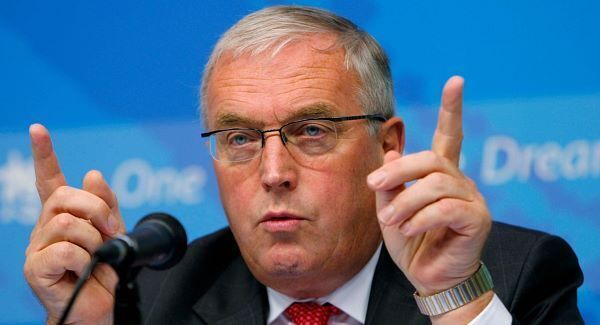
European Cycling Union vice president Harald Tiedemann Hansen feels Pat McQuaid will need a “sledge hammer” to defend himself against corruption allegations in his bid to be re-elected president of the International Cycling Union.
The UCI Congress will vote for the world governing body’s next president at the World Road Championships on September 27 in Florence, Italy.
British Cycling president Brian Cookson is challenging McQuaid for the leadership of the international governing body in what is becoming an increasingly bitter election contest – and a process which is still in dispute after McQuaid failed to secure a nomination from either his home country, Ireland, or Switzerland, his current place of residence.
McQuaid now wants the UCI Congress to vote in a rule change to allow him to be nominated by Thailand and Morocco. A number of federations, including the United States, have asked for the UCI to take the dispute to the Court of Arbitration for Sport for a decision on whether that should be permitted.
Yesterday, McQuaid issued a strongly-worded statement in response to corruption allegations. He has also written an open letter to all of the national cycling federations, in which he called for Cookson to condemn such “gangster politics” and help protect the “democratic process” of electing a new leader.
The election comes against the background of the Lance Armstrong doping scandal which erupted 12 months ago.
Tiedemann Hansen, who is also president of Norwegian cycling, feels the current controversy is not helping the image of the sport.
“I expect that there will be much debate around McQuaid and these accusations. I am reasonably sure he is going to need a sledge hammer to defend himself against all that,” Tiedemann Hansen told www.procycling.no.
“If there is truth in any of this, it is obviously very serious.
“I believe, however, that it is published evidence. It is not enough to make a number of accusations without finding out if this is true or not.
“The evidence, if any exists, must be submitted to the UCI Ethics Commission. It amazes me that it has not been done already.
“If you are not satisfied with the conclusion from there, you can then take the case to outside agencies.”
Tiedemann Hansen continued: “What puzzles me a bit is that he [McQuaid] must have known that this was going to happen. Why has he not resigned long ago? Why is it that he fights so incredibly fierce? Had he resigned some time ago, people might not spent so much energy trying to get this to light.”
McQuaid, meanwhile, hopes new policy proposals will provide riders with the right amount of support and mentoring to help the long-term battle against doping.
Under the proposals, there will be new team structures to ensure that there is one doctor, one coach and one sports director, each holding separate responsibilities, for every seven riders within the group.
There will be the introduction of a skills certification standard to make sure all those working within professional cycling are suitably qualified and approved to do so.
“Today’s riders should never be faced with having to make the same choices as previous generations,” said McQuaid.
“Today’s teams and those of the future must be built upon a model where riders are placed at the centre of the organisation where their performance is monitored and underpinned through collaboration with a multi-disciplinary scientific team.
“This will enhance the level of monitoring care and support available to each rider, thereby helping riders to better manage their workload, race schedule and recovery.”
McQuaid also acknowledged the UCI must introduce a sustainable economic model to help teams implement the new proposed initiatives.
He added: “This may well require the UCI to reduce the size of teams at UCI World Tour level and UCI Continental level by five or more riders respectively.”