We must still beware the sides of March
A Saturday to savour in Dublin was made even sweeter by a cracking performance from Scotland in defeating back-to-back Six Nations champions England in Edinburgh, writes Donal Lenihan.

We must still beware the sides of March

As a result, Ireland stand alone as the only unbeaten side in the tournament, with a massive five-point buffer over the English and the last team standing in the race for a Triple Crown and Grand Slam.

There is even the prospect of the championship being in the bag before that much-hyped visit to Twickenham on St Patrick’s day. With the potential banana skin posed by Wales now successfully negotiated, the quality of Scotland’s display at Murrayfield suggests that another awkward day’s work needs to be safely navigated when Gregor Townsend’s men arrive at the Aviva Stadium on Saturday week.

There are a number of reasons why Joe Schmidt will be pleased with so many aspects of Ireland’s hard-earned win over Wales in a contest that was in the balance right up to the final play. Another try for Wales would have yielded a five-point winning haul for the visitors. Jacob Stockdale’s stunning intercept meant that Warren Gatland’s troops left Dublin empty-handed and out of the running for championship honours.

It wasn’t difficult to sense just how miffed Schmidt was in advance of this game with the perception peddled by Gatland that Ireland play very little rugby. Having struggled to register a paltry two tries over the course of the last three tournament outings against the normally water-tight Welsh defence constructed under the impressive watch of Shaun Edwards, to score five, with a bonus point in 54 minutes, will have pleased him no end.

The variety of Ireland’s attacking play on this occasion was striking and the ease with which they managed to engineer effective line breaks — six in total — against a previously impregnable defensive line was impressive. At all stages, Ireland’s ball carrier had options open to him in terms of support runners on his inside and outside shoulder with another option coming from deep.

The key is in making the right decision when choosing the pass and invariably, with Johnny Sexton exemplary in this aspect of his play, that is what Ireland managed. Rob Kearney enjoyed one of his most impactful games with ball in hand for some time, while fellow back three residents, Keith Earls and Stockdale, enjoyed plentiful opportunities to show their class.

Jonathan Sexton. Photo: INPHO/Bryan Keane

Stockdale, with eight tries in seven internationals to date, is developing into a real scoring machine and is also effective under the high ball. There are aspects of his defensive play that remain a work in progress, but that will improve under the watchful eye of Andy Farrell.

What should please Schmidt most, however, is this squad’s capacity to deal with the inevitable injuries that, unfortunately, are now part and parcel of the game. To lose three Lions in a week provided Schmidt with a litmus test to benchmark the progress of three men capped for the first time since last June. All three passed with flying colours.

Chris Farrell was slow to find his feet when he arrived at Munster, but he has been a revelation since his elevation to the national squad in November. Showcasing his full range of skills on the occasion of his second cap, against Argentina, he has gone from strength to strength.

The loss of Henshaw to a nasty shoulder injury while scoring his second try of the day against Italy seemed cruel in the extreme, but Farrell stepped up to the mark so impressively on Saturday, it is clear he has the physicality and temperament to succeed at this level. He made three significant contributions, on either side of the ball, in the opening 10 minutes alone and went on to enjoy a really influential Six Nations debut.

James Ryan has already displayed all those attributes and looked utterly unfazed by the enormity of the occasion on Saturday. We have come to expect such composure and assurance from this young man which, after only six caps, is saying something.

In the circumstances, the biggest winner of all on Saturday was Andrew Porter, who was tasked with perhaps the greatest challenge of all in filling in for Furlong. It is totally different starting a test match than coming in off the bench, even as early as he did against Italy.

Chris Farrell. Picture: Inpho.

The Italians wouldn’t have known who Porter was and were blissfully unaware of his lack of game time as a tighthead prop at this level. Gatland was well briefed in advance and, because he was confirmed as a starter on Thursday, would have set out to expose him.

His first scrum arrived early, after only five minutes, but the fact that it was in the Welsh 22 removed the pressure somewhat. Porter was rock solid on the Irish put-in and helped deliver the platform that ultimately led to Ireland’s opening try two minutes later. That must have proved highly satisfying for the young prop.

As always, there were aspects that will disappoint Schmidt, not least the fact that despite enjoying a whopping 76% of possession in the opening half, Ireland only had a two-point advantage at the break and that courtesy of a Bundee Aki try in added time.

The main reason Ireland had such a narrow buffer was the unusual sight of Sexton leaving eight points behind when missing two very kickable penalties and a conversion that he would normally deliver with his eyes closed. That said, the pressure Ireland were applying throughout that period was taking its toll, even if it wasn’t reflected on the scoreboard.

Having conceded only two penalties in 85 minutes of action against England at Twickenham, Wales had six racked up by the half-time whistle and had succeeded in getting on the wrong side of referee Glen Jackson at the breakdown, where another relative rookie in Dan Leavy was making a big impact.

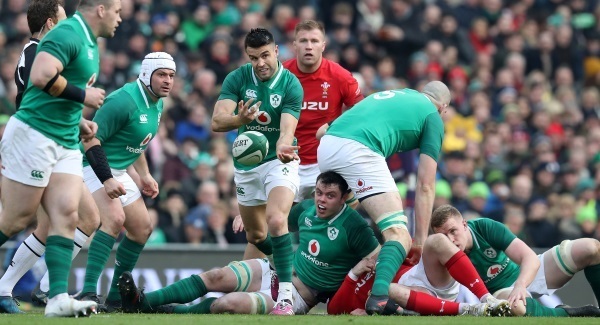
Conor Murray and Andrew Porter show their joy as Dan Leavy goes over for Ireland’s third try against Wales at theAviva Stadium on Saturday. Picture: Inpho/Dan Sheridan

Wales were forced into making a whopping 101 tackles in that opening half, while Ireland were only tasked with a comparatively low 38. Something had to give and it did when Leavy registered Ireland’s third try six minutes into the second half. That 14-point haul in seven minutes of action either side of the break ultimately proved decisive, given that Wales were never going to go quietly. There is an impressive resilience to Welsh rugby that was always going to make this game a far more difficult prospect than the 11-point spread the bookies portrayed it as early in the week.

They don’t often get those things wrong and, in the end, with a 10-point differential, they will argue they were spot on, but with Wales on the attack and only three points in arrears in the final play of the game, the visitors stood on the verge of a bonus-point win.

When Stockdale backed himself and sprung out of the line before launching his impressive 6’3” frame into the air to pluck Gareth Anscombe’s speculative looping pass to a three-man Welsh overlap, potential disaster was transformed into euphoria.

It’s been that type of campaign for Ireland to date. Just as in Paris, drama to the end.

More in this section

Sport

Newsletter

Latest news from the world of sport, along with the best in opinion from our outstanding team of sports writers. and reporters

Cookie Policy Privacy Policy Brand Safety FAQ Help Contact Us Terms and Conditions

© Examiner Echo Group Limited