Six Nations moves into cup rugby territory now
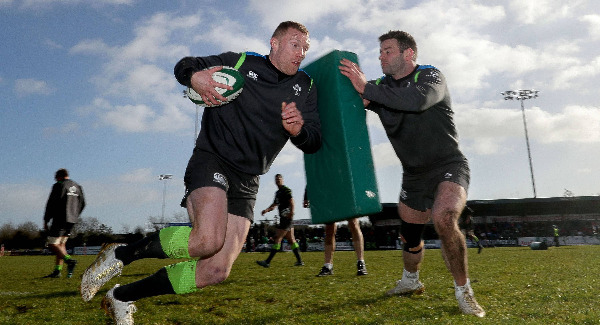
Even with the return of Ryan Elias and James Davies from the Welsh squad, it will be hard for those at the RDS to get a refresher on how the Llanelli franchise has changed the dynamic of Welsh rugby.
For that, Leinster and Munster supporters need only hark back nine months to the business end of the then PRO12 when Scarlets spanked both in semi-final and final.

Wayne Pivac and Stephen Jones have built on that progress this season with an energy and freshness that has driven them to a home quarter final in the Champions Cup against La Rochelle. They will go to the semi at least.
It’s rare that I can remember that a club side has brought that form to bear on the national set-up.
The national team has always been the engine driving the game in Wales but now you have a club side with a completely different philosophy to the way rugby is played in the valleys and it’s benefiting the national team, to the point where it’s a predominant factor in Warren Gatland and Rob Howley’s set-up.
How the Scarlets play with incredible pace, how they keep the ball alive in the tackle, playing with width, tempo, and audacious offloads to keep the ball alive at all costs. They are willing to make errors because they are always looking to score tries.
Joe Schmidt doesn’t need any refresher on Scarlets’ impact on the Welsh. He knows they are affecting a culture change with Wales’s normal game.
He recognises too the value of a team humming, that knows and trusts each other inside out and has that confidence of playing together on a daily basis.
To be fair to Gatland, he has adjusted his own game plan, facilitated too by the fact it’s the first time in a decade and more that Jamie Roberts isn’t in the centre for Wales.
Now they’re using Hadleigh Parkes as 12, a big lad with good hands who is critical to the Scarlets.
You think Schmidt will have the Irish lads ready for the organised mayhem Wales will look to inflict?
Of course, he will.
At the Aviva, Ireland seldom, if at all, are forced into chasing a game by the concession of early scores.
Save for the November defeat in 2016 to the All Blacks, I can’t remember one.
Which is just as well. Ireland doesn’t like unstructured rugby. Chasing a game is not on the menu. It’s composed, so with the likes of Wales, it’s fundamental you are not giving easy ins.
It should make for a very interesting opening quarter. Ireland conceded a mere three penalties against Italy last Saturday.
The error count is so low, Gatland knows the hosts won’t be dishing out any presents tomorrow week.
He will have to throw the hammer after the hatchet.

However, people are underestimating the value of home advantage. Despite everything that has changed, the old fundamentals of cup rugby still apply.
That is the territory Ireland has moved into after Six Nations Round Two.
You are not building for the future anymore, not eyeing Japan in 2019. We are now in shoot-out territory for three games because the prize is so big.
So, expect Ireland to go horses for courses, possibly to the extent of Joe picking different wingers for three different tests.
Robbie Henshaw is a big loss, but the show keeps going and someone will step seamlessly into the Schmidt system.
And that should be Keith Earls, who could seamlessly move in from the wing to 13, with a McFadden or Conway on the wing.
With the schedule of fixtures, Joe will look at Wales on its own merits, and then the other two as a block with a seven-day turnaround, because inevitably there will be an injury in the Scotland game.
Which may leave him with a decision on the hamstrung Tadhg Furlong for the Welsh game.
If the initial medical diagnosis was encouraging, any further damage would rule him out of the remainder of the tournament.
Trouble is, Furlong has made that position his own. Non-rugby people mightn’t appreciate how crucial the tight head prop is.
You just know Furlong isn’t going to get penalised at scrum time and isn’t going to give away silly penalties, and the coach loves that about him.
His work rate is huge, and as well as Andrew Porter played, Italy was his first game, and he is still in unproven territory. He has hardly played at that level, so everything is new and surprising to him.
And being a starter is a different pressure pot to being sprung unexpectedly from the bench, even after only five minutes.
When I started with the Crusaders, I didn’t know the home ground, the training ground, where the car park was, or what we do at half-time.
It’s a big ask and Gatland will analyse him forensically.
England have two awkward visits to Paris and Edinburgh but imagine the momentum of victories there heading back to Twickenham on March 17th.
They mightn’t always look the easiest on the eye, but they always win under Eddie Jones.
How quickly that apparent air of invincibility disappears if something were to happen to Owen Farrell is self-evident. He is the glue, the X Factor, and the bottle all in one now for England.
This isn’t breaking news to anyone who’s been reading these columns.

For the Irish game, Jones may go Farrell, Te’o and someone else at 13. That’s my gut.
I can’t see George Ford there if Bundee Aki is playing 12 for Ireland.
If I could be a fly on the wall in any team meeting in the Six Nations, it might just be an Eddie Jones seminar. He got to Rhys Patchell with his comments last week.
Like or loathe him, you’ve got to be impressed with Jones if you are in that dressing room.
He’s created a group which knows how to win, and that’s something that has undermined English rugby in the past.
The long-term plan is winning the World Cup, but he’s also pledged to tick the box of being ranked No 1 in the world.
It may be up for grabs when England play the All Blacks next autumn.
I am fascinated by the consistency of their results with a group greater than the sum of their individual parts.
Jones has a big Team England buzz going on, whipped up by his unwavering loyalty to the likes of Mike Brown and Dylan Hartley.
However, Wales found lots of space at Twickenham last Saturday and but for the human failings of the TMO system — that bizarre error — the entire shape of the championship could have shifted, never mind the game itself.
I flew out of Dublin last Saturday night for the long haul back to Christchurch via Dubai and Sydney.
It meant I only got to watch the Scotland win over France on Tuesday night back in New Zealand before the Crusaders flew down to Invercargill on Wednesday morning for a final pre-season tune-up against the Highlanders.
Sitting on the runway in Christchurch, I was thinking of the mood on that French team flight home from Edinburgh.
France have put in two decent performances and they will talk about the tiny margins, but we are all weary of saying the discipline issue is not a tiny margin. It’s non-existent.
I don’t have the precise details of what happened in the wake of Murrayfield. Was there a curfew?
The fact that Brunel now feels it necessary to leave out so many for the next game would indicate that rules were broken. And if you sacrifice the team rules, then it’s a free-for-all.
The sad part is that the likes of Teddy Thomas is in flying form.
But it’s impossible for Jacques Brunel and the national coaches to impose discipline with regard to rules and, more importantly, with regard to bad habits on the pitch, when it isn’t a daily factor at club level.
It takes three weeks to learn a behavioural skill or to change a bad one. The French view discipline as a word when it’s a behavioural issue.
‘Lads, discipline has to be better’ — that is worthless. You have to coach that, implement that in daily sessions, referee the offside line in training. It’s critical.
France need only look at what Joe Schmidt has done with Ireland to appreciate that.