Parents must curb their great expectations
I spent an absorbing couple of hours in his company. As can be read elsewhere in these pages, his reflections on the heart attack that nearly claimed his life five years ago prove especially compelling â and sufficiently important, in terms of his message, to warrant the space we have given it today.
But if Paul Osam is marked by that life-changing event, he is not defined by it. For the 50-year-old Rathfarnham native, football continues to be his lifeblood.

âThe street was our education in football,â he says. âI firmly believe that street football lent itself to technically better players. There are lots of other factors, of course, but that would have been a big help. Because, nowadays, I donât think young kids have as much contact with the ball.
âA bedrock of technical ability is something they should develop between, say, seven and 12. Is that nature or nurture? I believe itâs nurture. Youâve got to practice. If you research any of the top people in any sport in the world, theyâll all say they were constantly playing their sport as young kids. They may be born with some genetic predisposition, but they have had to put in the practice to reach those standards. Thereâs no doubt about that in my mind. Particularly in soccer, because, no disrespect to other sports, but thereâs so much skill involved.â
And informed coaching, from an early age, he says, is crucial. âYou can be technically brilliant as a footballer, but if you donât understand the game and havenât been coached properly â and you canât be over-coached, either â you wonât make the most of your talents,â he says. âYou need guidance, you need education, you need detail. And that should come from the coach. To me, the coach should be like the teacher in school you look back and remember years later.
âAt a junior club, I think your best coaches should be with the youngest players, because they can impact them more. U7/8/9/10. Not overloading them with tactical stuff, but making sure theyâre getting the right kind of training and coaching, and especially the proper kind of technical work.â
As the better players develop into their teens, Osam also says itâs vital that parents donât overload their children with unrealistic expectations.
âThe amount of parents who think their kids, because theyâre successful in the youth game, are going to go on and play in the Premier League, is mind-boggling to me, it really is,â he says. âThe fact is the percentage of kids who come back from the UK is in the high 90s. And theyâre going over by the boatload, at the minute.
âIâm not saying every child should stay here. If heâs an exceptionally high talent, Iâm all for him going to the UK, if thatâs what he wants, to enhance his development. But I see clubs in England who are not investing in these boys. They get offered a two-year scholarship and either it ends after that, or they get a one-year professional contract. And thereâs a huge amount of them who come back then. Theyâd be far better off staying here, playing in the national leagues, and getting an education, and then, if theyâre good enough, going over when theyâre 20 or 21.
âWe need to have a good look at this. I think there should be some kind of workshop for parents of elite players. You canât say to people they canât send their kids away, but I think they need to be made aware of the pitfalls, the risks and, most importantly, the stats.â
Paul also holds âvery strong viewsâ on how coaches should interact with their charges. For his UEFA Pro Licence badge â the highest coaching qualification available â he is working on a thesis entitled âCoaching From The Sideline: Benefits or otherwiseâ.
âIâm a very passive coach during the game,â he says. âAs a player, I hated it when empty vessels were shouting at you. And, with hindsight, thatâs because they hadnât prepared the team right. Of course, there has to be some interaction during a game, because of what the opposition might do or an individual player might need a word.
âBut the bulk of the work is done on the training pitch, at the team meetings, in the hotels, on the bus, every time youâre with them. What they bring with them, going out onto the pitch, is what will really dictate how they play. Thatâs my belief.
âI will always say to the players: you will know your job with me as a coach. Under no circumstances will you be going onto the pitch without a clear picture â not a rigid one, a clear one â of what your role is and what your responsibilities are.â
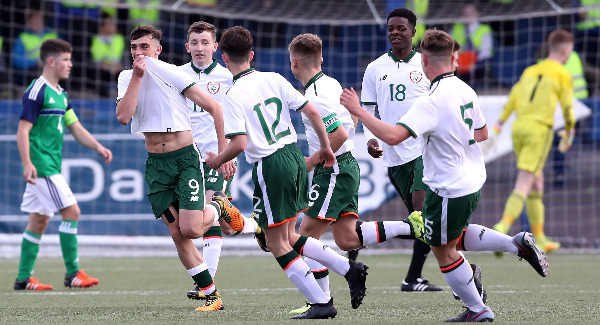
Osamâs approach paid off with the U16s in 2017, as they drew with Wales and beat Northern Ireland and Scotland to win the prestigious Victory Shield tournament for the second year running.
For the concluding victory, over a strong Scottish side, Osam tweaked his teamâs approach to cope with the oppositionâs high press, by going a little more direct than would be the norm at underage level.
âIf Iâd gone solely after developing the players in that game, I think we would have lost the game and not won the tournament,â he says.
âThis was developing them in another way, by playing slightly differently to what my preferred way to play and coach might be, and have a better chance of winning. Because itâs important, too, for the players to develop the habit of winning in tournaments.â
Osam is now halfway through his season with this latest group. Coming up is a double-header in Hungary, at the end of February, and then a development tournament in Sweden, in May, at which Ireland will play Sweden, Turkey, and Austria.
âTodayâs best player isnât necessarily tomorrowâs best player,â he says, âso although some of the personnel might change, the idea is to be peaking at the end of the season, as a team. As much as (U15 head coach) Jason Donohue is preparing players for me, my job is to go to (U17 head coach) Colin OâBrien and say, âhere you go, these are the best we haveâ.â
The ultimate goal is to produce Irish footballers who will one day be good enough to play for the senior team. âAbsolutely,â he says.
âAnd if, over the next four years, or whatever, one of those players could say that Paul Osam was a big influence on me as a player, that would be the biggest endorsement of all.â