Katie’s fists in God’s hands
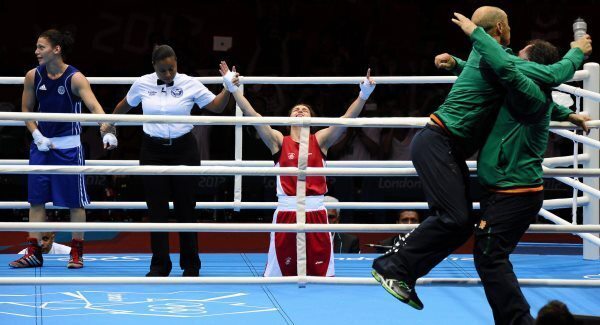
The first is how surprisingly petite she is. The other is how genuinely shy and mannerly she is, yet intertwined with that humility is a robust self-confidence. She knows how good she is at boxing, because she knows how hard she works at it.
She speaks softly but openly about what she believes in and what she doesn’t. For instance, sport psychology; it’s not for her. Nearly everyone else in the high performance unit may swear by it and its 2008 Olympians give praise to the teachings of Gerry Hussey, but she declined the use of such a resource.
“Mental strength is something you either have or you haven’t,” she maintains, leaving no doubt as to which side of the line she believes she stands on; God saw to it that it landed that way.
“The Bible,” she smiles, “is my sport psychology manual. God is my psychologist. And my dad is probably the best sport psychologist in the world.”
With the two of them in her corner there is nothing she would want.
You can’t begin to tell the story of Katie Taylor without mention of those two guiding lights. Her mother, Brigid, is a born-again Christian, and the rest of the family all followed — Katie, her two brothers and sister, and her dad, Peter.
Peter boxed himself. That’s how she got into it. One evening he was all set to train in the club in Bray, preparing for the national championships which he’d previously won as a heavyweight, when 11-year-old Katie’s athletics training was cancelled. It was too late to find a babysitter so he brought her to the gym “to do a bit of skipping and that”.
Before he knew it, she was in the ring, sparring with fellas. He thought it might just be a phase, a way of getting stronger to supplement her football, but she’s been in the gym since and Peter’s been with her ever since too, him and God.
That sense of values governs everything she does, to the point it shines brighter than even the Olympic gold she yearns and strives for.
Take last autumn’s World Championships in Barbados. You’ve probably heard about the dramatic way she won her third consecutive world title to go with the four European championship gold medals she’s accumulated.
With 30 seconds to go in her semi-final with America’s Queen Underwood, Katie trailed by a point, having entered the fight feeling weak. But then she heard her father scream the score, and from somewhere, someone, she mustered the energy to land a flurry of devastating, precise punches to earn an 18-16 victory.
What you probably haven’t heard about is that on the eve of that semi-final, the authorities presented each boxer with a skirt and a tight-fitting vest rather than their traditional uniforms.
Peter Taylor could see what was at work here. With the Olympics approaching, the authorities were feeling the need to sex up their sport and distinguish it more from the male game, and this was the start of phasing it in. The Taylors weren’t having it.
“They said to us, ‘You have to wear the skirts’. I said, ‘Katie’s not wearing that’. So he says, ‘If you don’t wear them, you can’t box’. And I said, ‘Okay, so she won’t box’.” The way Peter calculated it, the World Championships needed Katie more than she needed it.
As we know now, she boxed. The authorities would later claim the skirt was merely optional, and in the end only 14 of the 40 boxers who reached the semi-finals across the divisions wore a skirt. The 26 who did defy the implicit urgings of the authorities did so safe in the knowledge Taylor was on their side. Because in many ways, Peter was right. Katie was as big as the World Championships.
She’s not as big as the Olympics though. Peter and Katie know that. And with the International Boxing Association’s president CK Wu advancing the case that wearing skirts would help viewers tell more easily the distinction between male and female boxing, a case with large support within the International Olympic Council, that could mean the ultimate confrontation between Katie’s principles and Katie’s dream.
But for the Taylors there would be only one outcome.
“She won’t box,” says Peter. “Simple as that. We’ve got morals that go above marketing.”
If there is one reason why the Goliath of women’s boxing keeps winning, it’s because she keeps thinking like David, keeps reading from David. When the high performance unit asked her a few years ago to give a line to the motivational phrases on the wall of their gym, she chose from Psalm 18, the story of David’s redemption.
The day of every fight, she’ll comfort and lose herself in the Bible, often Psalm 18 or Psalm 20.
And that is the approach she brings to every fight, every workout. She never thinks like Goliath.
“I don’t get complacent because I know if you slack off, you’re going to be found out. This is international boxing and every fight is a tough fight. I’m winning these competitions because I’m boxing well in these competitions; it’s not like I’m just turning up on the day and boxing.”
! The Olympics might be why she’s resisted going professional, it might be what drives her, but it will not define her.
“All I can do is my best,” she says. “At the end of the day my legacy doesn’t depend on whether I win an Olympic gold medal or not. I’ve already done so well throughout the last few years. This is just a dream that I have, a goal that I have, so I’m going to train as hard as I can and try my best and just leave it in God’s hands then.
“Whatever happens — win, lose or draw — I know it’s God’s will.”
CONNECT WITH US TODAY



Be the first to know the latest news and updates