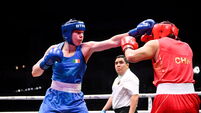
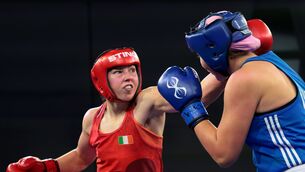
O’Flynn kicks way to Thai boxing title
The Cobh fighter, 29, delivered a decisive kick to the head of Thailand’s Kongdej Sittradtrakan early in the third round of their five-round, 61.5kg fight at the Neptune Stadium to add the WMTO title to the WKN belt won from another Thai in Belfast in April 2002.
It capped a remarkable evening for the sport on Irish soil, which saw a crowd estimated by the organisers at 1,500 entertained by five other international fights featuring four top Irish fighters, three support bouts including a female class and junior boy’s contest and a demonstration of ancient sword-fighting by two of the highest grade instructors outside Thailand.
Muay Thai, which translates into English as Box Thai, or Thai Boxing, is over 2,000 years old and has developed as a sport from the Thai warrior system of Krabi Krabong, which means long and short weapons. The idea is that when a warrior is disarmed he must use his own bodily weapons: hands, knees, elbows and feet.
It is as important a tradition in Thailand as hurling and Gaelic football is in Ireland, and is taught in Thai schools from an early age, where pupils dream of fighting in Bangkok’s five professional stadia just as Irish kids aspire to running out at Croke Park on All-Ireland final day.
The thought of a Thai gracing the hallowed turf of Croker with distinction, though, is still fairly fanciful. Which makes O’Flynn’s emergence as a world champion Thai boxer all the more remarkable.
“It’s a great feeling to have won here because the pressure was on fighting in front of a home crowd,” O’Flynn said. “I haven’t fought at home in over seven years and it’s worked out well.
“With the extra pressure on me fighting at home it came together well. The more the fight went on, the harder it was going to get for me anyway.
"You both get the rhythm of the fight and the measure of your opponent. It’s in the first two rounds that you get warmed up and into it. By the time you get into the third round you’re well used to each other then and it gets a much harder and tougher fight. So it was a great kick to the head at the right time.”
To have beaten a reigning Thai champion and much more experienced fighter only added to the pleasure of O’Flynn’s victory.
Of Sittradtrakan he said: “He’s had 189 Thai boxing fights by this stage, 40 of them professional, with 168 wins. But that’s not unusual for Thai boxers. We start much later than them, not until we’re at least 16.”
Saturday’s victory was O’Flynn’s 74th in his 87 fights with two more ending in draws.
Like his Thai opponent, he too has turned professional, leaving behind a career as a hairdresser in Cork to shuttle between Ireland and Bangkok, where he immerses himself in training camps and lives out the dream of many a Thai by fighting in the Rajadamnern and Lumpini stadiums that are the stuff of legend in the ancient kingdom.
O’Flynn’s training partner and fellow Corkman is Martin Horgan, a European champion himself at 66kg. Horgan, though, came up against another European champion in Denmark’s highly regarded Dennis Koebke and suffered a third-round knockout.
There were mixed fortunes for the other Irish fighters with Paddy Ivers of Carlow defeating Aijo Thomas of Denmark by a decision to maintain his unbeaten record with an eighth win in eight fights.
Galway’s David Joyce was unfortunate to lose his bout after the referee stopped his fight against another Dane, Oscar Lundberg in the first round, when the Irishman suffered a deep cut to his forehead. Dundalk man Ciaran O’Rourke made all the running against England’s Dan Bassett only to be knocked out in the fourth round.
There was some consolation for O’Rourke, however, when he was awarded the prize for best fighter of the night other than the main event.
Muay Thai, like other oriental martial arts, is not all about the result. A fighter is judged on his technical ability, his technique and his true warrior spirit; in other words how he promotes Muay Thai in its best and truest form. O’Rourke won hands down.