Conspiracy theory
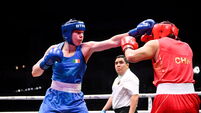
That is the sensational theory that has emerged from Las Vegas, where Tyson's latest bout of irrational behaviour is threatening his comeback fight against Clifford Etienne in Memphis on Saturday.
Tyson's torso is already adorned with body art. But it is thought an allergic reaction to the extraordinary facial tattoo may be the reason why the controversial American skipped several training sessions last week and then yesterday missed his scheduled flight from Vegas to Memphis.
Victory over Etienne would have set up a rematch with Lewis in June from which the two men might have earned at least £15 million each.
But if Saturday's bout does not go ahead Tyson may find that promoters and television companies are no longer willing to risk vast financial investments on him. And 37-year-old Lewis may decide to retire. At least that's the theory. The conspiracy theory.
Here we examine some of the more fanciful sporting excuses of our time.
REGARDED as the best pound-for-pound boxer in the professional fight game today, Roy Jones Junior bowed out of the amateur ranks in controversial style in Seoul, South Korea, during the 1988 Olympic Games.
In one of boxing's worst judging scandals and there have been quite a few Jones was robbed of a gold medal having clearly beaten his South Korean opponent in the final.
It was later established that bribes had been paid to ringside officials in order to boost the home country's medal count, with Jones, who is now world light heavyweight champion, one of the victims.
Yet officials refused to change the result and hand the gold medal to Jones.
And this was after Morocco's Hiouad Larbi, a judge in the Jones fight, had admitted to reporters immediately after the fight (Sports Illustrated's Pat Putnam, Ken Jones of the London Independent and French reporters from the renowned L'Equipe newspaper) he had falsified his scorecard.
Wanting to be seen to be doing the right thing, albeit nine years later, the International Olympic Committee launched an investigation into the affair and summoned Larbi for an interview.
The Moroccan, though, denied being interviewed by the reporters and denied admitting falsifying his scorecard. He backed up his new claims by insisting Jones was not actually that great a boxer and had fully deserved to be beaten.
The IOC denied Jones his gold medal.
BOXING had spent enough time on the ropes so it was without need to take a knockout blow such as the one delivered to it in March 1999 at probably its most spiritual venue.
Lennox Lewis decisively defeated Evander Holyfield at New York's Madison Square Garden, yet had one of the sport's worst decisions to show for his efforts.
The British boxer, who had unlike Roy Jones Junior actually been awarded a gold medal in Canadian colours at Seoul in the super-heavyweight division, appeared to win as many as 10 of the bout's 12 rounds by completely dominating the ageing Holyfield. And even Evander's most loyal supporters would have shifted uncomfortably in their ringside seats at the Garden that night at the thought of awarding their man any more than three or four rounds that they could argue he won.
Lewis fought a great fight that night to take Holyfield apart tactically and clinically. But instead of being crowned undisputed heavyweight champion of the world, Lewis' efforts were soon forgotten as controversy raged on both sides of the Atlantic and he had to wait another eight months before getting his chance to beat Holyfield again.
WHEN Canada's Jamie Salé and David Pelletier came off the ice at Salt Lake City in February last year, the general consensus was that they had just skated themselves into the gold medal position of the Pairs Figure Skating event. A flawless programme had seen off the Russian pair Yelena Berezhnaya and Anton Sikharulidze, who had committed some technical errors in their performance. But a French judge, Marie-Reine le Gougne, marked the Russians higher, together with judges from China and the former eastern bloc members Russia, Poland and Ukraine and Berezhnaya and Sikharulidze were awarded the gold.
The decision caused a stink and threatened to wreck the Winter Olympics before the International Skating Union was forced to review the situation. The ISU said that it had received evidence that le Gougne had acted improperly, suspended the Frenchwoman and disregarded her score, leaving both pairs tied. Salé and Pelletier shared the gold.
Why did le Gougne do it? Well, it has been alleged that the French skating federation pressured her to vote for the Russians in exchange for the Russian judge voting for the French couple. Nothing was proven to substantiate this and the French federation denied the claims. Au naturellement.
THE 1995 Rugby World Cup was the crowning glory for the new, non-apartheid South Africa and the stage was set when the Springboks reached the final at Ellis Park in Johannesburg against New Zealand.
Joel Stransky's extra-time drop goal edged South Africa home to a 15-12 victory and even the most creative of Hollywood's scriptwriters could not have conjured up the tear-jerking emotion as President Nelson Mandela, wearing captain Francois Pienaar's No. 6 jersey, presented the trophy.
However, the defeated All Blacks cried foul, claiming they had been poisoned the night before the final and a former major in the South African police backed up the claims. Rory Steyn said he had no doubt the sickness and vomiting which afflicted the New Zealand team had been deliberately planned.
Steyn, who was head of South Africa's VIP protection unit at the time and was in charge of team security at the World Cup said: "The local protection officer ate with the team and he came down with the same food poisoning. He was so ill he couldn't even get to the bathroom before vomiting."
HARDLY the most surprising sporting development in these cynical times but when the cyclist was Italy's Stefano Garzelli, many cycling brains immediately smelled a conspiracy when this scandal broke last May. Grazelli was leader of Italy's Mapei-Quickstep team, who alleged that a positive drugs test during the 2002 Giro d'Italia was the result of a conspiracy within the sport to blacken their name.
Garzelli had been leading the race having dominated the first week when it was announced minute traces of a diuretic had been found in his urine after a stage win in Liege.
Mapei's team management said a series of coincidences could point to the team's food or drink being spiked with the drug, which can be used to mask steroids, namely that they had been called by anti-drugs police in Padua asking about positive tests in the team only four hours after Garzelli gave the sample.
Mapei's paranoia was based on their unpopularity among other teams because of their outspoken opposition to the use of drugs.
THERE are some who believe that disgraced former South African cricket captain Hansie Cronje lost his life in a plane crash due to his involvement in a match- fixing scandal.
The former 'golden boy' of South African cricket shocked his compatriots in 2000 when he admitted to taking 130,000 to fix matches. Indian police had caught Cronje, who also captained Ireland during the 1990s, in conversation with a bookie on the 1998/99 tour. After initially denying any wrongdoing, he admitted receiving money from bookies for giving "pitch and weather information" and was banned from cricket for life.
When Cronje, was killed at the age of 32 in a light aeroplane crash 350 kilometres east of Cape Town, there were suggestions that irked Asian bookies had played a part in his death. ALGERIA were the victims at the 1982 World Cup in Spain when West Germany and teutonic neighbours Austria danced a last waltz together, keeping the north Africans from qualifying for the next phase. The Germans lost to Algeria in their opening game and came face-to-face with the Austrians, needing a win to progress to the second round. Austria, meanwhile could lose by two goals and still go through ahead of the Algerians.
Germany duly went ahead in the 11th minute before the sides shut up shop, strolling around for the rest of the game as the ball was idly pushed around in midfield in the front of an increasingly impatient crowd. As the boos grew louder hundreds of Algerians in the 41,000 crowd began waving white handkerchiefs and bank notes in disgust while chanting, 'Algeria, Algeria', and 'stop the game.' An Algerian appeal was passed on to the FIFA Organising Committee, who threw out the protest. A shameful episode.
A SENSE of old world begrudgery against upstart footballing nations once again tainted the sport's greatest spectacle last summer when Spain and Italy both claimed they had been robbed by referees as part of a plot to help hosts South Korea reach the latter stages.
Of course, the fact that co-hosts Japan failed to make any impact on the 2002 World Cup is was neatly sidestepped as the fiery Latins were sent packing by energetic Koreans. Ecuadorian Byron Moreno accounted for the Azzuri in the second round, according to Italian conspiracy theorists, with Italian federation executive Raffaele Ranucci calling his decisions to disallow Italian goals part of a FIFA plot to advance the game in Asia.
Italian striker Christian Vieri was also outraged, calling Moreno a 'village referee,' conveniently forgetting to mention he had missed from point-blank range when in with a chance of scoring the winning goal.
THE 1978 World Cup is riddled with controversy. Staged in an Argentina ruthlessly governed by a military junta capable of unspeakable violations of human rights, the tournament was blighted not only by political troubles and the assassination of a leading tournament official but also by dodgy refereeing.
There was also more than a whiff of suspicion about the host nation's progress to the final when, needing to beat Peru 4-0 to pip Brazil out of the second group stage to make the final, they won 6-0.
The Argentines also had the luxury of knowing what was required as their deciding game against Peru kicked off after Brazil had played Poland.
Argentina did possess an extraordinarily gifted group of players, not least leading scorer Mario Kempes. But even so, beating a strong Peruvian side 6-0 raised more than a few eyebrows. Maybe the fact that Peru goalkeeper Quiroga had been conspicuous by his absence throughout the match had something to do with it. Or that he was born in Argentina.
DID European captain Sam Torrance play a tactical masterstroke on the last day of the 2002 Ryder Cup at The Belfry, or did his American adversary Curtis Strange lose it? Woods was left to tee off last in the singles in the belief he would close out the tie for Americans. But Torrance sent out his big hitters at the top of the order and they delivered the goods by building up an unbeatable lead.
Now it could have been a blunder by Strange but there are those who subscribed to the view that he was leaving the game's greatest player until the end in order to hit peak viewing time in the US for Ryder Cup broadcaster NBC. Surely not.
HOURS before the 1998 World Cup final at the Stade de France, Ronaldo suffered some sort of fit and was whisked to hospital and out of the team only to stage a miraculous recovery and start the match only to turn in an anonymous performance as Brazil were outclassed by the French.
Alex Bellos, the author of Futebol: The Brazilian Way of Life cites not just one conspiracy theory about the incident but five, so take your pick. Theory A: Nike and the Brazilian football federation CBF forced Ronaldo to play in order to fulfil a contractual obligation that he had to play in the final.
Theory B: Brazil's players received a total of $23m, the promise of Brazil hosting the 2006 World Cup, and an easy passage in the 2002 World Cup to throw the game. Ronaldo refused to play ball and so was dropped but changed his mind after Nike threatened to withdraw his sponsorship money. Theory C: Ronaldo was drugged by France. Theory D: Ronaldo was unwell, a secret medical problem which he had kept hidden.
Theory E: The doctors gave him a "blue pill" as a painkiller but it had tranquillising effects that made him drowsy.
IT IS the last refuge of the beaten, The Row in the Dressingroom at half-time.
They were flying, you know. Six up after 20 minutes, five ahead at half-time and the supporters gone lunatic in the stands. Could it be, could it finally be
Second-half, disaster. One point in total, and that from a free. Head bowed, your funereal march up Jones' Road is interrupted by a lad you half-know from going to the matches. He half-knows another fellow whose half-cousin is half-physio to the team, and he has just come off the phone to him, and he has the inside track "There was a massive row in the dressingroom at half-time."
Alleged dressingroom rows of our time include the Kerry bust-up in the 2001 All-Ireland semi-final prior to their collapse against Meath, Galway in the 1999 Connacht Final, and Galway and Kilkenny every year they don't win All-Irelands.
One other theory: Ronaldo, Nike, NBC, FIFA and Asian bookies have formed a secret cartel to keep Munster from playing at home in Heineken Cup knockout matches.
CONNECT WITH US TODAY



Be the first to know the latest news and updates