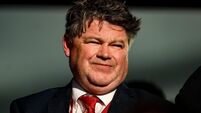
Masters of their craft do battle
Both of them lifted the MacCarthy Cup as an All-Ireland-winning captain; the younger one did so twice. It was always anticipated that the latter, being the leader of men he so patently was, would go on to become a manager; the other gent, however, was plucked from nowhere to become an intercounty boss and, as if to demonstrate that occasionally you just never can tell, has gone on to become an absurdly successful one and a national personality into the bargain.
Brian Cody and Anthony Daly. So similar and so utterly different all at once.
They’ll fill the TV screen tomorrow during lulls in the action at Croke Park. It’s Kilkenny versus Dublin, yes. But it’s also Cody versus Daly.
Hurling figures do not come larger or more interesting.
It’s Cody’s 17th national final as a manager. It’s Daly’s second. Does that mean anything? Not in the least. Nor does it matter that Daly is a coach as well as a manager whereas Cody is a manager but not a coach. On which point, it seems to have largely been forgotten at this stage what a fine job Daly did during his three years at the Clare helm, getting the best out of the Tonys Griffin and Carmody in 2005-06 and coming within an ace of beating Cork in the 2005 All-Ireland semi-final. And eight minutes from the end of the following year’s semi-final the Banner, after missing three solid goal chances in the first half, were still neck and neck with a Kilkenny team that would go on to win four in a row.
Too often in the GAA we judge a manager by the silverware he wins or doesn’t win instead of judging him by how close he comes to glory with the resources at his disposal.
Another difference. Daly, in the vernacular, does tactics. He’s been doing them since he deployed Alan Markham as a seventh defender against Kilkenny in the 2004 All-Ireland quarter-final. Cody used to like saying that he “didn’t do tactics”, which was certainly the case in the first half of the Noughties but hasn’t been the case for a long time.
The possession of heavier ordnance than most teams are blessed with is no reason for not taking the trouble to think laterally. That’s one lesson Cody has learned.
Nor are they two of a kind as social animals. At the risk of stating the obvious, you’d go for a few pints with Daly sooner than you would with Cody. That said, on All Star nights at Citywest the latter can be found lowering Guinness into the early hours and shooting the breeze with all and sundry. What’s more, The popular image of Cody as a dictator cannot possibly be true, either. Were that the case, the peasants would have revolted long ago.
It would be naïve to believe that Cody’s relationship with his players has not been informed by bitter personal experience. Before he was 22 he had won All-Ireland medals at minor, U21, senior, club and colleges’ level and been an All Star recipient. But the speed of the fall from Everest would prove as notable as the speed of the ascent.
The trauma of the 1978 All-Ireland final, when he was sited at full-forward and substituted, and its sordid sequel at the homecoming on the Monday night. Kilkenny claiming their 21st title in the following season with a different James Stephens man — 38-year-old Fan Larkin — at full-back. Regaining his place in 1980 only for Offaly to floor the All-Ireland champions in the Leinster final. Failing to make the lineup in 1981. What didn’t kill Cody, and what would have destroyed a lesser man, served to make him stronger.
One of his most overlooked talents is his ability, a la Arsene Wenger, to dispense with someone’s services at the optimum juncture. Was Cody right to let you go when he did, lads? “Yes — and he rang me and explained why,” says Martin Carey, James McGarry’s understudy between 1999 and 2001.
“At the time you’d think he was wrong but in hindsight he was probably right,” says Walter Burke, a substitute in 2002-03.
“I was based in Carrick on Suir and he wanted somebody nearer to Kilkenny, which was understandable, but it was all very polite and professional and I’ve nothing but the best to say about him,” says Niall Geoghegan, the team physio in 2000.
“It’d be easy to blame Brian when it was myself I should have been looking at — I should have been doing the extra training, the ballwork, myself and I just didn’t do it,” says Aidan Cummins, a panellist in 2000-03.
An unsentimental manager, then, but not always. For what was it but sentiment that impinged on Cody’s judgement last September when he selected Henry Shefflin, a man who 11 years earlier began his championship career as a player the same day Cody began his as a manager and who had started each and every one of Kilkenny’s championship outings in the interim, for the All-Ireland final?
He wouldn’t have been human if it hadn’t. But he compounded matters with a wretched day on the line against Tipperary, with ‘Cha’ Fitzpatrick and Eddie Brennan both left on far longer than they ought to have been and TJ Reid withdrawn after hitting four points.
And fair enough, after 21 successive games when the Kilkenny management had got it right it can be argued they were due an off day, that injuries had dealt them a rotten hand and that events in general had conspired against them. Yet when Cody came to do his annual de Valera number and peer into his own heart during the following months, as he does every autumn, he won’t have spared himself. He can’t have.
As ever he’ll be looking for a performance tomorrow. So too will Daly, not least because this is not a game Dublin simply have to win. Not in the way that last year’s All-Ireland quarter-final against Galway was a game that Tipperary simply had to win or the 1997 Munster final was a game that, in the words of Ger Loughnane, the Daly-captained Clare simply had to win. Next year or the year after, Dublin will tog out for a match they simply have to win. But for the moment, tomorrow’s match is one in which they merely have to perform.
If that performance is enough to bring them silverware, so much the better. If it’s not, well, they’ll have sampled at first hand the pressures of a national final and they’ll be a better and wiser team for it. Whatever the outcome, we’ll still have the pair of them afterwards. Cody and Daly. Two of the great hurling men of our time.
Two of the great hurling men of all time.
2002: Kilkenny 2-15 Cork 2-14
KILKENNY start well, Cork recover strongly but a late Brian Dowling point wins it. The MacCarthy Cup is claimed in September and for the manager the nexus between league success and championship success is firmly established.
2003: Kilkenny 5-14 Tipperary 5-13
A CRAZY game on May Bank Holiday Monday in front of a near-deserted Croke Park. The holders come back from eight points down with 11 minutes remaining and Henry Shefflin kicks – yes, kicks – an injury-time winner. Four months later the All-Ireland is theirs again.
2005: Kilkenny 3-20 Clare 0-15
A MATCH perhaps most notable for a remarkable save by Davy Fitzgerald from an Eoin Larkin piledriver. It’s the one time under Cody Kilkenny failed to follow up springtime success with glory in September, losing instead to Galway in a classic semi-final.
2006: Kilkenny 3-11 Limerick 0-14
AN easily forgettable contest. Limerick fight gamely but the holders, with a reshaped and emerging team, have more firepower. They’re All Ireland champions again a few months later.
2007: Waterford 0-20 Kilkenny 0-18
NOT an easily forgettable contest because it marks the winners’ first national trophy in 44 years. The losers start Cha Fitzpatrick at full-forward, an indication that for once victory isn’t quite the be-all and end-all for Cody.
2009: Kilkenny 2-26 Tipperary 4-17 (aet)
REMORSELESSLY physical, frequently nasty and entirely absorbing. Most All-Ireland finals haven’t come within an ass’s roar of it for sustained intensity. Tipperary give ample notice they’re the coming team but a severely understrength Kilkenny still have enough in the locker to pull away in extra time.
CONNECT WITH US TODAY



Be the first to know the latest news and updates