Experimental hand-pass rules come up 'very short' of addressing throwing, insists former Tipp star O'Donovan
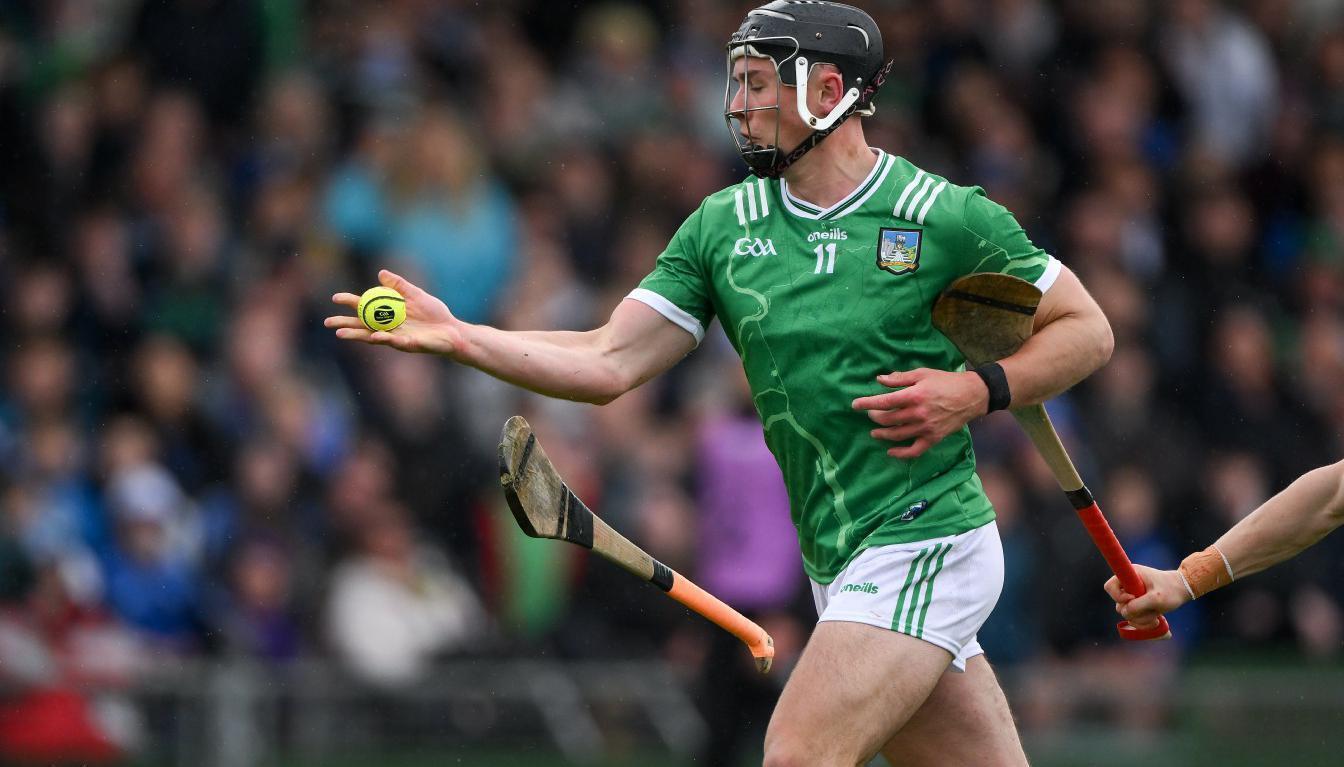
Aidan O’Connor of Limerick handpasses the sliotar. Pic: Brendan Moran/Sportsfile
Hurling’s new experimental rules on the hand-pass come up “very short” of addressing ball-throwing in the game, says Conor O’Donovan.
The All-Ireland-winning Tipperary defender has long canvassed for the GAA to tackle illegal hand-passing in the game. He believes cheating will continue to be practised irrespective of the changes that will be trialled in third-level league games starting next month.
The hurling expert advisory group have proposed a ban on successive hand-passes and the insertion of the word “clear” into the definition of the hand-pass to read that the ball must be “released and struck with a clear and definite striking action of a hand”.
O’Donovan’s own motion to only permit hand-passes to be completed from the non-holding hand or having first been bounced on the hurley was defeated at Congress last year.
He is adamant the GAA should be focusing on the actual act of the hand-pass, not the amount that can be permitted.
“Saying that the player's only allowed one hand-pass and then the ball has to be struck with the hurley, that does absolutely nothing to address ball-throwing,” insists O’Donovan.
“I can hand-pass the ball to a teammate. That means I can still throw it. The ball then has to be struck with the hurley and he’s going to ‘Brick Flick’ it. Another throw can follow that, then another ‘Brick Flick’ and another throw and so on.”
O’Donovan doesn’t see the value in amending the wording of the rule to include “clear”.
“It absolutely adds no value to it. The wording of Rule 4.2b effectively covers it. It's a foul to hand pass the ball if it hasn’t been released in a stroke with a definite strike and action on the hand. Sure, it's the same thing. They're just playing with words there by saying a clear and definite strike and action. That's a misnomer.”
Former Limerick forward Seamus Flanagan’s recent admission that he “always used to throw the ball” only cemented O’Donovan’s long-held belief that players were cutting corners.
“The interviewer who was speaking to Seamus said to him that was cheating and that’s exactly what’s going on.
“I’ve highlighted it to the GAA that one of the core values in the GAA’s code of behaviour for under-age players is to ‘never cheat, always play by the rules’.
“What really disappoints me is the leadership know what's going on. They know now, because I have highlighted it to them. By doing nothing to stop the ball from being thrown, they're effectively condoning cheating.” In their interim report, the hurling expert group highlight “the hand-pass and the throwing problem”.
Over 65% of referees, coaches and the media wanted stricter enforcement of the current rule, while the GAA’s games intelligence unit found in this year’s Division 1A and 1B fixtures that four in 10 passes came via the hand.
“No issue came close to the hand-pass for consistency, depth and urgency of feeling,” read the report. “It was the number one concern in every single dataset, across all provinces, all stakeholders, and all competition tiers.
“Everyone agreed on the core problem: the ball is being thrown rather than hand-passed, referees aren’t enforcing the rule, and the practice is now being actively coached at every level.”
O’Donovan suggests his previous proposal could be amended to allow players to drop the hurley to hand-pass as the case in hurling up to 1990.
“There is pressure on a swarmed player to hand-pass from the same hand but if he was allowed to drop the hurley and complete the hand-pass from the other hand, it would satisfy both issues.”
Extending the amount of steps allowed to be taken with ball in hand from four to six is also an issue for O’Donovan.
“You’re looking now at a player who's been allowed to run with the ball further with the ball in their hands. It means less ball striking.
“Hurling is essentially a ball-striking sport. Now it's becoming one of ball throwing, running with the ball in the hand and a bit of ball striking. Not as much ball striking as there used to be. There are three core elements to hurling, and it should be just the one – striking. It's a hybrid sport now.”
CONNECT WITH US TODAY



Be the first to know the latest news and updates