Could this Clare man's invention solve the GAA's HawkEye problem?
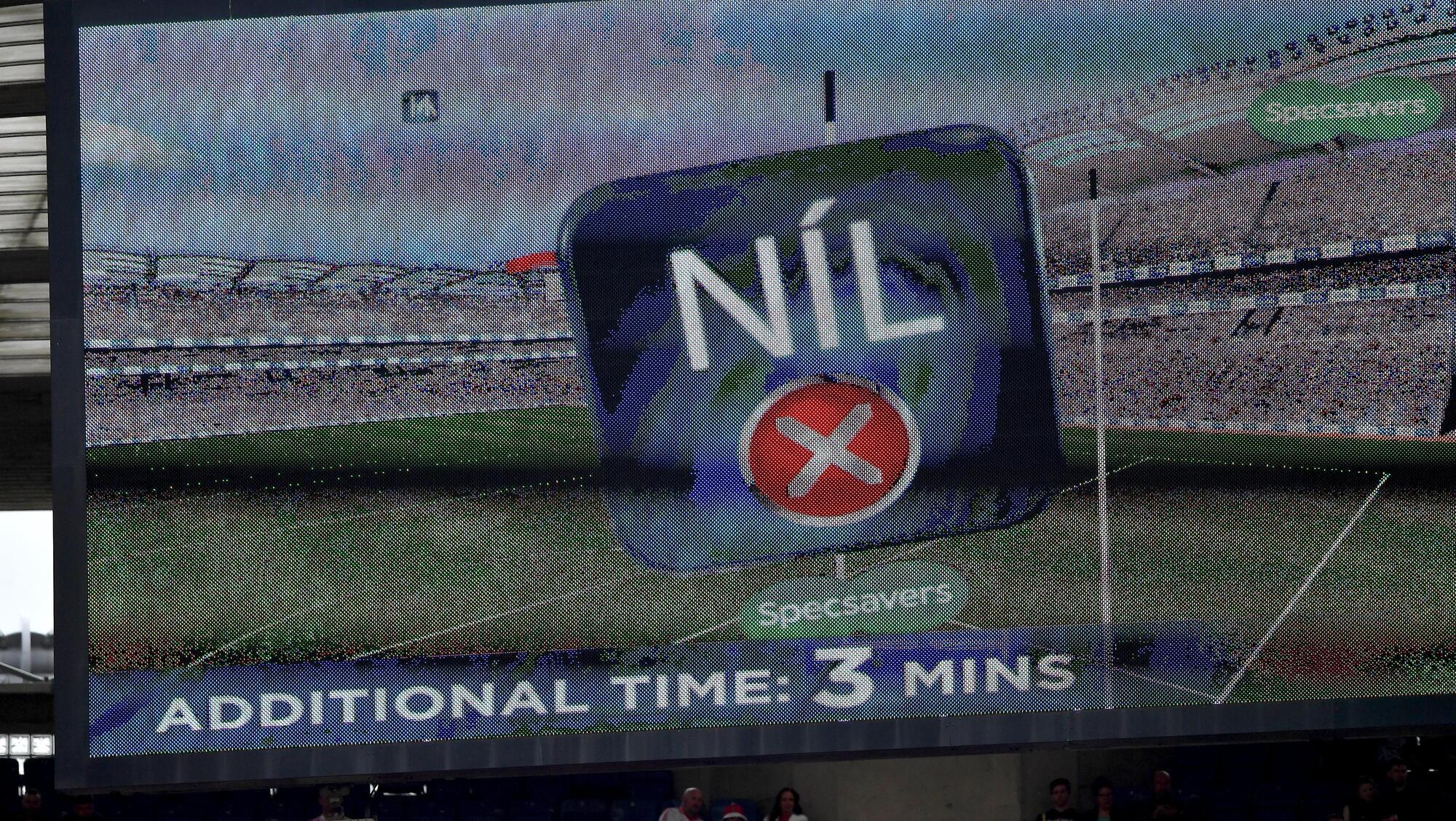
The scoreboards indicates a 'NÍL' during a championship game at Croke Park. Pic: Ray McManus/Sportsfile
There have been occasions, several in fact, where Michael McMahon wonders what might have been.
Every time he’s watched a disputed point or wide, his point catcher prototype comes to mind. There is little doubt his creation would have confirmed Noel McGrath’s point attempt in last year’s All-Ireland SHC semi-final had gone wide.
It’s 20 years since the Feakle man, a long-time resident of Tulla, and friend, former Clare hurler Pádraig Giblin from Scariff of Sportsworld Netting, came together to produce the simple but ingenious means of detecting points.
Combining their efforts with Tallow-based Goalposts Ireland, they pitched their idea to GAA officials. A number of meetings were held in Croke Park but their hopes of an endorsement came to nothing.
At a time when Croke Park was considering the use of HawkEye, that wasn’t surprising but 12 years on from that particular score detection technology has proven to be too cost prohibitive to extend beyond Croke Park and Thurles.
The point catcher is two sets of side nets affixed to a 16-metre set of goalposts, the additional netting running from the crossbar to the top of each upright and measuring out one metre to a back set of posts. A ball that is directed towards inside of the posts drops down onto the top of the goal net, while those struck wide would bounce away from the net.
McMahon came up with the idea when he was coaching a Tulla U14 team while umpiring a game against O’Callaghan Mills at the same time. Would-be Clare two-time All-Ireland winner David McInerney and 2013 medalist Darragh Corry were on the Tulla side.
“A young lad in their half-forward line got the ball and then in a snap the ball went close to my head. I hadn’t a clue whether it was inside or outside the box.
“I quietly said to our goalie Niall Bolton, who has since won All-Irelands in handball, if it was a point and he said it was. It got me thinking that if an U14 can catch you like that, imagine what it’s like for senior umpires. They wouldn’t stand a chance.”
McMahon, a carpenter by trade, and Giblin secured the patent for the catcher in 2007. Having been granted planning permission by the county council, Giblin’s club Scariff was the test ground for the posts where it was eventually put into action.
It passed with flying colours, although had to be taken down for a Clare-Laois National Hurling League game as other games wouldn’t benefit from them. The sight of two sets of goalposts at each end was offset by the back posts painted black.
The likes of Clare manager at the time Ger “Sparrow” O’Loughlin and 1997 hurler of the year Jamesie O’Connor and then senior county hurler Jonathan Clancy featured in a promotional video for the catcher. “You don’t necessarily want the flow of the game to be interrupted,” said O’Connor at the time.
“This is a way where the flow of the game isn’t going to be interrupted but yet acknowledging human error can sometimes be the difference between winning and losing. Given the amount of professional commitments teams are making now, if we can work on eradicating those mistakes, it’s something that should be welcoming.”
The GAA had a fascination with technology at the time and ascertaining how they could determine if a point was good or not when it flew higher than the posts.
It was McMahon’s contention that concentrating on what was happening between or outside the posts was where the focus should be. “In the early 2000s, there was a score controversy one hurling or football match after the next and it was shown again on ‘The Sunday Game’.
“It’s even worse now because everyone has a phone and can record what’s happened. My argument was that TV can’t categorically show that a point was a point over the posts. From the top of the post down, there was a problem that could be solved.”
As HawkEye became the soup du jour, the GAA lost interest in the point catcher. It didn’t have the bells and whistles of the system used in Wimbledon. “I’d be going to club matches and people would be saying ‘it’s too simple to work’,” recalls MacMahon. “But then they saw borderline shots for points and the shots were either caught by the net or bounced away for a wide.
“It wasn’t fancy enough for the GAA. You have HawkEye in Croke Park and Thurles but is it anywhere else? In the vast majority of inter-county matches, there is no mechanism there.”

CONNECT WITH US TODAY



Be the first to know the latest news and updates