‘It needs to be more open’: Tipperary's Clodagh McIntyre on breaking camogie’s silent taboo
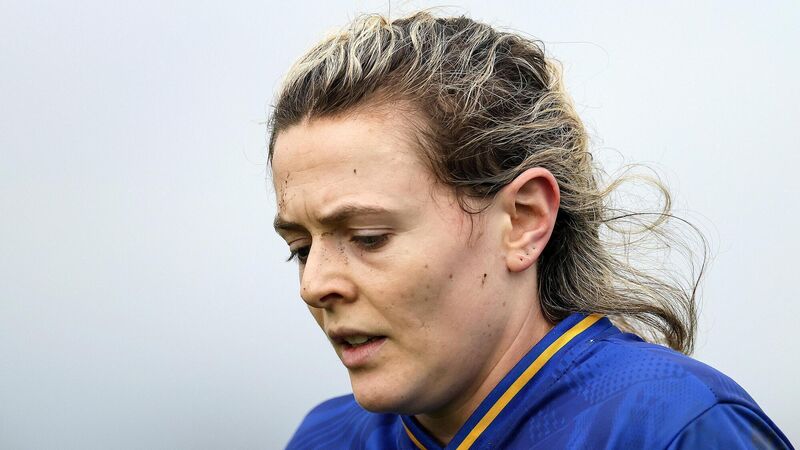
Tipperary's Clodagh McIntyre dejected after the game. Pic: Laszlo Geczo/Inpho
Starting the conversation. Ending dressing room embarrassment. Taking hold of a taboo and thrashing it out.
Tipperary forward Clodagh McIntyre scored the equaliser at the end of her county’s National Camogie League game away to Cork last Saturday. But as crucial as her 64th minute point was in preventing a third straight Tipp defeat, she’s not here to talk recent results or League form.
No, the purpose of the chat is to destigmatise and demystify the health issues encountered and privately endured by so many female players.
The conversation was started by the recently published survey results on the health experiences of female inter-county players.
Some of the figures - 84.8% reported no access to a medical doctor - are shocking, but still only figures nonetheless.
McIntyre is stepping forward to provide the lived experience. It was during her college-going years where she first noticed symptoms of pelvic floor dysfunction, albeit didn’t know at the time that this was the condition she was grappling with.
While engaging in as simple a training drill as hopping, McIntyre would deliberately not give maximum effort. Her preoccupation was instead with maximum squeezing of the pelvis to prevent urine leakage.
“That was when I was left with the realisation that, OK, something is wrong here,” she begins.
“I used to get very anxious back in college, whether it was an exam or even just in a social environment. And when you do feel more anxious, you tighten from being in that fight or flight mode.
“That can cause a non-relaxing pelvic floor, and it gets tighter and tighter then when you add the impact of exercise on top of it. Your pelvic floor nearly can't control any additional pressure, so any time you’re hopping, jumping, or however you’re impacting with the ground, you can feel a bit of leakage of urine and lack of bladder control.
“And even though I’m now well-educated on this, it is something I still have struggles with. When I’m really trying to improve my ability to spring off the ground, I find it hard to fully control the pelvic floor and you might feel a bit of leakage on very intense impact.
“As a physio, the awkwardness and embarrassment women can feel when discussing topics such as stress incontinence is something I’d really like to be able to demystify and destigmatise.”
Of the 480 female inter-county players surveyed, 70% rated their literacy of pelvic floor health as “poor to very poor”. Only 32% were actually aware of pelvic floor dysfunction as a clinical concept.
Because of her physiotherapy profession, as well as the yoga teacher training she’s completed, McIntyre knows both her triggers that can threaten urgency and leakage and how to treat them.
“I do think the prevalence of your symptoms is linked to what's going on around you. Are you in a stressed environment? Coming up to big matches, and we’ve been in so many All-Ireland semi-finals, I’d be so nervous in my own head, worried about what will go wrong.
“Learning how to manage it is not something that goes away. It is a constant practice of trying to keep them thoughts at bay and understanding what you can control. Yoga and down-training too, I’ve found so beneficial.
“All that has definitely helped me manage the continence side of things when playing sport and then, more day-to-day, not feeling that urge of urinary incontinence where you go from one second feeling fine to the next moment, I need the bathroom and are nearly on the brink of losing control.”
The conversation McIntyre is having with the is one she’s never had with a teammate. She never informed Tipp management of her pelvic issues primarily because she never believed her symptoms to be severe enough.
But with only 19% of inter-county players having ever reported a female health issue to a backroom team member, the 25-year-old accepts there is need for an attitude shift in the dressing-room. The environment too needs changing.
Female players must feel comfortable enough to be able to raise a health concern with a backroom member, regardless of its severity.
“It definitely has been a taboo subject, and it needs to be more open. The figures show there are a lot of people dealing with symptoms but not openly discussing it or even knowing where to go to try and get a solution,” she continued.
“By discussing my case, it could hopefully help even one person to realise this is an issue that I don't have to struggle on with or stop exercising because of concerns around bladder control.”
The first-ever female inter-county players charter, implemented in 2024, states as a minimum requirement that panels receive two sessions per year with both a nutritionist and sports psychologist.
The survey figures tell a different story. 38.3% reported no access to a nutritionist, 41% are not seeing a psychologist from one year to the next.
Against this deflating backdrop, McIntyre and her Premier teammates are in a privileged position. They have full-time psychologist Adam Derby on board, and nutritionist Dee Murphy pops in weekly.
“I’d love to get to a point where someone would come in and give an educational talk to panels on how pelvic floor pain can impact so many different things, such as lower back pain, posture, and hip-related pain. If women are given that knowledge from the start, that’d definitely help reduce the incidence of these issues even starting.
“No matter what level of backroom support staff is there, once you speak up in a team setting, even if the person you speak to doesn't have the answer, they'd be able to direct you to someone who can help.
“I see first-hand how any sort of pelvic floor dysfunction can influence performance. If you're in an elite inter-county setting and training five days a week, but one issue like stress incontinence, urge urinary incontinence, or pelvic floor dysfunction is that barrier to you reaching your full potential, well then, on reflection, it sounds ridiculous that it's something you wouldn’t deal with just because it might be a bit embarrassing.”


CONNECT WITH US TODAY



Be the first to know the latest news and updates