LGFA to table motion designed to tackle payment issues
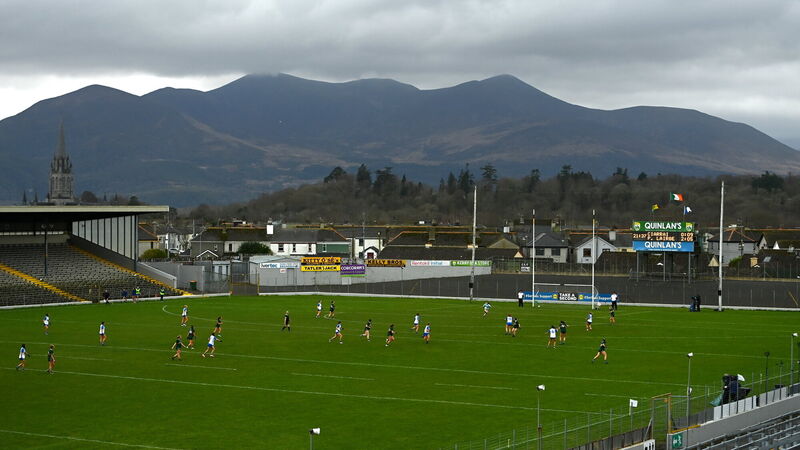
CLAMPING DOWN: The motion, tabled by the LGFA management committee, is clearly designed to tackle payments to managers operating in the ladies game. Pic: Tom Beary/Sportsfile
The LGFA will this weekend attempt to write into rule that no player, official, or member shall accept payment in cash or in kind in conjunction with the playing of Gaelic games.
The motion, tabled by the LGFA management committee, is clearly designed to tackle payments to managers operating in the ladies game.
At present, the LGFA Official Guide makes only one reference to the game being amateur in status, and that is Rule 8 which reads that “The Association shall be an Amateur Association”.
Payments to managers is not currently dealt with in the Ladies Football rulebook.
Ahead of Congress in Sligo this weekend, the motion, seen by the states that “a player, team, official or member shall not accept payment in cash or in kind in conjunction with the playing of Gaelic Games. A player, team, official or member shall not contract herself/ himself/itself to any agent other than those officially approved by Central Council.

Read More
“Expenses paid to all officials, players, and members shall not exceed the standard rates laid down by the Central Council.
“This Rule shall not prohibit the payment of salaries or wages to employees of the Association. Members of the Association may not participate in full-time training for monetary gain.
“The Club is amateur and non-profit making in status. Any surplus income or gains shall be reinvested in the Club, and there shall not be any distribution of Club assets, in cash or in kind, to members or third party. A breach of this rule may be subject to sanction under the CODA rules.”
Elsewhere, departing Ladies Football CEO Helen O’Rourke has said that addressing integration challenges around communication, transparency, timelines, and local identity is essential to ensure a “smooth transition” to a fully merged Gaelic games family.
In her final report after 28 years as CEO of the LGFA, O’Rourke set out that the year ahead will focus on finalising integration proposals for Congress 2027 and supporting structural change at club, county, and provincial levels.
The integration work undertaken in 2025, she added, has laid a strong foundation for a more inclusive, unified, and sustainable future for Gaelic games.
As she hands over the reins to incoming CEO Lyn Savage this weekend, O’Rourke writes that integration has the potential to become one of the most significant developments in the history of our games.
“2025 marked major progress toward unifying the Camogie Association, GAA, and LGFA into one integrated Gaelic Games organisation. The primary focus was creating a one membership model for all participants and establishing consistent governance structures across every level. While complex, these priorities are central to delivering One Association,” O’Rourke remarked.
“Challenges arose around communication, transparency, stakeholder engagement, representation, timelines, and local identity. Addressing these challenges is essential to sustaining momentum and ensuring a smooth transition that effectively supports our volunteers.
“We must actively listen to all stakeholders and thoughtfully respond to the concerns they raise. Getting the structure of the new unified association right from the outset is critical to the success of every association involved.
“In 2026, the focus will shift to finalising proposals informed by feedback gathered during the roadshows, enhancing communication efforts, supporting structural change at club, county, and provincial levels, and broadening member engagement.
“Outline proposals will be presented for a fully integrated model - One Club, One County, One Province, One Membership, with members ultimately deciding the future direction at Congress [in 2027].”
With total income for 2025 climbing to just shy of the €10m mark, the Ladies Football association recorded an overall surplus of €128,071.
Gate receipts improved by 42% to €946k, while corporate sponsorship ballooned by 36% to €616k.
In light of the recent announcement by Lidl to extend its partnership with the LGFA through to 2030, with an additional €7.5m investment, total investment by the international supermarket chain in the association now stands at €22.5m.
Injury fund payouts increasing by half a million euro to €1.488m was the chief contributing factor to overall expenditure rising by 9% to €9.4m.
Dublin are seeking a change to the injury fund whereby the maximum payout of €5,500 would be reconsidered in the event of a “serious injury” sustained by a player.
“Serious injury would be for example an ACL knee injury All such written requests would be considered on an individual basis with supporting documentation such as original invoices to be supplied in full,” reads the Dublin motion.
Dublin footballer Lauren Magee, who ruptured her ACL in May of last year, spoke out at the time to highlight that the “injury fund isn’t good enough and it doesn’t support us as players”.
She revealed that teammates, over the years, “had to get credit union loans out” to cover their surgery.
In a week where retired Kerry great Louise Ní Mhuircheartaigh labelled as "frightening" the loss of ladies football talent to the AFLW, there was not a single mention by O’Rourke in her report of arguably the single biggest issue facing the inter-county game at present.
Signing off, O’Rourke, who served as Ladies Football President for three years before taking up the role of CEO in 1997, writes of her particular pride at the progress made in ensuring women’s voices in sport are heard, valued, and respected.
“When I took on this role, I could not have fully grasped the responsibility it carried. It was a very different era, one without formal female leadership programmes, and I was finding my way in a predominantly male-dominated sporting environment.
“The growth in visibility, attendances, and ambition within Ladies Gaelic Football in recent years reflects the resilience, belief, and hard work of so many, both on and off the field. I have had the opportunity to witness, and be part of, a period of remarkable transformation,” she concluded.


CONNECT WITH US TODAY



Be the first to know the latest news and updates