TV clock accuracy questioned following freezes during Connacht and Munster football finals
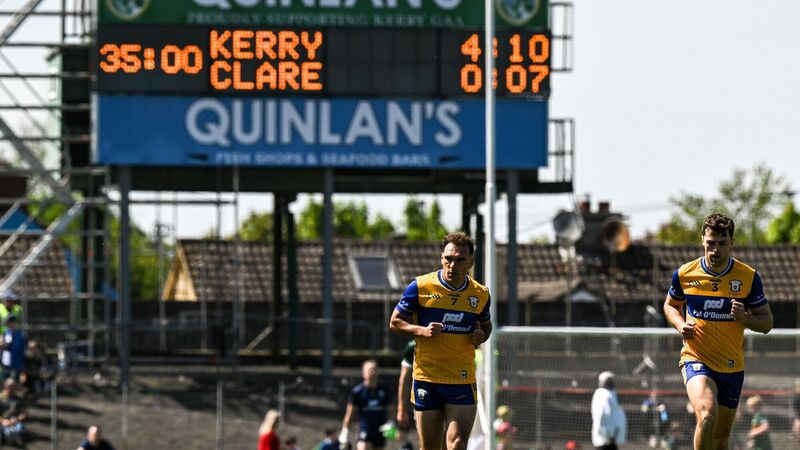
LIKE CLOCKWORK: The use of the public clock in televised inter-county Gaelic football matches has been called into question following several freezes during the live broadcasts of Sunday’s Connacht and Munster football finals. Pic: Brendan Moran/Sportsfile
The use of the public clock in televised inter-county Gaelic football matches has been called into question following several freezes during the live broadcasts of Sunday’s Connacht and Munster football finals.
Several inaccuracies were provided to RTÉ viewers from both Mayo-Galway and Kerry-Clare games in Hastings Insurance McHale Park and Fitzgerald Stadium.
In Castlebar, the clock was stopped on at least three occasions while action continued. Including one stoppage that lasted one minute and 39 seconds towards the end of the first half and two further halts in the second half the second of which was 1:23 in duration, the clock froze for three minutes and 33 seconds.
The incidents in the transmission of the game in Killarney weren’t as significant, although there were at least two periods when the clock didn’t move as the ball was in play.
The clocks used at the venues and by the broadcasters are not synchronised and it is understood a lack of clarity around referees’s communications of “time off” and “time on” to the clock official who controls the stop clock have created difficulties for the likes of RTÉ, TG4 and even the GAA’s own streaming service GAA+.
Their respective on-site production teams have to interpret such signals and in some of their broadcasts the clock as shown in the top left corner is stopped to allow it to sync up with the one in the grounds.
In March, the GAA’s Central Competitions Control Committee (CCCC) advised Central Council that updates were urgently required to avoid discrepancies between the clocks.
“We feel it is also essential that modifications are made to existing clocks to allow for TV Broadcast synchronisation (i.e. to ensure the same time is being displayed on the clock in the grounds as on TV).”
The use of the public clock and hooter had been a major concern for the GAA’s media broadcasters. In January, Nemeton’s head of sport Maidchí Ó Súilleabháin warned of the challenges of synchronising the two timekeeping systems.
“The referee will stop the clock for injuries, substitutions, and other stoppages, but the broadcast team will rely on a visual cue from the referee to manually stop or restart their clock,” he said.
“Any delay or miscommunication could lead to a mismatch between the TV and on-field clocks, causing confusion for viewers. This dependence on physical signals from the referee highlights a potential flaw in the system, making accurate synchronisation a logistical hurdle for broadcasters.”
The inaccuracy of what was presented on TV on Sunday was in contrast to an Armagh-Tyrone Division 1 football game in Box-It Athletic Grounds in February when the scoreboard lost power and players, management and those in attendance were not aware of what time was remaining. However, those at home had no issue.
The clock/hooter is set to apply to this weekend’s Leinster and Ulster SFC finals but will feature in only one of the eight Tailteann Cup games, the Westmeath-Antrim Group 3 game in Mullingar. The timing of the other seven will be controlled by the referee in question.
The following week, two of the four Group 1 games as chosen for streaming by GAA+ will be subject to the public clock and the other two under the remit of the referee. The Galway v Dublin Group 4 and Kerry v Roscommon Group 2 matches are expected to be selected, the other two games being Mayo v Cavan (Group 1) and Clare v Down (Group 3).
That distinction between televised/streamed games and those not shown live follows a Central Council decision on foot of a recommendation by the CCCC that the clock/hooter only be used for televised or streamed games.
The rationale behind the call was a financial and logistical one as the CCCC estimated an initial cost of €250,000 to fit the required technology in each championship venue so as to ensure “the risk of reputational damage/system failure is mitigated.
“It is unfortunate,” said Football Review Committee (FRC) chairman Jim Gavin, whose body recommended the technology be introduced to Gaelic football this year and claimed in March that it was having an “overwhelmingly positive impact”.
He continued: “Obviously, from an FRC perspective, we'd like to see it everywhere.” Last month, the Kildare-Westmeath Leinster quarter-final in Newbridge was subject to the stop clock as it was streamed on GAA+. The following day’s provincial clash between Louth and Laois at the same venue wasn’t as it wasn’t being screened.
The clock/hooter has been a headache for the CCCC, who in March convinced Central Council to allow play to continue following the sounding of the hooter until the ball goes dead.
Also backed by the FRC, the amendment came into force into Division 1 and 2 for the final two rounds of the Allianz League, but it has led to confusing situations for some players, the most high profile incidents involving Cavan’s Dara McVeety and Louth’s Craig Lennon.


CONNECT WITH US TODAY



Be the first to know the latest news and updates