Rebels beware — final atonement never comes easy
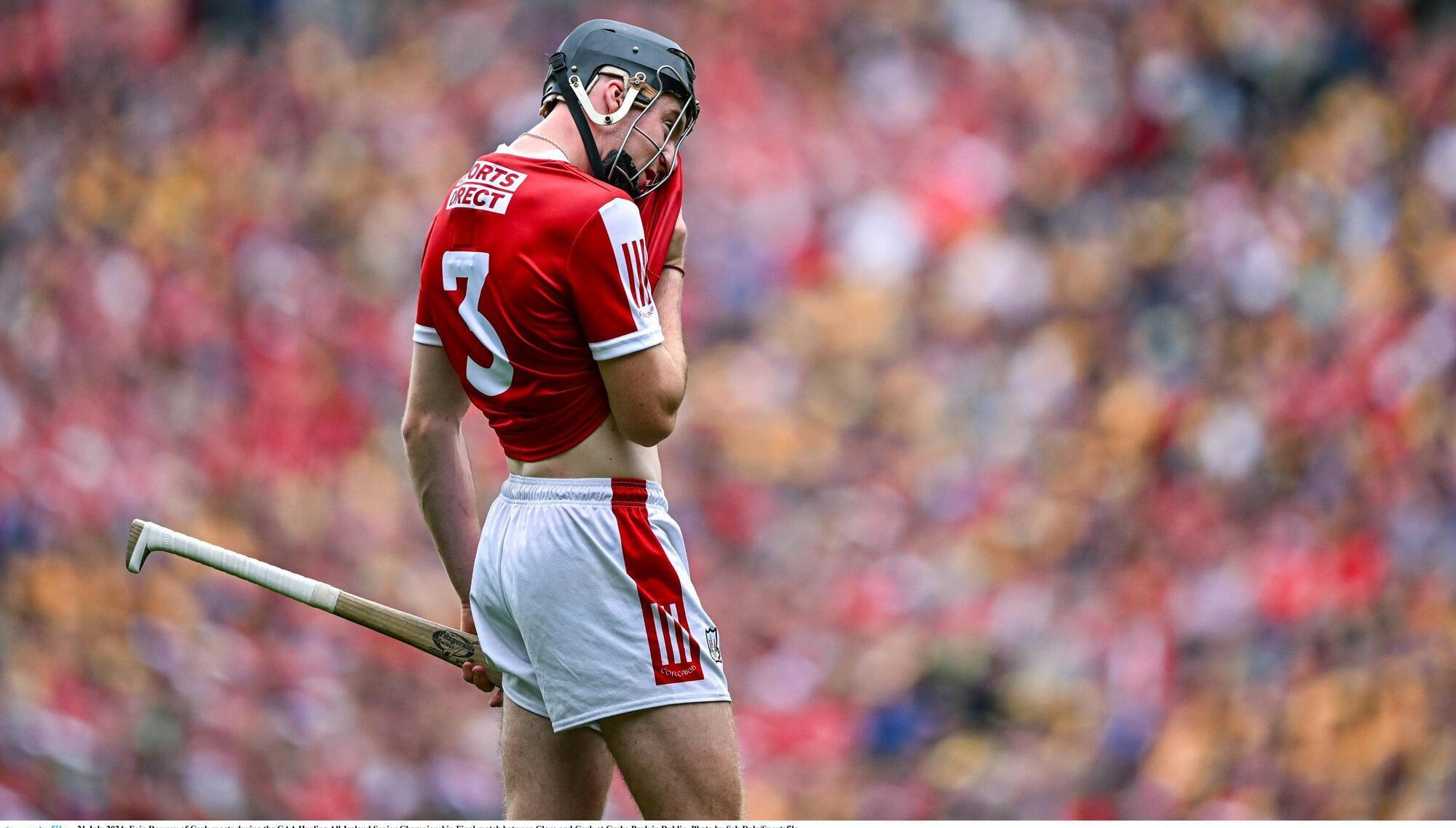
LONG ROAD BACK: Eoin Downey of Cork reacts during the GAA Hurling All-Ireland Senior Championship Final match between Clare and Cork at Croke Park in Dublin. Photo by Seb Daly/Sportsfile
On the morning after the All-Ireland hurling final last July, Pat Ryan got a text from Conor Counihan. The words were short and to the point, but it was Counihan’s way of reminding Ryan of how he had suffered the same wound to be able to recognise the scar.
Beaten in the 2009 All-Ireland football final by Kerry, Counihan’s Cork returned to win the title 12 months later. The core of Counihan’s message to Ryan was that the agony he and his players were feeling in that moment could be transformed into ecstasy a year later.
The hurlers have history in this regard too. After Cork lost the 2003 final to Kilkenny, the long road back to them winning the title a year later began in the team huddle on the pitch.
“The stadium was practically empty,” recalled Donal Óg Cusack in the book ‘Last Man Standing’. “I remember Mickey (O’Connell) with his nose bust. It was all just pure misery. I remember being so sad for the boys and saying that whatever we have to do over the winter, we have to get back here. Whatever had to be done, whatever cost it would be to ourselves, we had to do it.”
Every team that loses an All-Ireland final is hell-bent on atonement, retribution and redemption, but those powerful sources of motivation don’t always get those sides back to their ultimate destination.
In the last 35 years, only 10 of the 70 defeated teams (five in each code) have bounced back to win the All-Ireland the following year.
Two of those sides – Kerry and Kilkenny - were serial All-Ireland winners, but it still wasn’t plain sailing. After losing the 2009 Munster semi-final replay to Cork by eight points, Kerry only beat Sligo – who missed a late penalty - by one point in Tralee, before scraping past Antrim a week later.
Six of those ten teams which rebounded back lost in the province (before the hurling system changed) the following year, some of which were near crisis-point defeats. Five of those six sides only got back on track after tight, sometimes multiple, get-out-of-jail victories through the back-door.
Other sides though, never recovered. And never came back. Rehabilitation is all the harder again when the final defeat is in double digits. In his Laochra Gael documentary, Ken McGrath graphically detailed the impact Waterford’s 2008 final hammering had on him. "I was never the same player afterwards,” he said. McGrath was even more emphatic about the experience in his book. “That game finished me,” he wrote.
The source of Meath’s struggles over the last 20 years can be pin-pointed to their 2001 All-Ireland defeat to Galway. Meath were raging favourites, but Galway did more than just empty Meath; they psychologically buried them.
“The 2001 final hit a lot of us hard and we didn’t have the heart for it anymore,” said Darren Fay in 2005. “We got such a shock that maybe our confidence just went. The belief was gone. Teams weren’t afraid of us anymore. We had no edge. Everything Meath football had stood for pre-2001 was completely gone.”
The support structures are much better now, but the psychological challenges can still be difficult to overcome, especially the following season. After losing the 2007 All-Ireland final, the Cork footballers lost an All-Ireland semi-final replay in 2008, before losing another final to Kerry in 2009.
By 2010, Cork were the best conditioned team in the country, but they still didn’t play as well as they had in 2009. They won the semi-final and final by margins of just one point. “We were a bit scarred throughout 2010 and that’s why we didn’t play such great football,” said goalkeeper Alan Quirke a few years later. “But we won tough matches because there was a resolve there not to lose again. The fear of losing did drive us on.”
Cork had that big-game experience but not every team has the worldliness to fully process the fallout from an All-Ireland final defeat. When Limerick lost to Offaly in the 2008 qualifiers in the Gaelic Grounds by ten points, they were booed off the field by their own supporters just ten months after reaching an All-Ireland final.
The hangover from losing the 2007 final lasted far longer than everyone expected. Limerick were annihilated by Tipperary in the 2009 All-Ireland semi-final. The players went on strike the following year. A host of factors contributed to that downward spiral, but it took Limerick years to recover.
In the last three and a half decades, only 14 of 70 defeated All-Ireland finalists returned to the final the following year. Mayo dominate those stats, bouncing back to reach successive finals in 1997, 2013, 2017 and 2021. But they still didn’t win any.
Of all the defeats Mayo suffered, their last, in 2021, appeared to be the most traumatic. After beating Dublin in the semi-final, there had never been more expectation ahead of the final against Tyrone.
The fallout was extreme. And extremely bruising on the whole group. Just five weeks after that defeat, then manager James Horan went on local radio to try and quell the innuendo. “I find it incredible the amount of untruths published,” said Horan. "It is phenomenal. Some of the stories generated are actually incredible.” Mayo never recovered in 2022. They did reach that year’s league final but were hammered by Kerry. After losing to Galway in Connacht, Mayo scraped past Monaghan and Kildare in the 2022 qualifiers before getting clipped in the All-Ireland quarter-final by Kerry.
It’s arguable if Mayo have ever recovered from that 2021 final defeat, but it can take years for a group to flush those toxins out of their system.
After losing the 2017 All-Ireland hurling final, Waterford failed to win any of their next eight championship matches over the following two seasons. In 2018 there had been extenuating circumstances: no home championship games, a crazy amount of injuries, a gruelling schedule of four championship matches in 22 days, being denied a win against Tipperary (a match they drew) by the infamous ‘ghost goal’ incident.
Everything that could have gone wrong, went wrong, but there were still underlying issues of mental and physical fatigue, even if it wasn’t apparent to them at the time.
“Maybe the fact that the All-Ireland final was at the end of a three-year cycle when we had done everything perfectly and then the fourth year (2018) we just couldn’t go to the places we’d gone to before,” said former player Brian O’Halloran at the outset of 2020.
“There’s also an emotional side to it. You don’t think about it too often but maybe in our subconscious, the emotions of losing the All-Ireland did knock us a bit going into the next year.”
After Derek McGrath stepped away at the end of the 2018 campaign, the 2019 season was loaded with more bad than good. Waterford stormed to the league final but collapsed in a heap against Limerick and never recovered. They lost three of their four Munster championship matches by an aggregate of 51 points.
After changing their manager again in 2020, Waterford made it back to the All-Ireland final that season under Liam Cahill. There were multiple reasons for the group failing to build on that progress and, while Waterford won the 2022 league title, they still only won four out of nine championship matches in 2021 and 2022.
After reaching the 2021 All-Ireland hurling final, Cork lost the All-Ireland quarter-final to Galway the following summer. Cork threw that match away but they had no consistency after losing the league final to Waterford; Limerick hammered them in their opening championship match; Clare beat them far more convincingly than the two-point winning margin suggested in Round 2.
Kilkenny were the last hurling team to bounce back from losing a final in 2010 and win the Liam MacCarthy a year later. In the intervening years though, Kilkenny in 2023 were the only team to even get back to a final after losing the previous year’s decider.
Cork were the last football team to make up for that disappointment 15 years ago, but, outside of Mayo, no other beaten finalist managed to return to the same stage 12 months later. In seven of those last 14 seasons, the defeated finalists didn’t even make it back to the following year’s semi-finals.
After losing the 2022 All-Ireland football final, Galway exited the 2023 championship at the preliminary quarter-final stage, going down to Mayo in Pearse Stadium, becoming the first provincial champions not to feature in an All-Ireland quarter-final or semi-final. It was the first year that such an outcome was possible with the new system but Galway never rediscovered their mojo that had carried them to within touching distance of the title the previous summer.
"It's a very, very disappointing year,” said Padraic Joyce after that 2023 defeat to Mayo. “That's the bottom line. There's no point trying to gloss it over. It’s another season gone by for Galway.” Last winter was much harder again to put down for Galway, having lost the All-Ireland final to Armagh in agonising circumstances. A one-point defeat was even more devastating again considering the scale of opportunity beforehand.
“The dressing room is in an awful state,” said Joyce afterwards. “The lads are devastated in there. We had chance after chance after chance, so it’s going to be hard to take. We’re going to regret this for a long time. It’s going to haunt us for a while.”
The Cork hurlers also know that pain but they’ve already shown how much they have taken the learnings from that defeat to Clare last July on board. "Coming after an All-Ireland final loss you're trying to see are the lads up for it and ready to go,” said Pat Ryan after the league final win against Tipp two weeks ago. "They didn't feel sorry for themselves. They've trained hard and we've got better over the league. But league is one thing. Championship is where it's at."
It always is. As Cork and Galway chase a first All-Ireland in over two decades this summer, their games against Clare and Roscommon this weekend won’t define the outcome of their season. They will be hugely motivated from the pain of last July but both teams will still need to put those harrowing experiences to good use in this championship to make sure that the long road back is not as long and arduous as it has been for so many defeated All-Ireland finalists.


CONNECT WITH US TODAY



Be the first to know the latest news and updates