Maurice Brosnan: 8 observations from the football championship
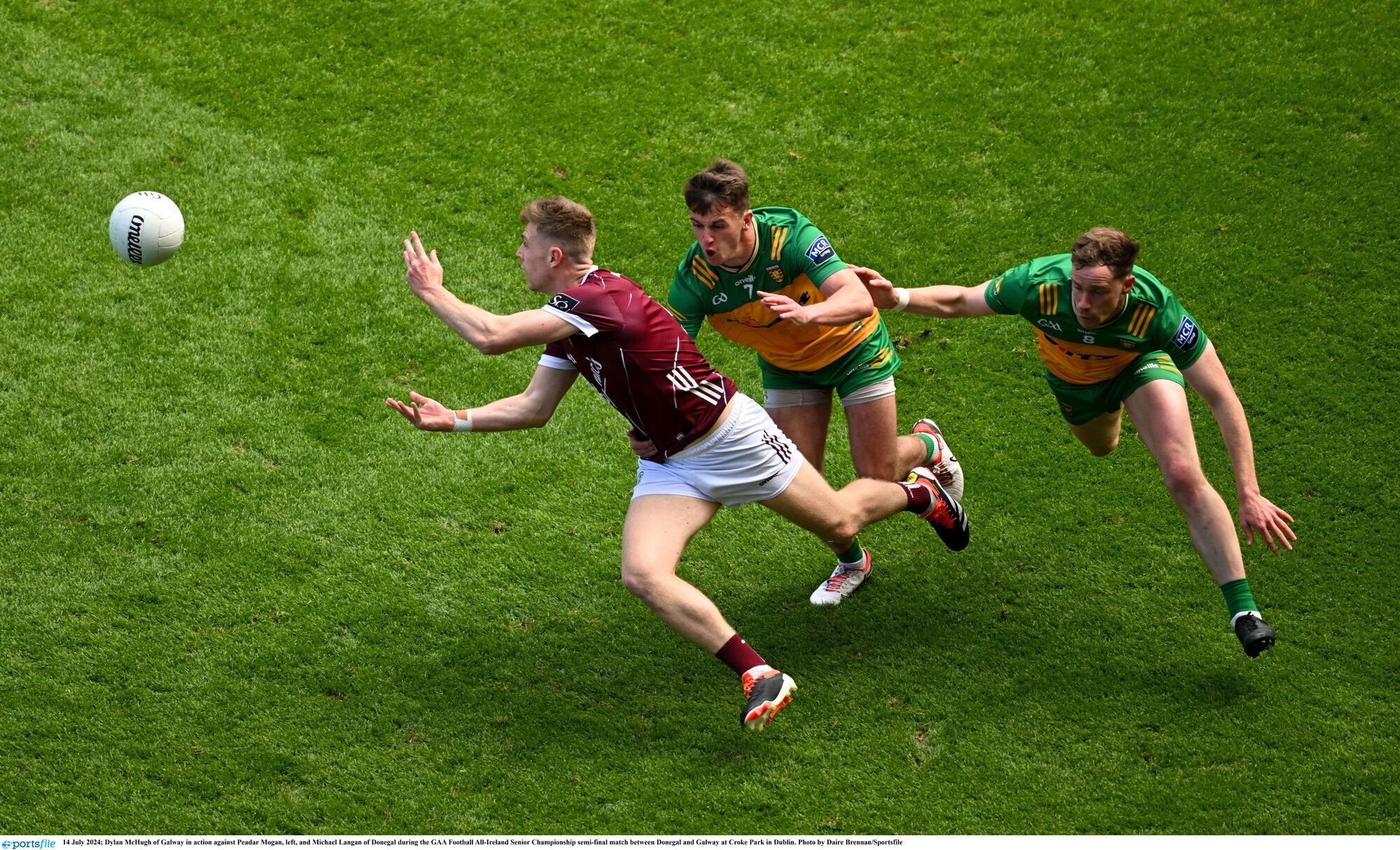
Dylan McHugh of Galway in action against Peadar Mogan, left, and Michael Langan of Donegal. Picture: Daire Brennan/Sportsfile
In the carefully constructed delineation that is modern sport, it can be hard to find a space for the sprawling parish of emotion. Its visceral possibility can overwhelm its neighbours. Regulating and managing it can be a tricky task.
Pádraic Joyce admitted as much after Galway's semi-final. Three days earlier, two-time All-Ireland winning manager John O’Mahony was buried in Ballaghaderreen. The 71-year-old was a mentor to Joyce as well as selector John Divilly and physio Aofáine Walshe, who also worked with Galway during those two All-Ireland triumphs.
Joyce was the titan of O’Mahony’s team. They stayed close long after. After Kevin Walsh stepped down, O’Mahony publicly backed Joyce for the job, while stressing he was not trying to influence the process. That relationship endured as the legendary forward duly became Galway boss. It survived the oft-complicated club manager-intercounty manager relationship when O’Mahony took over Salthill-Knocknacarra in 2022.
The feeling that came with his sad passing obviously couldn’t be ignored. The group needed to find a template to express it. During the week, Joyce spoke to the players and recycled motivational quotes O’Mahony had previously utilised. A cohort of the Salthill contingent travelled together to the removal on Wednesday. Players spoke about their warm memories of that team and endless spins of A Year 'til Sunday.
As a tribute, they elected to form a V as the pre-game stadium montage played. Strength and conditioning coach Cian Breathnach McGinn marked the standing spot while the parade took place. Every player knew precisely where to go and what to do.

“It symbolises V for the vanguard,” explained Dylan McHugh. “John’O was so ahead of his time. It was nice to honour him, we had to do something for what he has given to Galway football.”
Joyce is not often sentimental, but he is a student. Few have a better grasp of Galway football history and heritage. That is a fundamental element of his management.
As countless tributes over the past week have reinforced, O’Mahony was an innovator. Plenty of that had little to do with the tactics of Gaelic football. His off-field preparation, investment in nutrition, hydration plans and analysis were renowned. Joyce has clearly learned from that.
Much has changed. That fundamental truth remains the same. Now the role of the manager is even more wide-ranging. It is about coordination and unification and culture. Joyce has excelled in that regard this season. There exists a depth and bond within the squad that is formidable. The style of play has clear fingerprints of their coaches, but the team has been moulded by Joyce’s hand.
Joyce learned from O’Mahony. Others will learn from him.
Here are eight observations from the Gaelic football championship.
Start with the numbers. The basic source of scores suggests Kerry made an error. In normal time, Armagh scored 0-8 from their own kickout. Kerry scored 1-6. Armagh’s press yielded 1-1 from Kerry’s restart. Kerry let Armagh rack up 100% retention by conceding.
There were only seven long kickouts in the entire opening 70 minutes. In extra-time, Armagh’s bright start and early lead forced Kerry to press. There were five long kickouts during that spell. Armagh won four (three of their own and one Kerry).
GAA analysts and coaches are steered by the data. They cannot be wedded to them. What factors influenced Kerry’s decision to drop off? Armagh’s advantage in midfield is undeniable. They trusted in a robust set defence to force low-percentage shots or turnovers. Armagh’s overall conversion was 47%, Kerry scored 0-7 vs Armagh’s 0-4 from turnovers before extra-time.
Remarkably, since Jack O’Connor’s return in 2022, Kerry have not conceded a single goal from their own kickout in championship before Saturday. Shane Ryan’s only slip in three seasons was a double-whammy. An errant kickout followed by a bumbled catch. As the final whistle sounded and both sides prepared for another 20 minutes, the difference in their net return on kickouts was exactly three points.
In every championship fixture this year before their All-Ireland quarter-final victory over Roscommon, Armagh’s bench have at least matched their opposition’s scoring return. Davy Burke’s subs broke the streak when they became the first side to outscore Armagh’s replacements.
Kieran McGeeney wouldn’t have been overly concerned at that. Stefan Campbell kicked two points and had one wide. Oisin O’Neill created a score and missed another. They were in control for all of the final quarter.
Campbell has become a guaranteed impact sub. He has come on in three successive games and scored in every one. Management made the bold call of bringing back on Conor Turbitt and Oisin Conaty on Saturday.
If there is any solace, perhaps it is in the fact that Jim McGuinness is in phase one versus Pádraic Joyce is well down that road? One team starting afresh, another fighting against the ticking clock? Not likely.
This perception was all over Croke Park last weekend, inside and out. Joyce referenced how ‘battle-hardened’ Galway were thanks to competitive games they’ve played lately, while Donegal cruised past Clare and Louth in comparison. Selector John Concannon openly admitted that this could be the last All-Ireland chance for some Galway players.
And yet, tally up the championship appearances for both starting 15s at the weekend and Donegal were considerably more experienced, 418 versus 382. Paul Conroy might have been the oldest player on the pitch, but Patrick McBrearty has him well beat for appearances, six clear on 71.
McGuinness has turned true potential into a real power. Donegal also had the capacity, the same team that was relegated from Division 1 last year beat eventual All-Ireland semi-finalists Monaghan in their final Sam Maguire Series game.
This wasn’t ever meant to be a long bet. McGuinness could see the chance in front of him and believed they had the ability to grasp it. That is what made it so hard to take.
“People talk about Year One and all this,” he said post-match. “There is no such thing. It is this year. And this was an opportunity this year. We had an opportunity. We’ll have to take this on the chin and move on from it and take as many lessons as possible.”
Damien Comer and Shane Walsh understandably command much attention from opposition coaches. As a result, they dedicate their best man-markers to this task. Last Sunday, Brendan McCole went to Comer, Eoghan Ban Gallagher took Walsh.
In the other corner, Peadar Mogan started on Rob Finnerty. At other times, Caolan McColgan picked up the number 13. The corner-forward’s first shot was blocked down but broke for Dylan McHugh who pointed. He then scored his first from play and added another moments later.
In the second half, he reacted expertly to the break after a long ball to Comer and selflessly teed up Walsh.
Finnerty finished with 0-4, including two frees. It brings his total to 1-33 (16 frees, 1 mark). He is Galway’s top scorer in championship. He is also their top creator in championship, with 1-11 in assists.
Buried among the litany of radical suggestions currently being tested by Jim Gavin’s Football Review Committee was one practical one. Highlighted with its own section was Rule 5.40 with a section crossed out.
"The Referee shall signal that advantage by raising an arm upright and shall allow the advantage to run by maintaining that arm in the upright position for up to five seconds after the foul or for less time until such time it becomes clear that no advantage has accrued.”
The five second limit would be eradicated. It is an entirely sensible suggestion.
Six minutes into the Tailteann Cup final second half, James Kelly forced a turnover and Evan O’Carroll broke free on the counterattack. He was fouled outside the 45 but managed to kick it forward to Kevin Swayne. Referee Brendan Griffin raised his hand to play advantage and sounded his whistle after five seconds.
Just as he did so, Swayne had skipped past the Down defender. He was evidently enraged by the decision, yet it was the right call because of the wrong rule.
Griffin was sharp on the subsequent free too. Down did their best to distract noted placed ball kicker Killian Roche, encroaching on his free as he lined it up. The attempt went wide but Griffin called it back and awarded a free from the top of the D. Mark Barry duly levelled it up with his left.
Two months ago, we tried to analyse Armagh’s set signals and overloads. It was an obvious tactic used repeatedly during the Ulster semi-final victory over Down.
Teams at all levels deploy similar prepared moves now. Clubs can make an audible call, that luxury doesn’t exist in a heaving Croke Park so signals are the next best thing. It is a strategic way of manipulating a blanket defence. By forming a spine down the middle or overloading an area like the square or a wing, the opposition are forced to make a call, follow the attacker and vacate space or let them create an overlap. Kerry also resorted to this signal method in the same match.
Did you read that analysis feature? Not likely. Do you remember RTÉ co-commentator Éamonn Fitzmaurice repeatedly referencing the shapes Armagh were creating during the quarter-final win over Roscommon? Maybe. The best way to do justice to innovation in the game is show, don’t tell.
To their credit, The Sunday Game highlights finally analysed one of these moves using the high-behind camera from Croke Park. Paul Flynn pointed to Oisin O’Neill raising the ball in both hands and Stefan Campbell’s subsequent movement. That sort of breakdown is to be welcomed. The interest in analytical punditry might not be vast but there is a considerable appetite for well-designed portions. Few shows are better placed to satisfy it.
Corofin’s Dylan McHugh was always a talented footballer. He has also managed to improve season-on-season.
He was a full-back on the Galway minor team that lifted a first Connacht title in eight years back in 2015. He started in the half-back line alongside Kieran Molloy and Cillian McDaid in 2017 as the U21s reached an All-Ireland final.
In 2020, he came on as a substitute in the All-Ireland club final as they secured a historic three-in-a-row. A year later, he was invited into the Galway senior panel.
The wing-back was a mainstay during the run to a 2022 All-Ireland final but was not nominated by an All-Star. His absence was hugely felt in 2023 as he missed their preliminary quarter-final loss to Mayo due to injury. On Sunday he was Man of the Match and is the current favourite for Football of the Year.
“Once you get a chance and you are in an environment like this, you are only going to improve,” he explained outside the dressing room on Sunday. “Coaches like Padraic, Divo and Cian O’Neill, you will always get better. I did nothing in particular, just kept plugging away.”
Speaking on the Irish Examiner Gaelic football podcast, club team-mate Gary Sice pointed to his transformation during the pandemic.
“Covid came at an exceptionally good time for Dylan. I think most lads come out of Covid badly, he came out like a machine. I can’t over-emphasise that. He came out in outrageous nick.
“I remember doing a Yo-Yo test directly after and he blew the whole thing out. He was three or four levels above everyone else. Everything changed. All of a sudden, we had a machine to go with the football. He just went from strength to strength.”
On a recent episode of the Second Captains, two-time Fitzgibbon Cup winning manager and hurling pundit Jamie Wall offered a simple piece of advice that will make any GAA fans life considerably easier. There are certain controversial statements routinely cycled out. No matter how you respond or what evidence is produced, they will endure. The best approach is to immediately accept the offeror has a considerably different outlook on the game and the conversation has no future.
It is an inspired creed. Make your list, keep a wide berth of any guilty party. Once we come across a certain take on Aidan O’Shea or Jim McGuinness’ impact on football, the only available option is to an immediate change of topic or adieu.
The gleeful detractors of David Clifford deserve such treatment. At the same time, there is a legitimate case to have a considered look at his performance. After last year’s All-Ireland final, the primary takeaway was that Kerry need to find a way to lighten the load. They evidently failed to do so. The litany of skewered chances on Saturday meant he had to excel for them to prevail. He did not.
This semi-final is different to the 2023 decider. True there were occasions when team-mates failed to facilitate him. Brian Ó Beaglaoich opted not to pop to the two-time Footballer of the Year on the loop in the opening minutes, instead driving into the heart of the Armagh defence and getting turned over. When Tom O’Sullivan butchered his second goal chance, Clifford was closest on the outside shoulder.
He finished with 16 possessions in 70 minutes. That includes one wide, one shot attempt that ended in a goal, one turnover, one mark, one point from play, two frees and one assist. In the final minutes, the Fossa star seemed to be struggling with cramp as he stretched out his calf. He was restricted during extra-time and kicked another wide during that spell.
For Kerry, the task this winter is the same as the last. Can they find supportive couriers for the king? Did the Cliffords get a sufficient break? Can their main forward find another way to impact the game when his radar is off?
Ultimately, the priority is getting more from what is undoubtedly one of the most gifted footballers of all time. And there is only one answer to those in denial of that.


CONNECT WITH US TODAY



Be the first to know the latest news and updates