Mayo’s man-marking template one to follow and the All-Stars so far
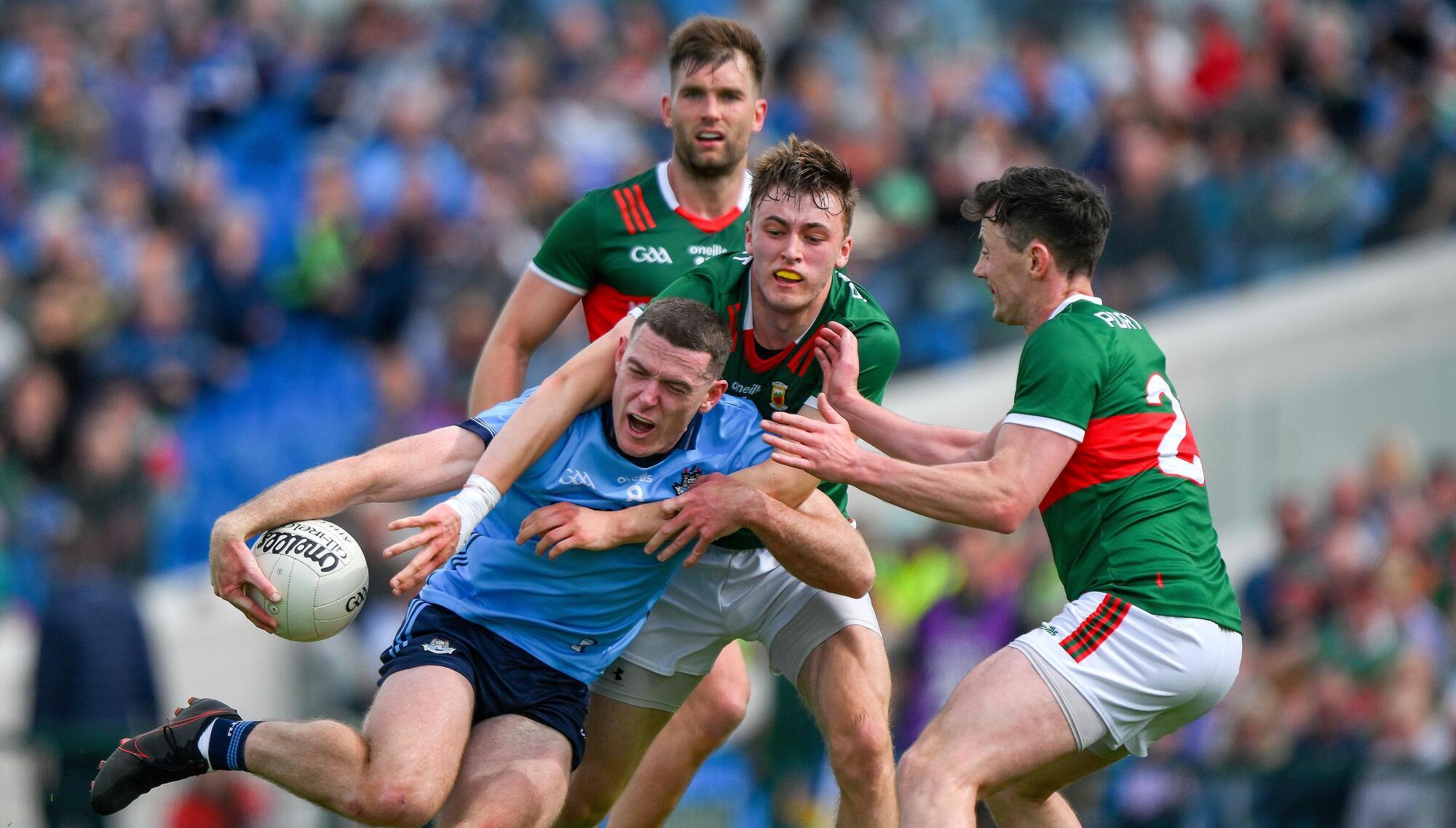
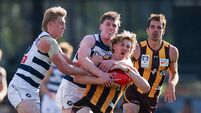
Brian Fenton of Dublin is tackled by Donnacha McHugh, centre, and Diarmuid O’Connor of Mayo. Picture: Ray McManus/Sportsfile
Back in April at the first unveiling of Jim Gavin’s Football Review Committee, the six-time All-Ireland winning manager wanted to pay tribute to similar groups who had come before. In particular, he pointed to Eugene McGee.
In 2012, the GAA legend launched his own report on the state of the game. “The overriding conclusion that has emerged from all this research is that Gaelic football is in a fairly healthy state,” McGee declared. Over a decade later, was Gavin in agreement?
“You mentioned Eugene McGee saying in 2012 the game isn’t in as bad as people make it out to be,” he was asked. “Are you of the same view yourself?” Gavin’s reply was immediate: “I am.” Him and thousands of others. Last week Gavin gave his latest update and announced a series of trials that are to take place over the next month. They were being steered by responses to the public survey, he stressed. Key themes had emerged from that process.
One of the main questions asked participants to rank the current level of the sport at inter-county, club, underage inter-county and underage club.
“In general, Gaelic football as a sport at [X] level is very good, good, average, poor or very poor.” In all four categories, the most popular response was good. For senior intercounty, 17% of the 6553 responses so far said it was very good. 39.1% went for good. 28.8% said it was average. 11.3% opted for poor and 3% selected very poor.
Of course, the fact that it was a survey of Gaelic football fans ensured a particular strain of response. There is always a need to appeal to a wider base. It is hardly revelatory that fans remain fans of their sport.
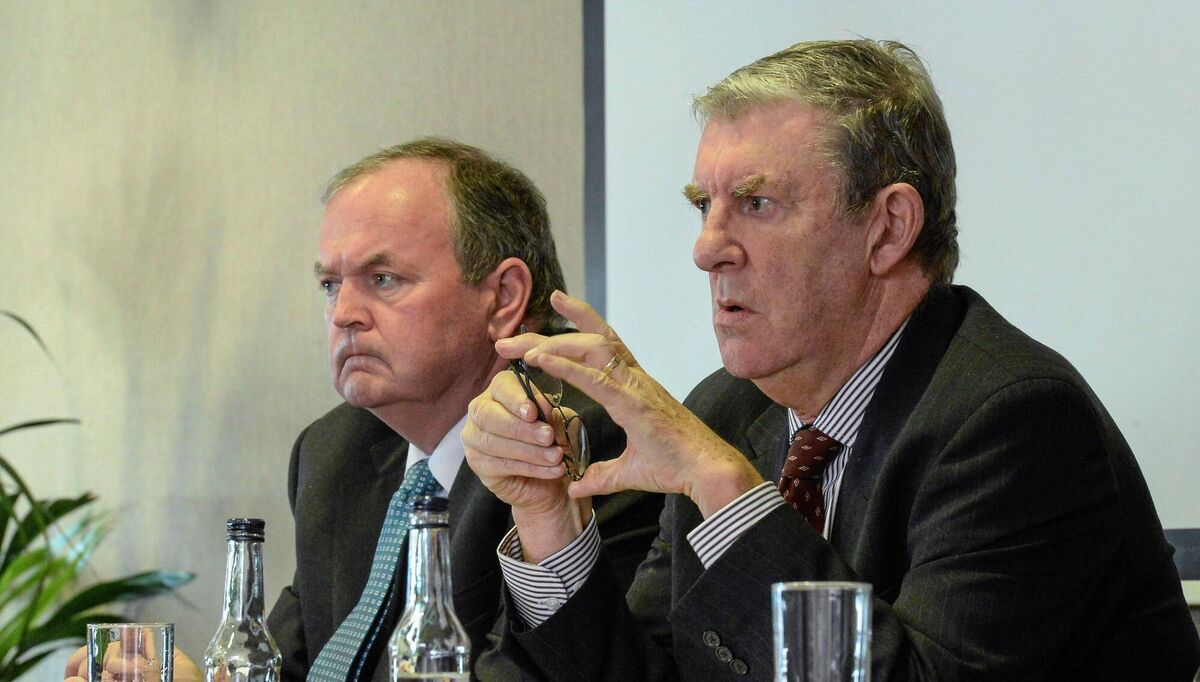
At the same time, this is the cohort who are concerned with the future of the game. Anyone can have their say. The FRC have actively courted engagement. Gavin’s briefcase was full with thousands of responses carefully considered, judging by the abundance of highlighter across it. Like much of the concerns currently facing the association, the reality is that it really only requires a tweak.
Part of the problem is the fundamental gloom-ridden nature of Gaelic football. We have a long, proud history in this regard. The one constant is the argument that the game is in crisis. That means conversations about the state of the sport or how to fix it, the format problems, the calendar and the attendances. Even when the games themselves are good.
And this season they have been. Think of the championship we’ve witnessed so far. Every single weekend, except for May 25/26 we’d argue, has had at least one gripping contest. Goals per game has boomed to 2 in the Sam Maguire series. It was 1.3 in 2023. For the first time since 2011, all four provincial finals were decent fare. From Waterford’s joy at the end of a 36-year wait to the Derry mystery. Donegal’s rise, Galway’s recovery, Louth’s admirable response to an explosive offseason, there have been so many highpoints.
Things can be better. That doesn’t mean we don’t have it good.
Here are eight observations from the Gaelic football championship
The first player to touch the ball in Dr Hyde Park on Sunday was Brian Fenton when he won the throw-in. At either end, the matchups were immediately apparent. Ryan O’Donoghue was marked by Eoin Murchan. Con O’Callaghan had David McBrien for company. It took a few minutes for things to get settled in the middle but eventually, Donnacha McHugh made for Fenton.
Already this season McHugh has limited Sean Kelly and Enda Smith. Against Dublin he demonstrated the template for this role. Brian Fenton racked up 14 possessions. Crucially, only five of them were in the opposition’s half. He won three kickouts and was turned over twice.
Defensively McHugh tracked Fenton all over the field. He forced a huge turnover in the second half that led to the hotly contested Colm Reape 45.
In possession, he dragged him deep into Dublin’s half. The Castlebar Mitchels man set up Ryan O’Donoghue who was fouled for a converted free early on. He was free at the near post when Stephen Coen smashed a shot over instead of going for goal.
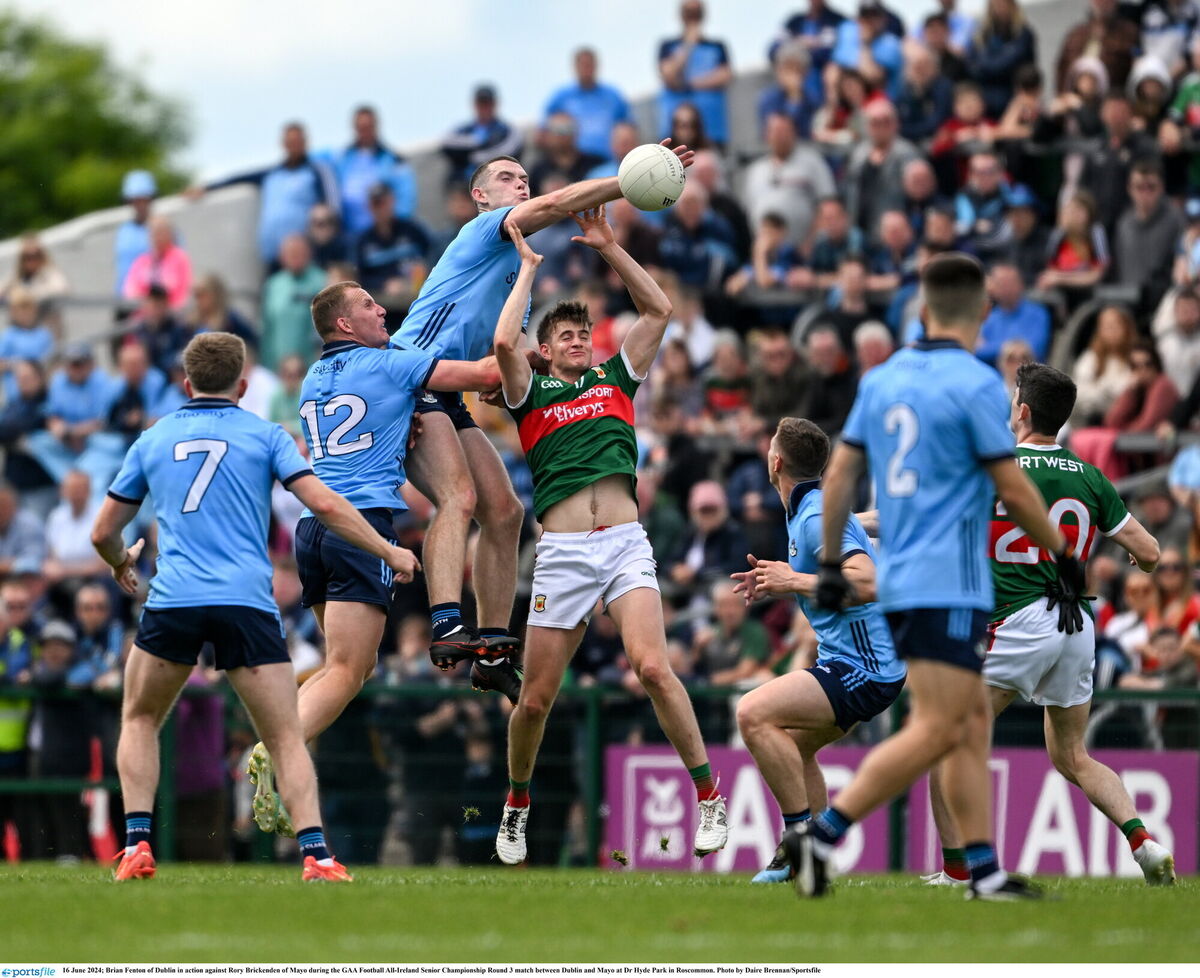
Of McHugh’s 14 possessions, eight were in the opposition’s half. The man-on-man nature of the contest saw Mayo dictate Fenton’s positioning. For the first time since the Round 3 win over Sligo a year previous, Fenton did not score in a championship start.
That season demonstrated why Fenton has to be stopped. In the All-Ireland final, Kerry gravitated away from their usual tactic of tracking him. The midfielder had 29 possessions, nine-line breaks and no turnovers or wides. He scored two points and had one assist.
It was a superb job by McHugh, albeit not a flawless one according to his manager.
“Donnacha is in Round 2, 3 maybe of his career,” Kevin McStay told Off The Ball’s Tommy Rooney post-match.
“He is going in a great direction. He gave us everything he has today to try and quell Brian Fenton’s influence. To a large extent he got the job done. Not perfectly. He had his moments and Fenton had his moments.”
Glenn Ryan became the third manager to step down after his side’s 2024 campaign came to an end. The Kildare boss announced the news after they were beaten by Laois 0-12 to 2-11.
Paul Kelly departed Tipperary last week while Niall Carew has already brought his five years with Carlow to an end. Elsewhere, managers have admitted they face tough conversations with county boards. In the aftermath of Longford's loss to Waterford, Paddy Christie stressed there will be no rash decisions before that conversation. Wicklow’s Oisin McConville said he would like to stay for a third year after they were beaten by Down.
“At the end of the day, I am very realistic,” he told the Wicklow People. “It might not be professional or all that, but it is a results game. If I was looking at my record this year from afar, I would say results are not good enough.
“You expect to be challenged over that and I expect to be challenged over that. My preference would be to stay but I understand if there is another direction that Wicklow want to go and believe me, I am very realistic about that.”
The end of the Sam Maguire Group stages is as good a time as any as to take stock of the season so far. The All-Stars will be heavily influenced by the knockout stages but that is not a reason to discard the performances so far.
Leading the way: Niall Morgan (Tyrone); Tom O’Sullivan (Kerry), Daniel O’Mahony (Cork), Johnny McGrath (Galway); Peadar Mogan (Donegal), Ryan McHugh (Donegal), Dylan McHugh (Galway); Rian O’Neill (Armagh), Michael Langan (Donegal); Conor Turbitt (Armagh), Sean O’Shea (Kerry), Conor Grimes (Louth); Ryan O’Donoghue (Mayo), Oisin Gallen (Donegal), Con O’Callaghan (Dublin).
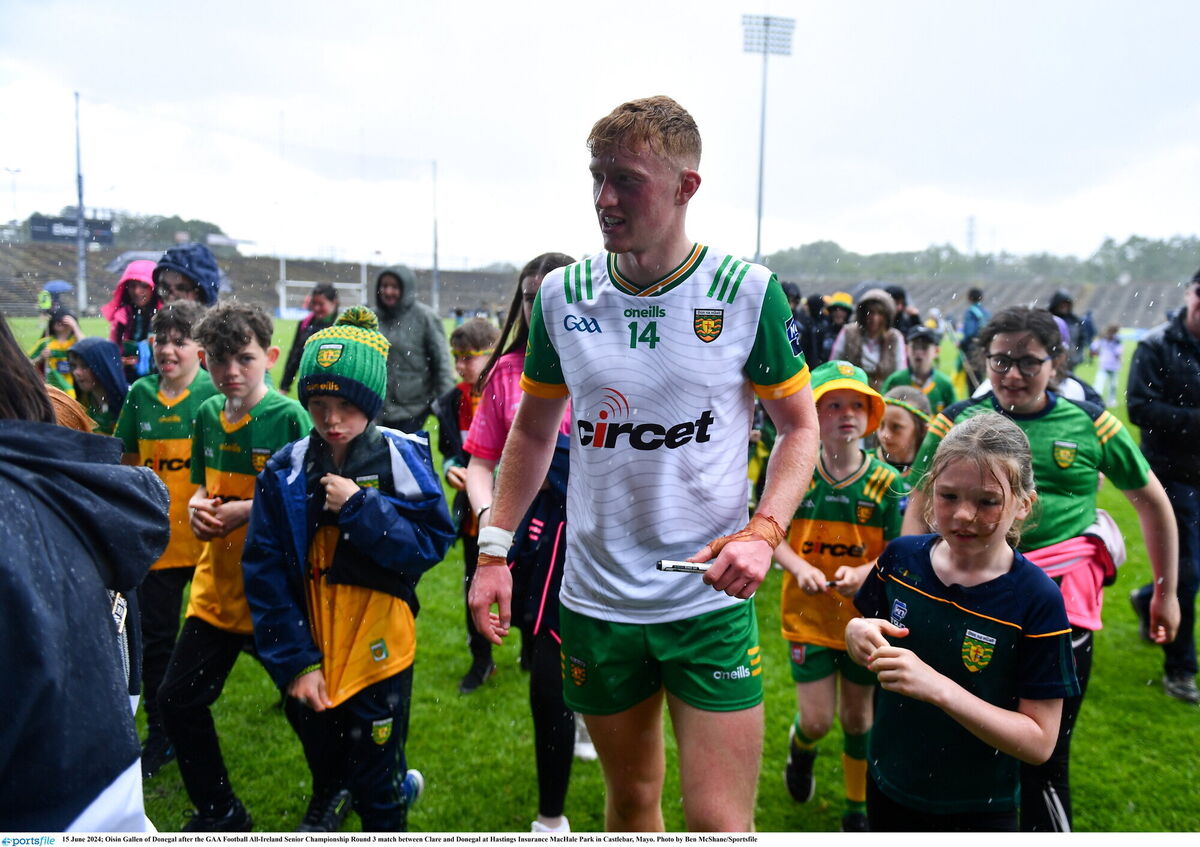
Rory Beggan’s Man of the Match showing against Cavan combined with some huge saves against Louth’s Sam Mulroy and Kerry’s Paudie Clifford has him in the mix. Armagh’s Blaine Hughes has been a rock all year long. Defensively, Brendan McCole, John Small and Donnacha McHugh have all produced massive man-marking displays. Craig Lennon’s rampaging runs forward have yielded four goals and he should have had a fifth but for a poor wide last Sunday.
Competition in midfield is fierce with Brian Fenton, Colm O’Callaghan, Jason McGee, Paul Conroy and Jack Carney all in the running. The same is true for the forward line. Ciaran Kilkenny, Darragh Canavan, the Cliffords and Robert Finnerty miss out.
The bandwagon rolls on. Donegal’s shock defeat to Cork did little to dent their confidence as they crushed Clare in front of significant travelling support in Castlebar. The Ulster champions now have a two-week break before their first All-Ireland quarter-final since their Super 8s appearance of 2019.
Jim McGuinness was beaming post-match. Tyrone had done them a massive favour by beating Cork. Conor O’Donnell played his first game in a year. He kicked 0-2 and took part in the sprint session afterwards. As he made his way back into the dressing room, McGuinness made his way over and cradled each cheek. Hugh McFadden and Stephen McMenamin also played their first game of the championship.
Then the manager made his way over for media duties. He is typically comfortable in this space. And controlled. At the Ulster provincial launch, he met questions about style of play with ambiguous answers about how it is “more complex” and “more nuanced.” He was precise on his grievances with the calendar and championship format. It was clear that was what he wanted to talk about.
Donegal bring a sizeable and passionate local contingent to every game. Once again, McGuinness had a message he wanted them and his players to hear.
A week’s break? “That is the most important thing.” Why? “On the physical side of things, we can hopefully put them in a good spot.” Did the previous defeat hurt them at all? “The defeat in Cork took nothing out of us at all. We know ourselves what went wrong in Cork.” Did they changed anything based on that? “Definitely not. No. There was nothing there.” Their strategy endures. Now they will have added energy. It gives everyone reason to believe. So, finally, how big is the two-week break?
“It’s good, yes. That is the third time I’ve answered that question,” he said with a laugh. The value of it had long hit home by then.co
Antrim emerged first from the dressing room at half-time in Brewster Park with Fermanagh leading 0-8 to 0-2. The second half continued in that one-sided fashion with Fermanagh hitting two wides with their first two attacks before Ronan McCaffrey made the margin seven.
Andy McEntee responded by making three changes at once. Peter Healy, Conor Hand and Eoin Hynds were all introduced together. Seconds after coming on, Healy collected possession outside the 45, soloed twice with the right before curling over a left-footed point. Those three subs scored six points between them. Antrim outscored Fermanagh 1-9 to 0-2 after those changes.
Some of the post-match celebrations were silly and led to a post-match fracas but it is easy to see why it was such a sweet one for the Saffron.
Last weekend Aidan O’Shea made history as he moved one appearance clear of Seán Cavanagh, to become the record holder of the most outfield championship appearances. Per Edwin McGreal, the 33-year-old has only missed one championship game since his debut in 2009. That was the 2012 Connacht SFC semi-final against Leitrim.
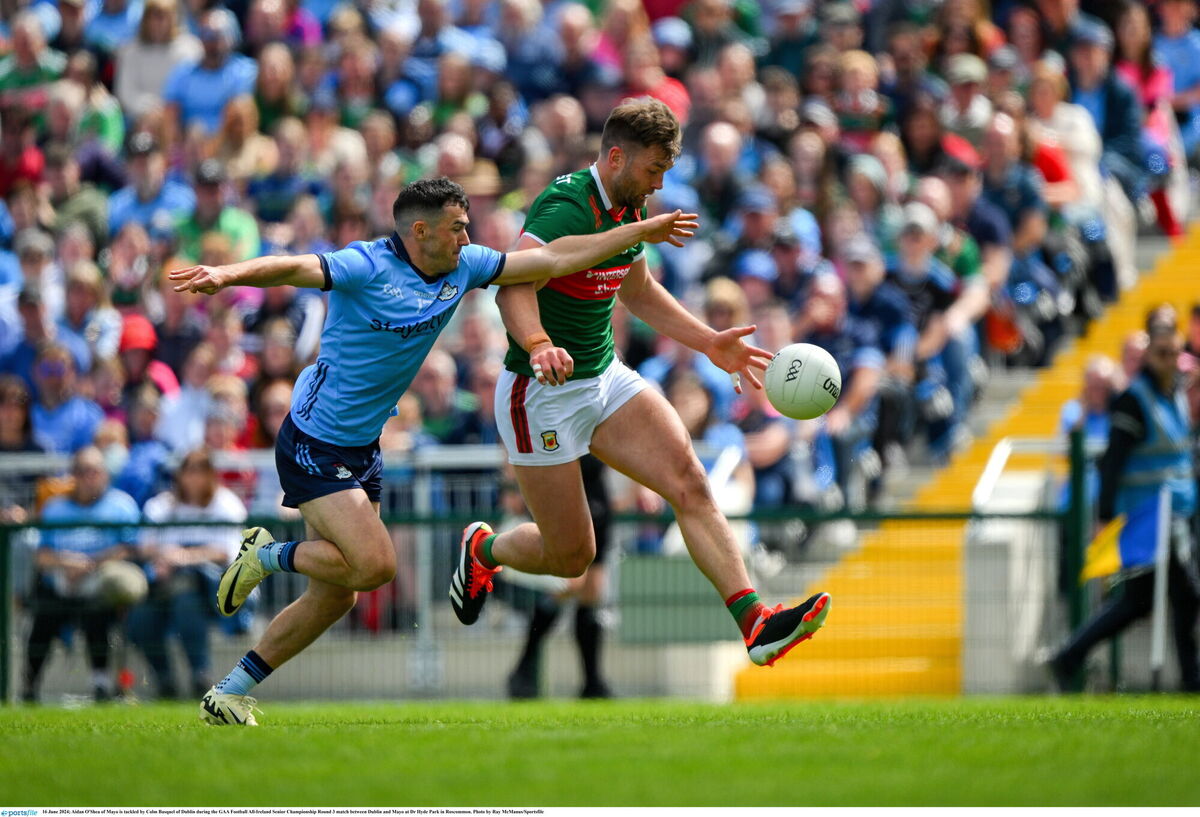
Colm Basquel peaking at the right time
In the aftermath of the Leinster final, Dublin headed for Portugal in what was an unprecedented move of planning a training camp during the championship. Evidently, it was a move into a high gear for all concerned.
2023 All-Star Colm Basquel’s form hadn’t hit the heights of last season before. He bagged 1-3 in a one-sided Leinster semi-final and scored a point in the decider but was the first taken off early in the second half. Dessie Farrell did not start him for the opening Sam Maguire series match against Roscommon.
With 20 minutes left that day, a terrific Roscommon showing had them within one. Jack McCaffrey, Sean Bugler and Basquel all came on. Brian Fenton found Basquel with a handpass and the Ballyboden St Enda’s man rode a heavy tackle before slotting into the bottom corner with his right foot.
He came on against Cavan and scored 0-3, one with his right. On Sunday he scored two points and assisted another. It is 1-5 in three games without a wide. In the 2024 championship, he has now scored 2-10 from play.
A point scored and the converted free after he was fouled only scratch the surface of Dylan McHugh’s sensational performance against Armagh. Few players have a better appreciation of space and positioning. The Corofin captain is moulded in the principles of his club. His ability to consistently handpass in stride, to cut in attack, to set screens and to break the press is integral to Galway’s attack. Finnerty and McHugh are the only two players with double-digit assists for Galway. Paul Conroy is closest with nine.
Midway through the first half in Markievicz Park, Armagh’s sideline were audibly encouraging a full-court squeeze. McHugh spotted the danger and dropped back to take the ball off goalkeeper Conor Gleeson. He carried from deep in his own half to the halfway line. That move ended in Cillian McDaid’s curled point.
His capacity to make defensive reads was evident midway through the second half when he intercepted Niall Grimley’s long pass. Shane Walsh dropped a shot short moments later and Armagh attacked again. As Joe McElroy drove down the wing, McHugh stood him up and won a free. From there Galway attacked and Liam Silke scored.
A collection of the latest sports news, reports and analysis from Cork.
CONNECT WITH US TODAY



Be the first to know the latest news and updates