How to compete with the best, top 10 Ulster final points ranked and more Gaelic football observations
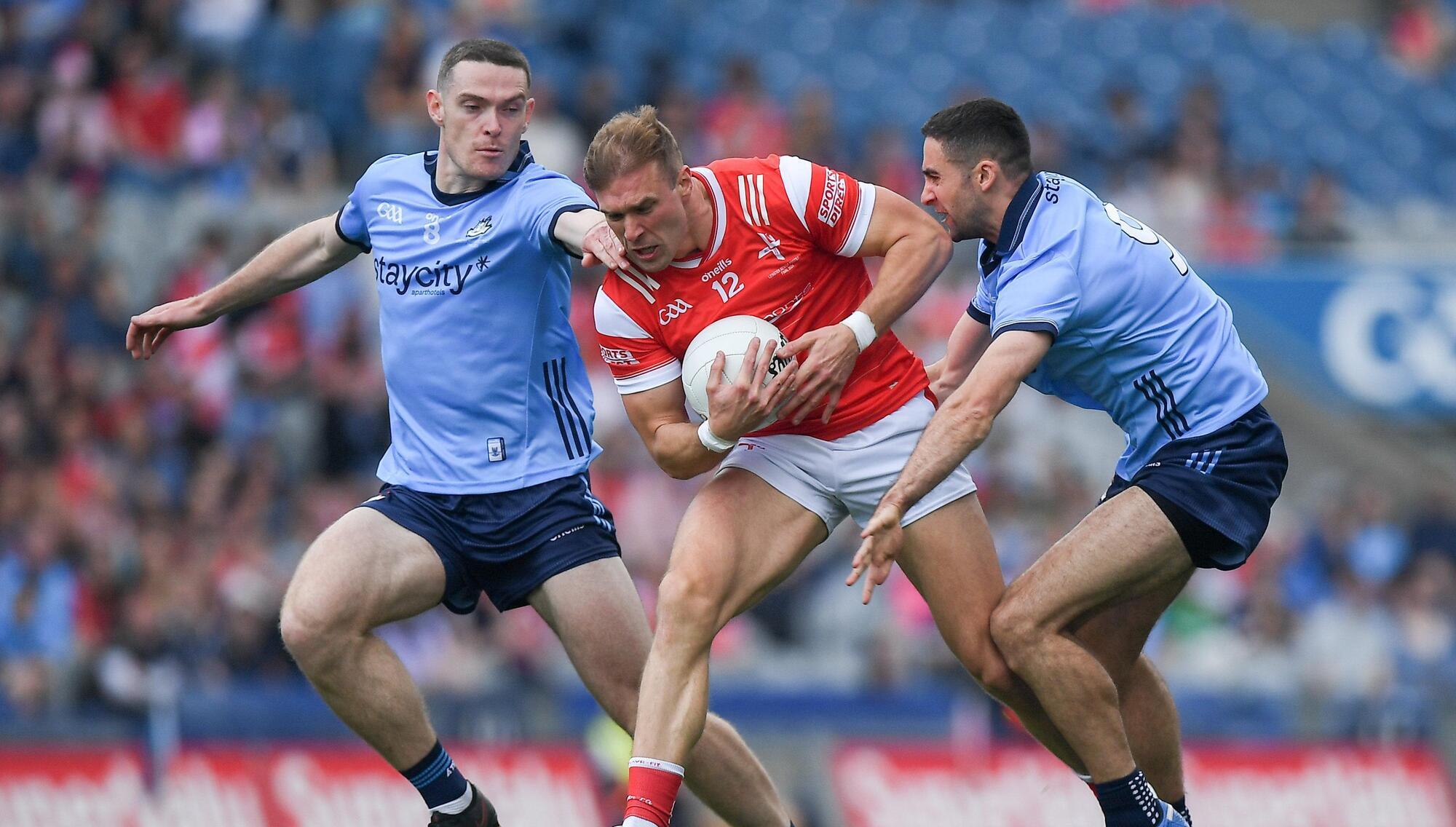
Conor Grimes of Louth is tackled by James McCarthy, right, and Brian Fenton of Dublin. Photo by Shauna Clinton/Sportsfile
Clones on Sunday was a steaming pot that continued to bubble even after the whistle sounded. By the time penalties loomed, some had reached their boiling point.
Just contemplating the logistics of a provincial final in a spot like St Tiernach's Park is mind-melding. Parking is an infamous nightmare. Coverage is patchy at best. It was long signalled that the game would be a sellout. To their credit, Ulster did their damnedest to get the crowd in early with a pre-match band and giveaways. It kept the 28,896 in attendance content, until some weren’t.

It started to really simmer as all eyes turned to the O’Duffy terrace for the shoot-out. In a bid to be prepared for the anticipated eruption, stewards began to erect fencing in front of the tunnel on the pitch. Advertising hoardings for post-match interviews were wheeled out. It meant a cohort in the lower section of the covered stand had their view obstructed. They’d been active participants in an epic up until that critical juncture and weren’t about to miss out on the finale.
It threatened to become messy. There were roars for relief and one particularly infuriated diehard attempted to make his way onto the field. Promptly, everyone came to their senses. The obstacles were removed. The poor Armagh supporter took a step back and had to endure watching his side hit five immaculate spot kicks until one slip saw them fall short of a first Anglo-Celt cup in 16 years.

That was reflective of the atmosphere on the day. It was teeth-grindingly close. And it was inevitable that that tension needed a release. For Donegal, it swept them across the pitch. They stayed for hours. Their manager powered around the ground embracing all who mattered. His mother, county legend Brian McEniff, former players and current ones.
There will be whispers that they overdid it. Galway and the Cork hurlers heard similar after their recent pitch invasions. Such criticism categorically misses the point. Firstly, imagine thinking you need to tell McGuinness, Pádraic Joyce or Pat Ryan that there are bigger prizes on offer? The thought of that is already a daily obsession. It can’t be the only one.
The buzz is what made the match last weekend what it was. Emotional investments need a payoff. Before you dissect or predict in sport, you have to feel it. Attempts to suppress that must be resisted. Continue to pull on that thread and the whole thing unravels.
Here are eight observations from the Gaelic football championship.
As the 2024 intercounty season hurtles along, so too does the work of the new Football Review Committee formed by GAA president Jarlath Burns and led by Jim Gavin.
The grapevine rattles with talk of the extensive process they are currently engaged in with regular meetings. Gavin was spotted at one recent provincial final alongside fellow FRC member Colm Collins. He presumably had his eye on his native county last weekend where the essence of the sport was captured perfectly.
Louth’s performance against Dublin was admirable. They conceded all kickouts, even from set-pieces. They clogged the D and forced shooters into pressurised efforts or low percentage areas. By half-time, Dublin’s conversion was 46% to Louth’s 77%. Crucially, Ger Brennan’s side dictated terms. They did it by controlling the ball.

The underdogs unveiled their plan immediately from the throw-in. Conor Grimes won possession and for the next two minutes, Louth maintained it. Brian Fenton strived to press goalkeeper Niall McDonnell but was unable to force a turnover. Eventually, Ciaran Downey kicked a wide into the Hill 16 end.
Cormac Costello responded with a miss of his own. This time Louth starved Dublin of the ball for two and a half minutes. Grimes won a free, Sam Mulroy nailed it and with six minutes played, Louth led. At half-time, they were one point up having enjoyed 59% of possession.
What does this mean for the sport? Louth honed in on something Roscommon identified last year. The best way to compete with top teams like Dublin is to be safe with the ball. Dublin didn’t deploy a blanket defence but when the steps rules isn’t enforced, when the tackle isn’t robust, when a goalkeeper can come out and become an outlet, it makes it easier than it should be to control possession.
Smart teams know this. They plan for it. In places, a pre-game target will be to keep the number of attacks beneath a certain threshold. That naturally makes a tie close. The safety of possession, once gained, has many effects. If the FRC want to encourage Gaelic football to be a more entertaining and chaotic game, they must tackle that root cause.
The first half of the Ulster final saw a sensational level of shooting. Donegal kicked 0-9 from 11 shots. Their first nine shots all resulted in scores, until Oisin Gallen’s wide just before half-time. Armagh racked up 0-10 from 13 attempts.
That level of productivity was never likely to last. The quality of points, however, did not suffer. Few finals in Gaelic football history have included an array like it. They deserve to be celebrated. Here are our official top 10.
10. Conor Turbitt’s show and go. Collected outside the 45, created the space with a sidestep and sent over a right-footed beauty. Point 11.
9. Rory Grugan’s unconventional hook shot. Struck it first time and looked to have skied it, only to split the posts. Point 4.
8. Oisin Gallen’s front-roll. The last of his five first-half scores. Kicked it first time and was sent tumbling forward as a scrambling defender dived at his feet. Point 18.
7. Niall O’Donnell’s floater. Off the laces from range as an Armagh defender hung from the crossbar. A crucial intervention with Donegal four down at the time. Point 23.

6. Stefan Campbell solo. Collected the ball between the 65 and 45, carried to the top of the D and unleashed with his left. Point 22.
5. Gallen over the black spot. Looped around O’Donnell and with two men in close contact, stroked over a first-time effort. Point 14.
4. Oisin Conaty’s spin move. Drove hard, rolled around a lunging Ciaran Thompson and finished with aplomb. Point 21.
3. Oisin O’Neill bomb. Technically perfect. Head over the ball, arm outstretched, full follow-through from just inside the 45. Gave Armagh the lead for the final time. Point 37.
2. Niall O’Donnell from near the sideline. Left foot solo, right foot boomer with his side four down again. Point 27.
1. Odhran Doherty’s equaliser. Magnificent. Turned down the mark, hit it with his left foot on the wrong side with his laces. Point 40.
After their triumph, Jim McGuinness made his way over for his TV interview and spelt out what it takes.
“It’s everything. It’s every night. It’s standards. It’s how you train. It’s your focus. It’s your energy levels. It’s sacrifice for their families, all that plays a big part. Then you have to come together and say, do I want to do this or not?” What does that do to a player?
Speaking to the Gaelic Life podcast, Niall O’Donnell outlined where their unwavering faith stems from.
“It comes from the work we put in. We feel we do so much work. We do more work than any other team in Ireland. With that comes belief because we leave no stone unturned. I feel every game we go into, we’re 100% prepared. Not 70%, 80% or 90%. There is no grey area.”
Coming down the home straight in the Connacht final, a familiar light started to flicker on Mayo’s dashboard. Once again, they had an issue in the engine room.
For the second successive game, Mayo’s long kickout was woeful. They won 4/7 but scored nothing from it and conceded 0-2 from the two they lost late on. Galway, in comparison, won 11/15 long to score 0-4 and concede nothing.
Their reliables all endured a mixed day. Matthew Ruane was immense going forward in broken play, kicking 0-3. However, three times he was turned over and Galway score from all of them. Jordan Flynn also scored but was taken before the final quarter. Jack Carney dropped too deep, Diarmuid O’Connor came on but is just returning from a hamstring injury.
The best outing of Kevin McStay’s reign so far was against Kerry where they scored 1-6 from 10 long kickouts. They need to rediscover that form.
After an injury-blighted league, finally Joyce’s squad has a healthy complication. Now there are new considerations.
With Derry coming to town this weekend, they must decide if Sean Kelly has to return to fullback to rediscover his form, whether they should start Shane Walsh and what will Derry do with Damien Comer?

In reality, all three are dictated by the same thing that has defined their campaign so far. Kelly’s performance is more reliant on clearing up his ongoing injuries than it is his positioning. It was noticeable that both ankles appeared strapped in Pearse Stadium. Shane Walsh is still managing a tricky issue around a groin tendon. A fully firing Damien Comer will pose a significant challenge to any of Eoin McEvoy, Chrissy McKaigue or Brendan Rogers.
Regardless of the matchup, Mickey Harte will likely look to provide more support than Mayo did to David McBrien. Which brings us back to question number two. If Derry drop a defender in front of the full-forward, who do Galway have that can exploit that?
When Mark Fitzgerald took over Clare, there was much discussion about the 12 experienced players who left the panel. The Kerryman’s success since stems from the fact that he focused on what he did at his disposal.
In the Munster final, midfielder Darragh Bohannon was up against a fresh partnership and Clare looked to profit from that, targeting him repeatedly as their long option. In total he won three kickouts.
In the 2023 final Clare relied on Eoin Cleary to do the bulk of their shooting. In his absence, they racked up 1-13 with 73% conversion by flooding the danger zone and encouraging any free man to shoot. Aaron Griffin scored 0-2 from two shots. Dermot Coughlan scored 0-1 and had a goal chance well saved just before half-time. They were the only two players to take more than one shot from play. Coughlan’s deployment at centre forward messed with Kerry’s structure, as their fastest defender Gavin White moved to six in a bid to stifle him.

Ikem Ugwueru man-marked Paudie Clifford. The Kingdom skipper scored 0-2 but Ugwueru still notched a goal at the other end. Clare were competitive by crafting a gameplan to suit their strengths.
Tony McEntee’s Sligo endured a frustrating start to 2024 when they were defeated by Clare having only scored 1-5, 1-3 from play.
Since then, they’ve kicked on impressively. For a side that was once perceived to be too reliant on key forwards, a noticeable feature is how well they have spread it. They finished out the league with a 1-14 to 0-11 victory over Westmeath. On Sunday they hit 2-21 with 11 different scorers. They had nine different scorers against Galway in the Connacht championship and eight versus Leitrim.
In this current era, every top team sees the value in sports psychology. That doesn’t mean old-fashioned spite-infused motive doesn’t still have its place.
Following in the footsteps of Galway manager Padraic Joyce, who took issue with the focus on his record against Mayo before the Connacht final, London’s Michael Maher pointed to the fuel that fired them to a 2-20 to 0-13 win over Offaly. It was their first championship win in 11 years.
“We read some very unfair press. The key one was written by a local paper which said we won't really know how good Offaly are until the group stages are complete because London won't really tell us,” Maher told the Irish Independent.
“And that was enough to motivate the lads to say we are going to go out and put on our very best display.”