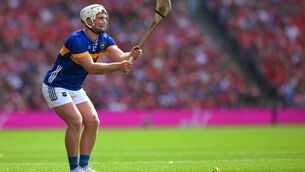
Cork CEO Kevin O'Donovan: Gaelic football must become more vibrant, unpredictable and creative
In a section of his report to annual Convention, titled 'The state of our games' O'Donovan says 'we must switch our approach from tinkering around the edges and instead introduce clear, simple, yet dramatic rule changes'
Cork CEO Kevin O'Donovan: Gaelic football must become more vibrant, unpredictable and creative

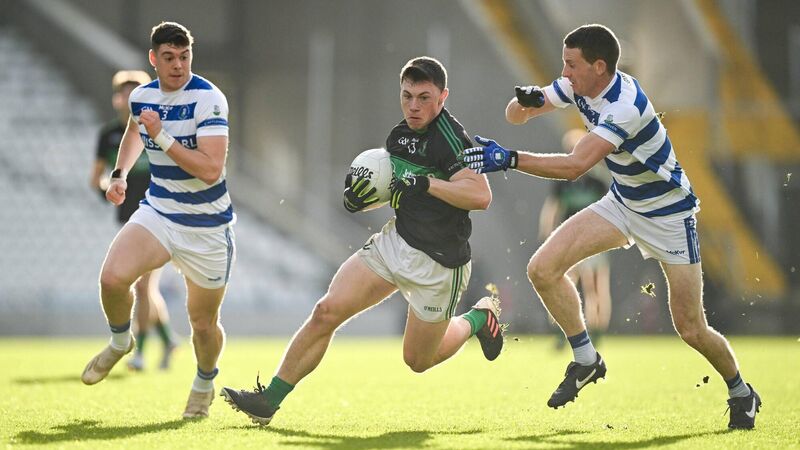
PRESSURE: Cork's county football final between Castlehaven and Nemo Rangers was, at various stages, an 11 v 11 stalemate

IN ADVANCE of any commentary on the current state of both football and hurling it must be first acknowledged that the Senior All-Ireland champions in both codes, namely Limerick and Dublin stood head and shoulders above all others and rightfully gained their crowns. Any analysis of how our games are now played must be separated from their success, as all teams enter the various competitions under the same terms.

That said, one cannot allow the opportunity to pass without making some comment on the current state of Gaelic football. Constant analysis and review by the respective coaching units has led to ‘death by percentages’ during games. Possession is king, conservatism is rife. Yet to expect any coaching team to just send their team out to play naively is simply counter-intuitive in a must-win environment. Therefore, the focus must be placed upon current playing rules rather than appealing to the ethos of the same coaches from whom we ultimately demand success.


However, it is encouraging to now see an overwhelming desire for change. Individual contests must be nurtured within our games and that teams must be either rewarded for keeping players in advanced positions or punished for maintaining overtly defensive positioning. We must switch our approach from tinkering around the edges and instead introduce clear, simple, yet dramatic rule changes.

Any of the possible approaches suggested for consideration below are clearly long-since in the public domain and simply require some courage for them to be introduced on an experimental basis. How they would be introduced is also worth considering, however. It may be a step too far to trial such rule changes in Third Level competitions given the importance of the respective grades and the ground-breaking rule changes required. A period of experimentation in laboratory-like conditions would be required whereby the committee involved would engage with coaching and games development expertise to play out the respective scenarios in a non-competitive environment, before then trialling in a competitive one.

Perhaps the most obvious and simple rule change relates to the role of the goalkeeper. It might be claimed that to limit the functions of any player is a regressive step, (but) the emergence of the goalkeeper as an extra outfield player combined with the continuous improvement in ball-keeping skills by teams has removed the contest from so much of our games. Preventing the back pass to the goalkeeper is certainly worth considering.

In addition, the bland, uncontested short kickout does absolutely nothing for our games. Yes, there is merit in enforcing kickouts past the 45m line, but we would caution against any such rule without an accompanying requirement being placed on the positioning of players. In order to avoid the obvious outcome of overcrowding underneath the dropping ball under such circumstances, it is essential that the fifteen players take up assigned positions to allow the ball to land in a non-congested area, thus ensuring the contest between high fielders which remains a glorious part of our game.

Any rule changes which place an onus on the attacking team or team in possession bring a high degree of risk if not accompanied by a requirement on the defending team in terms of positioning. We would support any change that would encourage teams to kick the ball forward at the earliest opportunity, but must at all times be mindful of counter-productive possibilities in terms of the opposing teams simply sitting back and welcoming the return of possession from a stray kick.

In terms of required positioning, having fifteen players in their regular 1-15 positions for kickouts would be a start and easy to implement. For example, requiring the six forwards and backs and the respective sides to maintain three-on-three inside the 20m line and a further three-on-three inside the ’45 could be considered. At least this would challenge the fitness levels of the corner forward who wished to plant himself on his own defensive D for the majority of a game.

Such a rule change should be experimented with but may require further elements given how defensive teams have set up over the last few seasons. Most other invasion field sports have some form of offside rule. It appears that the time has now come for Gaelic football to go down the same road with its own distinct version. The calls for a requirement that teams keep three to four players inside the opposition 45m are worth listening to and should be trialled.

Of course, such experimentation would need to be combined with a consultation with referees to avoid the game being dragged into constant decisions about someone’s foot being on the wrong side of a line. Only experimentation could confirm its true value. One was worried by this year’s (Cork) Senior Football final when both teams regularly had three-on-three inside the ‘45 and yet the collective defensive abilities from their respective teams, combined with modern-day fitness levels meant that an eleven-on-eleven stalemate still ensued inside the other ‘45.

Cork GAA CEO Kevin O'Donovan.

Therefore, a huge task now faces the Association in devising a simple yet dramatic set of rule changes to encourage attacking and creativity with a clear reward for teams that wish to ‘speculate to accumulate’.

That said, it is hardly an unachievable task, given the overwhelming consensus that we need to increase the number of individual contests as well as the ratio of kicking to hand passing. Limiting the number of outfield players to fourteen by excluding the goalkeeper, ensuring that the kickout goes long to an uncongested area in the centre of the field and restricting the movement of players to limit congestion in the final third would go a long way.

Given the decreasing attention span of all viewers, combined with the increased competition for hearts and minds in terms of sporting options, we simply now have no choice but to support the evolution of Gaelic football into a more vibrant, unpredictable and creative version.

***

WHILE IT is common practise nowadays for Gaelic football to be criticised at every opportunity, there appears to be a fear factor around any reasonable analysis of the game of hurling. Given its status as an unparalleled sporting spectacle when played at the highest level, any question around its modern-day characteristics is usually met by accusations of old-fashioned, closeted thinking. “Keep your hands off hurling”, they proclaim. And yet any clear analysis would surely indicate that hurling is embracing many of the traits which has led to the decline of Gaelic football as a spectacle.

The obsession with possession and the short passing game has led to many boring encounters in recent seasons. This combined with the ease of scoring from distance have drained the game of so many of its qualities, reducing man-on-combat in the final third. The novelty of the long-range point has long since passed. This tactic is again governed by the percentage-play. Shoot enough times and it will provide a better return than playing a long pass to a sealed-off forward unit.

Stopping the obvious and constant throwing of the sliotar would be a start here, as would penalising of players who take the ball into contact in pursuit of a free, having had prior opportunity to play it. Then, we might consider tackling the sweeper, limiting the scoring zone and reactivating the battle of the square.

Ultimately, it is rather sad that while our players in both codes are more skilled than ever, the modern ‘per centage game’ seeks to limit the skills on display. Retain and recycle rather than risk. Sit back rather than attack. Therefore, the terms and conditions simply must change. The playing rules must evolve.

*This is an excerpt from the report of CEO and former coaching officer, Kevin O'Donovan, to Cork GAA's annual convention next week.

More in this section

Cookie Policy Privacy Policy Brand Safety FAQ Help Contact Us Terms and Conditions

© Examiner Echo Group Limited