Quick puckouts, possessions and tackles: Limerick pay attention to every detail

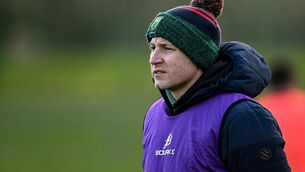
IN FOCUS: Limerick's Cathal O'Neill with a fan after the Munster final. Picture: INPHO/Evan Treacy
The new rules of engagement. Since joining the Limerick panel, Cathal O’Neill has watched the chasing pack closing in. In Limerick’s last 12 championship outings, 10 have been one-score games.
“It just shows how competitive it is,” he says with a nod.
“How hard it is to win. The fine margins, a grain of rice will tip the scales. That saying is used a lot. Preparation feeds into that. Luck feeds into it, there is no point saying otherwise. Luck does feed into it. Decisions by referees. Everyone is harping on about it.
“Trying to be as composed as you can down the stretch. Thankfully we have been on the right side of those games over the last year but when it comes down the stretch, it can go either way.”
For a time, O’Neill was the boy wonder they all knew was coming. When Limerick beat Cork in the 2013 Munster final at the Gaelic Grounds, he was sat in the open stand with his father. Nickie Quaid, Declan Hannon and Graeme Mulcahy played that day.
In the minor curtain-raiser, Limerick bridged a 29-year gap. That side included the likes of Darragh O’Donovan, Cian Lynch, Richie English, Sean Finn and Tom Morrissey. O’Neill was 11 and would soon fulfil a childhood dream to play alongside them. He came on and scored two points in last month’s provincial decider at the same venue.
O’Neill was included in championship matchday panels in 2021 and made his championship debut in 2022. The Crecora-Manister club man was still an U20 and therefore unable to play in that grade for the rest of the year. They went on to reach the All-Ireland decider, falling short against Kilkenny.
A frustration then and still frustrating now. In a game where the margins are so fine, all margins are accounted for. Strength and conditioning coach Cairbre Ó Cairealláin monitors each element. O’Neill even wore a GPS during Fitzgibbon games. “Your distance is tracked, how many high-speed runs is tracked,” he explains. Everything is factored in.
Because every little thing matters. They pay attention to every trend, every slight change. Before the Munster final, John Kiely specifically mentioned one specific area of the game and how significant it can be.
“The nature of the quick puckout after a wide ball now has changed the dynamic of the game,” he told RTÉ.
“The puckouts after a wide are very fast. You can’t be set up; you just have to do your best. It is obviously creating opportunities for scoring chances and giving the game no structure, which is no harm maybe at times. It is having a big impact.” Kiely was proved correct in the final play. For O’Neill, as long as the ruling is consistent, there is no issue.
“If you are not getting a chance to get out it is very hard. After a score, you know yourself, all your forwards could be one side of the pitch. A quick puckout to the halfback, he has a free shot and it makes a massive impact. I think if a referee is consistent with it all game, I don’t see how there is a problem but inconsistency I suppose is where the frustration creeps in.”
This Limerick team pay attention to the numbers. Performance analyst Sean O’Donnell is influential in the dressing room and the players study key metrics.
“It is a big thing in the modern game. Everyone has a statistician. Everyone has a performance coach or whatever you want to call it. You try to get as much out of them to better yourself as a player.
“Possessions I suppose. How you impact the game and how many times you get your hands on the ball. Tackles. Shots as a forward.” From that data they draw strength. This has always been the way. After their breakthrough All-Ireland title in 2018, footage from the dressing room captured their celebrations. In the background plastered on the dressing room wall was their tackle targets.
Thanks to this data they are not just a side who feel they are improving; they have definitive proof of it.
“It is not just someone saying to you we are getting better,” O’Neill says. “You can see the curve going upwards, see the graph. It gives authentic confidence that we are getting better. We are getting fitter. We are getting stronger. More clinical, our passing is getting better. Stuff like that. It is a compliment.”

CONNECT WITH US TODAY



Be the first to know the latest news and updates