Christy O'Connor: Stephen Cluxton a codebreaker among long-serving greats
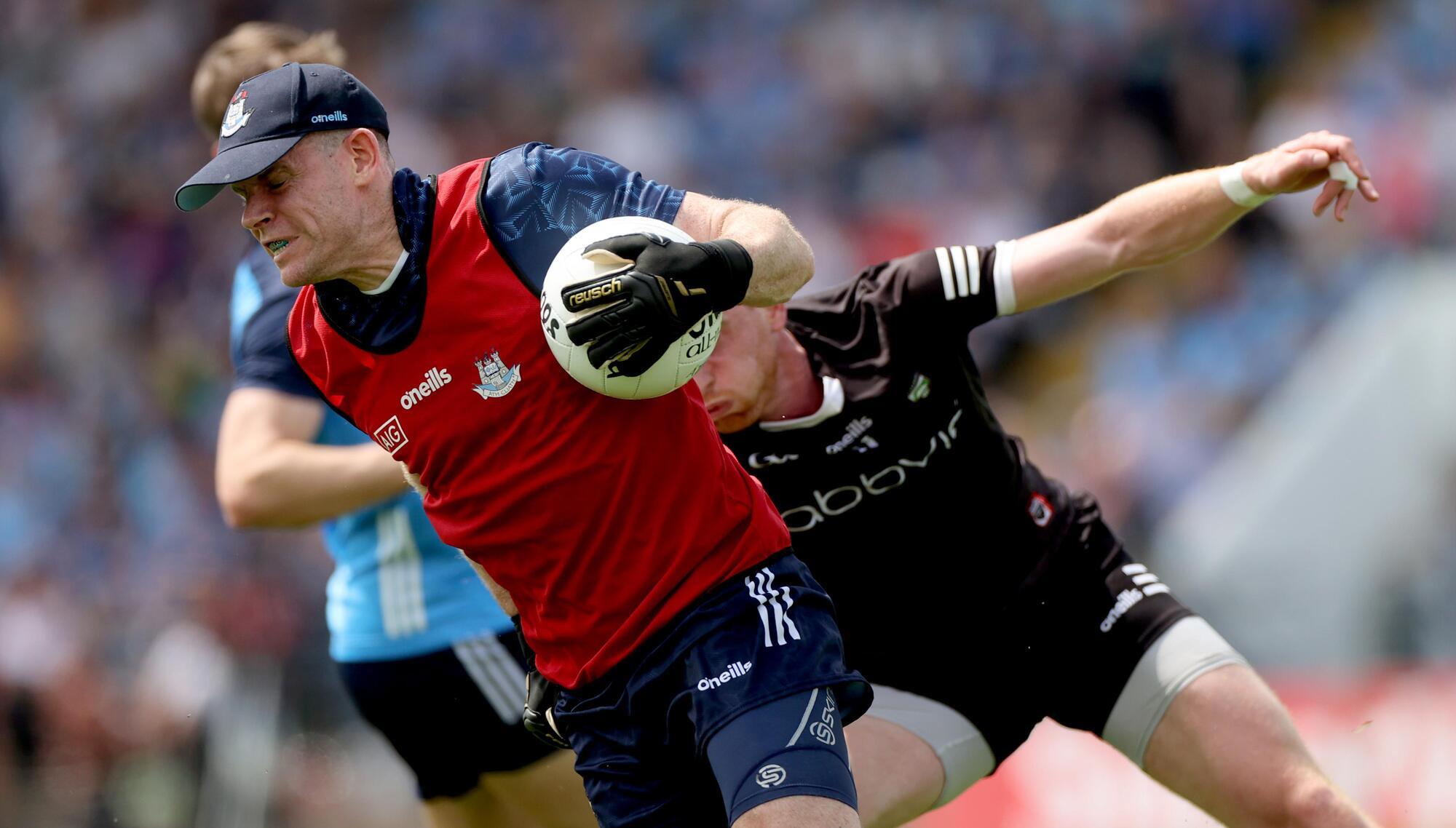
STILL GOING STRONG: Dublin’s goalkeeper Stephen Cluxton and Sean Carrabine of Sligo. Pic: INPHO/James Crombie
On February 26, Japanese football legend Miura Kazuyoshi turned 56. In April, he made his debut for the Portuguese second-tier club Oliveirense, coming on in the 90th minute of a 4-1 win at Académico Viseu. Now in his 38th season as a professional, Portugal is the sixth country in which Miura has played during a career that began in Brazil, with Santos, in 1986, before going on to play for a string of clubs across the world.
It's undeniable that Miura’s loan deal to Oliveirense has been aided by the fact that the team’s Japanese owners also own the J.League club, Yokohama FC, with whom he is contracted. But he’s so used to breaking records now that Miura is intent on seeing how many more he can break.
In March 2017, Miura became the oldest player to score a goal in a professional competitive match, at 50 and 14 days old, beating Stanley Matthews’ 52-year-long record.
Miura, who represented Japan’s national team 89 times, scoring 55 goals, is a freak of nature but he isn’t completely unique either; Ezzeldin Bahader from Egypt currently holds the Guinness World Record for the oldest professional football player at the age of 74, after playing in a third division match in October 2020.
Bahader broke Israeli goalkeeper Isaak Hayik’s record, who had become the oldest professional player in April 2019 at the age of 73. Goalkeepers definitely do have an advantage when it comes to longevity. In 2014, Faryd Mondragón became the oldest professional soccer player to appear in a FIFA World Cup match at the age of 43. Yet his record only lasted four years before being broken by Egyptian goalkeeper Essam El-Hadary, who played in the 2018 World Cup at 45.
It was a completely different stage but Darren Mulhearne made his championship debut with the Waterford footballers in 2019 at 46, some 29 years after first being called up to the senior squad as a 17-year-old. Mulhearne is surely the oldest player to ever make his debut, but he is not the oldest player ever to play inter-county. Leitrim hurling 'keeper Tommy McLoughlin played until he was 47 back in 2012. Former Cavan goalkeeper Enda Sheridan was 52 when he lined out with the county’s hurlers in 1999.
Stephen Cluxton though, is surely the oldest elite player to ever play in the All-Ireland series. Cluxton, who will be 42 in December, looked to have retired (without ever officially announcing it) until he sensationally returned to the Dublin set-up during the league.
It was reminiscent in some ways of how hard Tom Brady found it to walk away before eventually retiring for good earlier this year at 45. Brady had retired the previous year before famously unretiring himself after 40 days.
Brady, the most successful player in American football history with seven Superbowl titles, was the oldest quarterback to appear in an NFL game but he wasn’t the oldest player to appear on that stage. George Blanda was 48 but he was a kicker late in his career.
Male athletes typically peak physically in their mid-to-late 20s, and then incrementally lose V02 max capacity for the rest of their lives. But Cluxton, like Brady, isn’t a sprinter. He doesn’t need to break records in the gym. Rigorous, smart conditioning can prevent a significant drop-off in performance. And, similar to Brady, his decision-making, experience and insatiable hunger for success and excellence are the key to Cluxton’s longevity.
It’s pointless trying to compare professional multi-million-dollar sportspeople with amateur inter-county GAA players, but there is a tendency within the GAA to categorise players once they pass a certain age threshold.
Kieran Donaghy was 34 in 2017 when he committed to Kerry for another year in 2018. “I still feel I can do a job for Kerry and I still enjoy it, so why would I retire?” asked Donaghy. “Because society thinks I should retire? Because when you get over 30 in the GAA they all think you should retire.”
Patrick Horgan admitted as much to Maurice Brosnan in these pages recently. “It happens in other sports but in hurling and the GAA, it is a million times worse,” said Horgan. “As soon as you are 30, ‘Oh he has lost a yard. He has to go. Move on.’ When you think about it, it is ridiculous. There is no reason I can’t progress at this age.”
Some of the GAA’s greatest servants have all walked off the inter-county stage in the last few years in their late 30s; Ryan McCluskey (Fermanagh), Dermot Brady (Longford), Michael ‘Brick’ Walsh (Waterford), Brendan Murtagh (Westmeath), Mark Breheny (Sligo), Ross Munnelly (Laois).
Munnelly was 40 when he departed in December. For players who are no longer able to play at the elite level, there has always been the Masters (over 40s) competition. A couple of years ago, Stephen O’Neill became the first inter-county footballer to win All-Ireland titles at minor, U-21, senior and Masters. O’Neill was joined on the squad by three-time All-Ireland senior winners Ryan McMenamin, Conor Gormley and Ciaran Gourley.
The Masters has always been a brilliant outlet for players who want to keep playing and, while Cluxton walked away for a couple of years, his return shows he is only interested in playing at the highest level for as long as he can.
Cluxton sees no reason why he should stop now.
In their long and storied history, the one statistic Kerry have long had to make their peace with is their record against Down. When Kerry lost to Down by eight points in the 1960 All-Ireland final – the biggest defeat they had ever suffered in an All-Ireland decider – Kerry based their excuses on complacency. Yet when the sides met in the All-Ireland semi-final a year later, Down won again, this time by six points. Kerry returned to win the 1962 All-Ireland but when they ran into Down again in the 1968 final, they failed to beat them at the third attempt.
Two more championship meetings saw two more Down victories – the 1991 All-Ireland semi-final and the 2010 All-Ireland quarter-final. It pained Kerry that they couldn’t right those wrongs but those Down sides of the 1960s always carried a mythical status, while the Kerry sides which lost in 1991 and 2010 had no baggage with Down other than the tales they’d heard from their forefathers and their history books.
Tyrone, though, is another matter for every generation of Kerry player, not just because the three championship defeats in the 2000s were so seismic, but because of how much of an effect those defeats had on the psychology and culture of Kerry football.
Those Down matches in the 1960s were hugely significant in terms of how the game changed, and how it forced Kerry to take a hard look at themselves. Down not only played the catch and kick game as well as Kerry but they also adopted Dublin’s fluidity (from the mid-1950s) in attack and broke Kerry’s zonal defence.
Tyrone’s approach forced Kerry into another radical culture shift but, unlike Down, Tyrone have always been close after one traumatic decade of defeat. Unlike the Down history, Kerry also tended to those Tyrone scars, where three successive victories in 2012, 2015 and 2019 helped those wounds to heal.
Those wins also pushed Kerry out in front again in terms of numbers before Tyrone squared up the rivalry in 2021 with four victories each. Another Tyrone win now would grant Tyrone ascendancy in the historical rivalry again.
Kerry may have to grin and bear those numbers with Down and, while they had to do something similar with Tyrone in the 2000s, they certainly don’t want Tyrone to have that edge over them again now.
In his brilliant columns and in his razor-sharp TV co-commentary, nobody has observed and outlined Derry’s evolution over the past year better than Éamonn Fitzmaurice. Noting how they are the first defensive team that also attack with 15 men, Fitzmaurice’s insight has also painted a vivid picture of how Derry now attack, and how they react to whatever way the opposition sets up against them.
Against Clare in last year’s All-Ireland quarter-final, Derry pushed four and sometimes five players inside the opposition’s 13-metre line, which meant those players had to be marked. Yet the space was created outside to allow players like Shane McGuigan to come on the loop and shoot.
When teams began to move more men behind the ball, Fitzmaurice noted how Derry now push on to create a type of conditioned 14v14 game inside their 45-metre line, with goalkeeper Odhran Lynch available as an outlet outside. That denies the opposition the chance to set up as a sweeper, while Derry are excellent at opening up space around the D to get off shots from smart running angles or coming on the loop.
That will set a different challenge for Cork’s defensive set-up under Kevin Walsh, but Cork have really developed their tackling under Walsh. Since the Kerry game, Cork are also tackling far more aggressively and effectively too.
Cork’s running game could cause Derry problems, especially if they move the ball at the same pace as they did against Roscommon, especially on the counter-attack off turnovers. Clare and Donegal scored a combined 2-10 off turnovers, while Derry conceded 16 scoreable frees in those two games. If Derry do foul and Steven Sherlock is accurate from placed balls, Cork will give themselves a strong foundation from which to build.
Cork have travelled a huge distance since last year’s All-Ireland quarter-final defeat to Dublin. But how they deal with Derry’s style now will tell just how far Cork have really come.


CONNECT WITH US TODAY



Be the first to know the latest news and updates