Christy O'Connor: Rebels start as they mean to go on for once
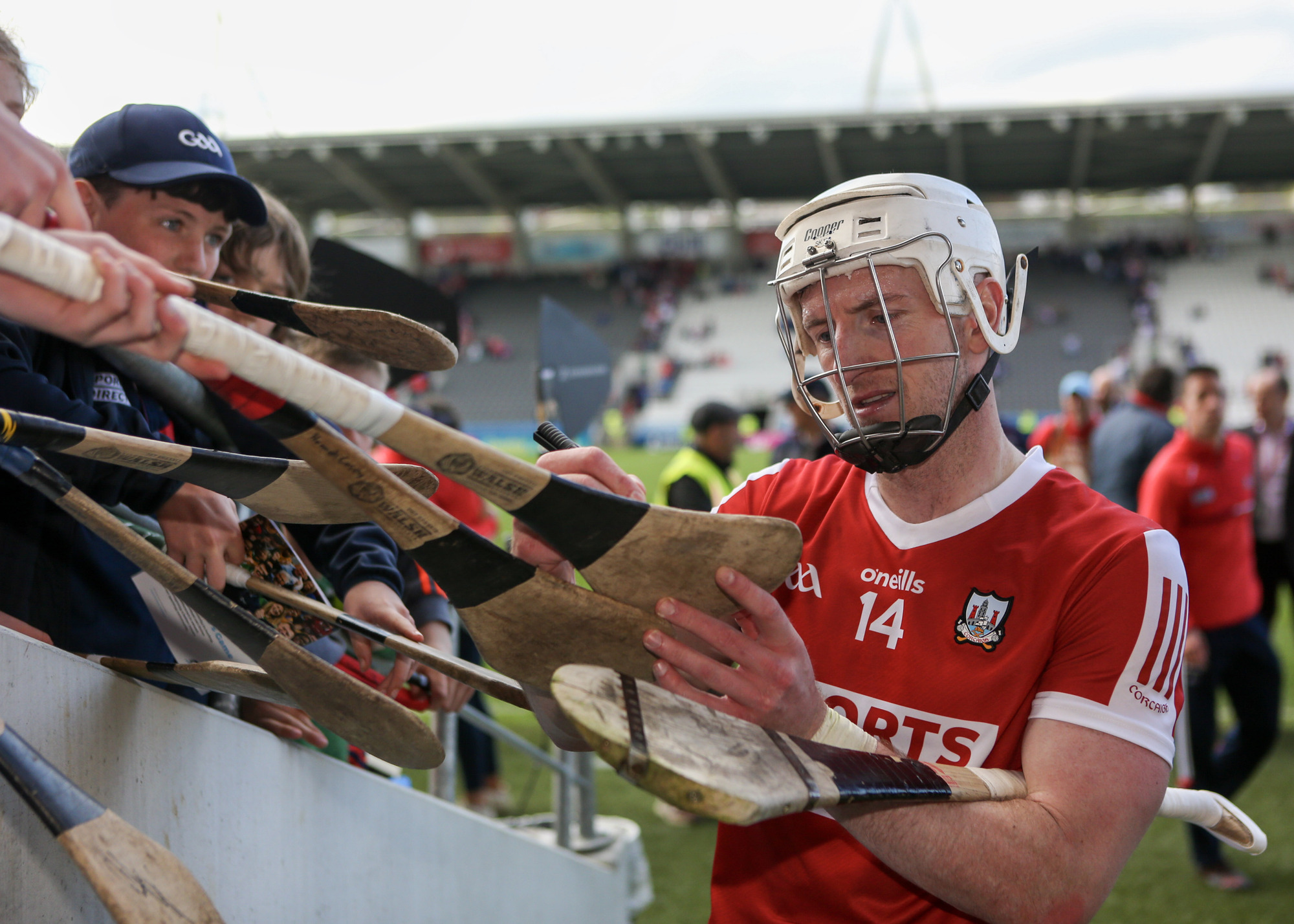
BAS MAN: Cork's Patrick Horgan signs autographs for fans at the end of the game. Picture: INPHO/Ken Sutton
The Cork hurlers may have started and finished the 1990s winning All-Irelands but when they were in the doldrums for most of that decade, the main thrust of their frustration stemmed from having to sit idle throughout the summer.
In six seasons between 1993 and 1998, Cork played only eight championship games, winning just two, against Kerry in 1995 and Limerick in 1998. That Kerry win in ’95 meant that Cork didn’t lose their opening championship game for four successive seasons, but that provided zero solace during such a dark period.
That was a different time when a championship defeat meant the end of the season. Cork lost their first two games of last year’s championship and still made it as far as the All-Ireland quarter-final. They could – and should – have won that match but there was still always a sense of Cork trying to make up lost ground after losing so much of it early in the 2022 campaign.
When Cork were well beaten by Limerick in the opening round last April, it was the first time in Cork’s history that they lost their first championship match in four successive seasons. At least Cork had the second chance that wasn’t available in the past. They did win some big matches but, in three of those four years, Cork never really made up that lost ground after that opening day loss.
A fifth opening day defeat in succession was unthinkable and Cork finally won that opening championship fixture for the first time since beating Clare in 2018. Cork were impressive but this was the weakest challenge they have met in that opening round in the last five years.
The game was played completely on Cork’s terms. It was open and loose, with loads of space, which is exactly the type of game that Cork are primed to control and dominate. Waterford were flat and completely devoid of energy. The biggest concern for Cork was that Waterford could have had five goals but there was still never any sense of Waterford posing enough of a threat to derail a Cork side that effectively did as they pleased for most of the match.
There were huge positives for Cork and, while they won’t find out where they’re really at until Tipperary arrive in town on Saturday, the biggest indication of their progress was their domination on puckouts, an area that Cork have struggled for far too long.
In total, Cork sourced 0-19 of their 0-27 from puckouts. They had such a grip on Billy Nolan’s restarts that Cork won 20 Waterford puckouts, some of which were hewn from that second ball on the short puckout.
That’s a good start for Cork under Pat Ryan. More importantly, Cork finally got a good start in the championship.
When Derek Lyng and Kilkenny look back on their draw with Galway, poor decision making and execution levels late on will define much of that post-match discussion. When Kilkenny led by two points with three minutes of additional time still to play, they eked out four scoring chances to two for Galway. Kilkenny missed all four. Galway nailed their two.
Cian Kenny, Eoin Cody, Mossy Keoghan (which was a goal chance) and TJ Reid hit four wides. Reid’s effort was from a sideline cut but Cody’s wide was the lowest percentage attempt as he was 25 metres out on the sideline, hemmed in by Pádraic Mannion and Gearóid McInerney.
Cody’s form was so hot though, that he was entitled to have a go. From just eight possessions, Cody scored six points from seven shots. His other possession was a shot involvement in another Kilkenny score.
Cody’s supreme economy though, was mirrored by Galway’s Brian Concannon. From ten possessions, Concannon scored 1-5 from six shots, while he also had a direct assist and was fouled for a converted free. It’s never that simple but, measuring the qualitive effectiveness of both players’ data, Concannon should have been man-of-the-match.
Galway will be delighted to have got the point but their biggest work-on in the coming week will be the amount of costly ball they turned over, and the damage inflicted from that possession – Kilkenny scored 0-15 off Galway turnovers.
Ten of those points came in the first half, which was even more frustrating again considering the absolute domination Galway exerted on puckouts; in that opening half, Galway mined 1-8 from puckouts. Kilkenny got 0-5 from the same source in that period but they were gorging on Galway turnovers.
Galway continued to turn over more ball than they’d have liked in the second half but they didn’t cough up as many scores from that possession. Yet they weren’t as effective on puckouts as they had been, which was partly down to Kilkenny becoming more dominant and forceful in that sector.
Still, Galway hung in. They will delighted that those last two points came from two young players, Liam Collins and Declan McLoughlin. And they’ll be thrilled with Concannon’s display.
Shortly before the final whistle blew in the Gaelic Grounds on Saturday night, the public address announcer asked supporters not to come on to the pitch after the game. The request at that stage didn’t even register with a crowd gripped in suspense and spell-binding drama and tension but, even if it had, trying to hold back the supporters of whichever team won would have been a futile exercise. The emotion was too loaded. There had to be a release. Minutes after that final whistle, the pitch was covered in saffron and blue colours, speckled with shades of green.
For all the compelling drama and intrigue of the round robin since its introduction, the format is still not really designed to feel like it did on Saturday night, especially this early in the season. It’s only round 2. The championship is still only warming up. Nobody was knocked out. Security and safety is still in a fragile state for both teams but this was another throwback match, so intense, guttural, raw and enthralling that it evoked all the old memories of what straight knockout championship felt like. The reaction at the final whistle reflected as much.
Clare played like their lives were on the line, but this match was absolutely faithful to the history and tradition of this fixture, echoing loud into the past. There was always the sense too - especially after drawing with Limerick twice over 70 minutes last summer – that if any team was to finally beat Limerick in a championship match for the first time since August 2019 that it would be Clare.
It took everything Clare had, and more. Limerick have become experts at winning tight games, especially anytime they have been under pressure late on. But when the sides were level with four minutes remaining and the tension was becoming almost unbearable, Clare looked Limerick straight into the eye and stared them down.
Clare’s history and culture means they have never been caught up by a fear of Limerick that has tranquilised other teams but they are also the one team who have consistently matched Limerick in the physical stakes. The intensity and ferocity throughout was off the charts but Clare’s conditioning was immense. After looking leggy against Waterford, Limerick looked tired by the end of Saturday night.
Both sides had the same amount of shots (43-43) but Clare got ten more scores from play. Clare could have had four goals. Limerick’s conversion rate was only 50%. Clare’s was 58% but, crucially, it was 65% in the final quarter when Clare got nine points in that period.
For Clare, this win in Limerick was seismic and historic for a whole lot more reasons than just the result. In the storied Clare-Limerick rivalry, this was another glorious and eternal chapter.


A collection of the latest sports news, reports and analysis from Cork.
CONNECT WITH US TODAY



Be the first to know the latest news and updates