Rob Mulcahy taking a long-term view to improving Clare's fortunes
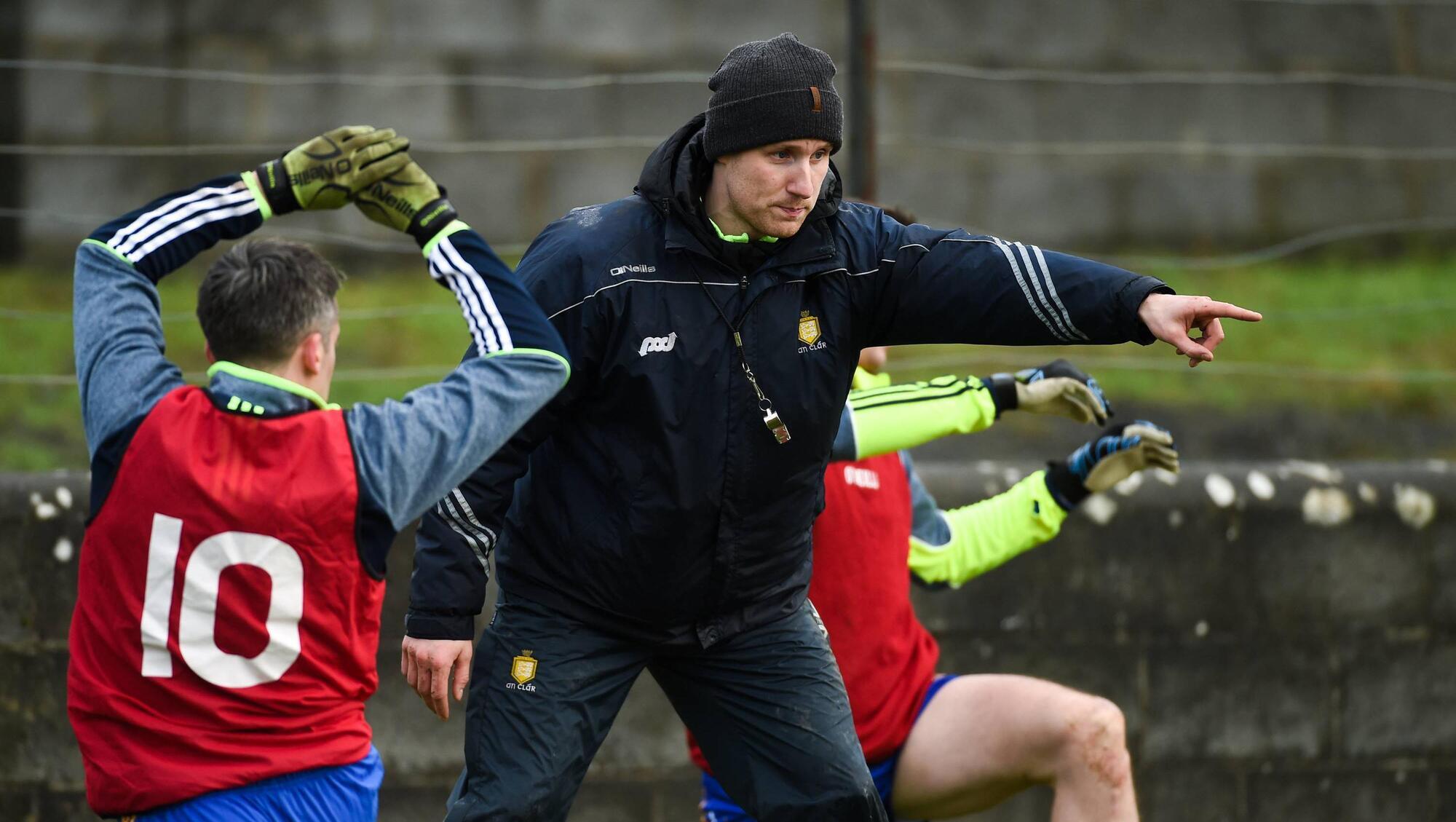
LONG-TERM VIEW: Rob Mulchy during his time as Clare strength and conditioning coach. Pic: Diarmuid Greene/Sportsfile
They’re doing things differently down in Clare these days, including – and because of – a Kerryman called Rob Mulcahy.
Although this is his first season in six years not being involved with the Clare senior footballers that square up against Limerick in the Munster Championship Saturday evening, he was highly involved in the two counties meeting in a couple of fascinating U14 hurling development games played out in UL a couple of months ago.
Mulcahy is studying for a doctorate in that same university on top of being the head of athlete development for Clare GAA. His area of research, not surprisingly given his day job, is on talent identification, and from that came the interest in trying out a concept called biobanding.
Essentially it means grouping players according to their physical maturity rather than simply their age. Clare underage hurling squads had been implementing this principle throughout all of last year in how they broke players out into various pods and skills stations and in-house games. In March then Mulcahy and his Clare colleagues, along with the head of the Limerick hurling academy, Darragh Droog, rolled it out in actual matches.
“Traditionally at U14, players would have been selected on performance: you’d go out and watch a game and generally pick the bigger, stronger guy because he’d have been more dominant,” explains Mulcahy over a glass of water in a café shortly before he has to dash around the corner to Cusack Park to take in the U20 hurlers who are playing the evening we meet.
“But when we categorised players according to their physical maturity, those bigger lads didn’t look the same as they would in your standard chronological game because they could no longer dominate physically.”
Clare have over 70 players as part of their U14 hurling academy; where yesteryear the old maxim seemed to be as few as possible and as big as possible, now it is as many as possible for as long as possible. Limerick have also cast the net wide, so both parties were able to go with the following experiment: in one game there would be 25 U14 players from each panel who were only 85 to 90 percent their predicted adult height, and then another 25 that were 94 percent or more their predicted adult height.
The games and findings were intriguing. The ‘smallies’ game was considerably more fluid, quicker, skilful, with it allowing players who would normally not emerge with the ball from rucks or win aerial ball flourish in those circumstances.
“For the bigger lads then, it showed they’ve to work more on the cognitive side of the game. At that size at that age you can be used to running in straight lines, playing against smaller lads, but when you’re coming up against someone who is even bigger and stronger than you, you’ve to try a new way of evading an opponent and solving the problem.”
It’s an experiment that both counties and others will roll out all the more in the coming months and years but Mulcahy is mindful that it doesn’t just become something that’s just trendy or tokenistic. A whole diet of biobanding games isn’t desirable either; a meshed approach, featuring your standard chronological games, is. And the most important point of all is to identify and note where players – kids – are at in their physical maturity cycle. Over the summer Mulcahy and his colleagues will be running workshops so that all clubs in Clare will know how to collect the growth maturation data using an algorithm that features the player’s current age, height and weight as well as the height of their parents.
“The easy and sexy part is to run a biobanding game; it’s the cherry on top, if you like. What’s most important is the actual collection of the growth maturation data and what we do with that. If you have players going through their accelerated growth spurt, they’re more susceptible to injuries, soft tissue injuries in particular; while bones grow really fast, tendons and ligament muscles don’t necessarily grow as quickly. So their training interventions would be markedly different to someone who is either before or after PHV (peak height velocity).
“You’ve to be really conscious of their load. If you’re a club coach and a guy who is going through a growth spurt comes up and says, ‘I’ve a sore knee’ and you reply, ‘You’re fine, keep training,’ that could potentially make the injury more debilitating.”
Ever before he got involved in Clare GAA or undertook this PhD, Mulcahy was aware how there could be late developers. He knew some of them personally very well. Although he’s a Kerryman and played a bit underage with the John Mitchels club in Tralee, Mulcahy was an international swimmer and a fine basketball player, winning an intermediate National Cup with St Brendan’s and being a squad member of the Garvey’s Tralee Warriors in their first season in the Superleague. On each of those teams was Kieran Donaghy, once the worst footballer on his Austin Stacks U16 team, later the most feared and influential full forward in the country, and to this day, Mulcahy reckons, the best teammate you could have.
“He’d have you run through a wall for him. I vividly remember in the dressing room before that 2016 Cup final, him going around to each and every one of us. I was just an aggressive defender and rebounder for us, I wasn’t a scorer or main man like him, but he made you feel your role was as important as anyone else’s.”
Shortly after that Cup win he was sharing a dressing room with another special individual: Colm Collins. For five seasons Mulcahy served as head S&C coach to his football team, all the way right up to them getting to Croke Park and another All Ireland quarter-final last season.
“I’ve never met anyone like Colm. Just how excellent and genuine he is with people and players and anyone who works with him. I wouldn’t have been following football hugely when I linked up with Clare; I was more into the NBA and had only been in the Limerick academy for a short while after doing my masters [in strength and conditioning in St Mary’s, Twickenham] but he gave me my opportunity. He’s brilliant at entrusting and empowering people and he always has an eye on the big picture.
“He knows the 14 year-olds playing in the county, all the way up. Every year he brings three or four guys in to start training with the panel. I remember when he first told me to link up with Emmet McMahon. Realistically it was going to take time for Emmet to [be in the playing rotation] but Colm had the foresight to think, ‘Get the work into these guys.’ A couple of years later and he’s making a big impact. The same with the Manus Dohertys, Daniel Walshes that are shining now.”
Mulcahy now in his own role has to take a similar, even longer-term global view. Where once his role in Clare was mostly confined to looking after the athlete development of Clare development football teams as well as Collins’ seniors, now he oversees everything on the hurling side from U20s down as well as the U16 footballers down.
It’s just one of numerous progressive appointments Clare GAA has made recently. As well as the advent of head of operations Deirdre Murphy (“A breath of fresh air,” says Mulcahy), and brilliant locals like games manager Michael Duffy, John Enright, Donal Moloney and Peter Casey, the county looked at its needs and identified that three part-time S&C coaches were required. Each were put on 20-hour contracts; long enough to cover everything Clare GAA needed yet short enough for the three of them to be able to freelance and take on other projects.
“I think what Clare has done the last couple of years is invest in really good people. Very few counties actually have paid positions but Clare have and so have been able to attract brilliant graduates like Criostóir McCaw, Bríon Moriarty and Hugh O’Neill. Bríon is now actually after taking on a PhD and started work with the Australian Institute of Sport which is a great reflection of Clare GAA. Now we’ve hired Dylan Kenny out of [formerly] AIT, another phenomenal graduate who links up with our interns.”
They don’t just work with the county teams or development squads either. Every week they’re in the schools. There isn’t a secondary school in the county where they’re not in rolling out a S&C programme for anyone 15 or younger who is playing football or hurling. ‘As many as possible’ isn’t a slogan to Mulcahy. It’s a creed, informed by both passion and science.
“The reality is out of every underage team only one or two are likely to go all the way through to the senior. It’s not like all your U14s are going to make it, or all your minors or U20s are going to make it either. So that in a way changes the whole focus of the squads. You want to bring everyone’s level up so that when most of them go back to their clubs they’re raising the standard and structures there.
“We’ve looked at all the Tony Forristal teams from 1986 on and essentially you’ll find there are two routes for a player who makes it at senior. There’s the linear route where a John Conlon has come in at U14 and gone all the way through, and then you’ll have your non-linear route, like a Shane O’Donnell who came in a couple of years later.”
We’re speaking in a week that is manic for Clare GAA, and Mulcahy in particular. The Clare minor hurlers beat Cork. The Clare U20 footballers pushed Kerry into extra-time. The Clare U20 hurlers are still in with a shot of progressing. The minor footballers lost to Limerick on Thursday night. Mulcahy think it’s reductive to just gauge the success of those programmes by their results this week or this year. It’s why the county still has 70 U17 hurlers still training, between the minor panel and a Celtic Challenge panel.
“For me I the focus should still be primarily developmental right up to U20s. If you win, that’s great, and believe me no one would celebrate it more than me. But if you come in at 14 we’re looking at improving you year on year to equip you to play either senior inter-county or adult sport. You want to see these players that are going through this transition will come through and they’re robust, they don’t break down, and they’re intelligent players. That for me would be success. You want to be able to stand over a guy and be able to say that he has improved in his hurling or football, his S&C, mindset, nutrition. I don’t think if the minors fail to win something, the programme has failed.”
The long game is the one to win.


CONNECT WITH US TODAY



Be the first to know the latest news and updates