Fogarty Forum: Add bonus points to goal-starved leagues
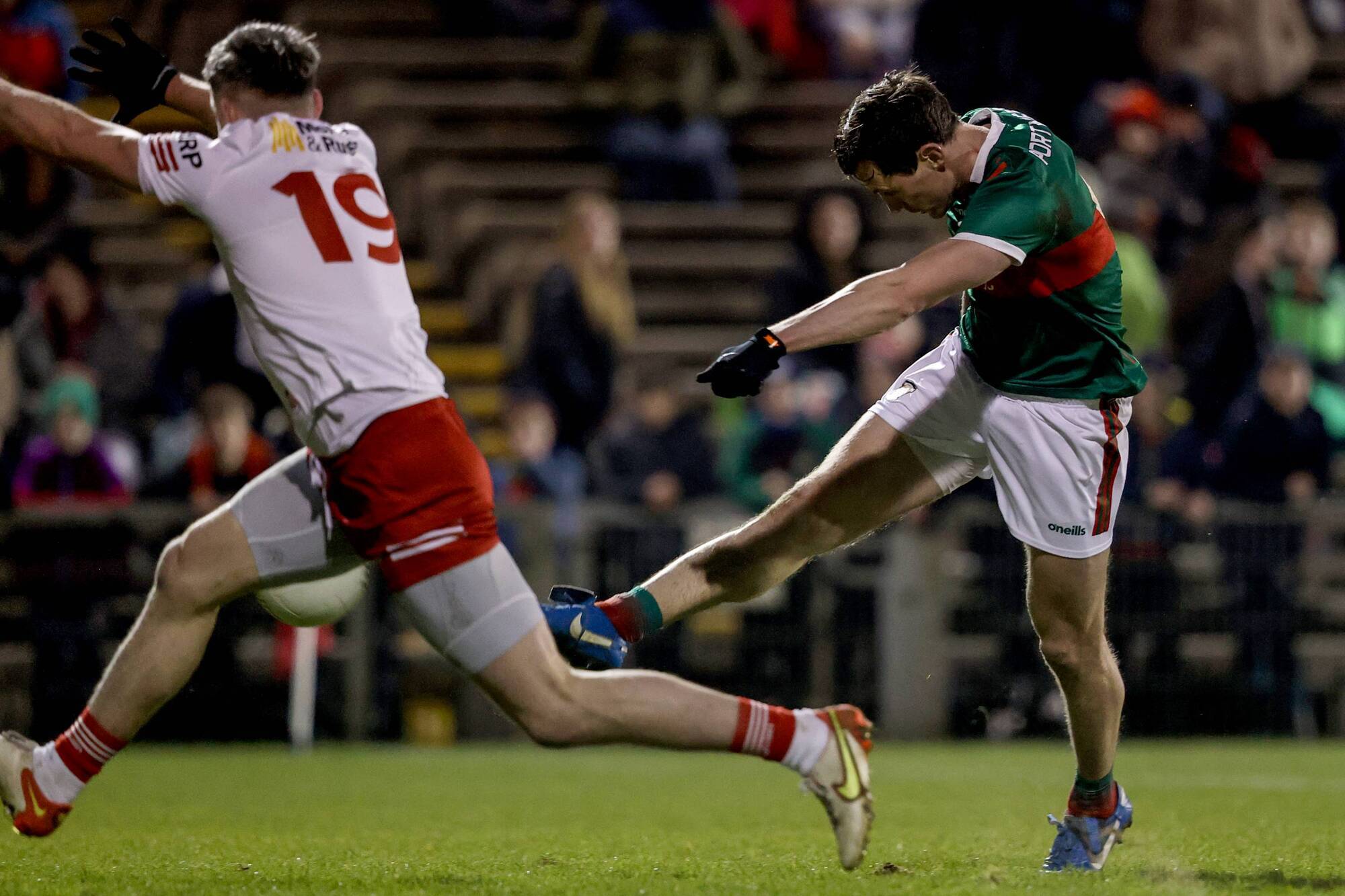
GREEN FLAG: Mayo's Diarmuid O'Connor scores his team's fourth goal against Tyrone on Saturday night. Picture: INPHO/Ben Brady

Perched pretty at the top of the Six Nations table, Ireland are five points clear of Scotland, France and England, three of their 15 points courtesy of their four-try bonus point victories.
A fourth-ever Grand Slam is the objective but in the event Scotland and/or England upset them in the coming weeks those bonus points could be the difference between winning a fifth Six Nations Championship and coming away empty-handed.
When the country's Triple Crowns 1982 and '85 were celebrated with all sorts of commemorative paraphernalia from pint glasses to jerseys, these achievements are not to be sniffed at and the bonus point system, introduced in 2017, truly rewards Ireland’s attacking play thus far.
The GAA’s Allianz Leagues could do with a similar incentive-based initiative. The goal-shy nature of both football and hurling at the halfway point of the competitions is clear – the average number of goals across the two Division 1 hurling competitions is 2.72 in hurling and 1.5 in football’s Division 1 compared to 3.11 and 2.25 at this same juncture in 2022.
Of the 16 Division 1 football games, six games have failed to provide a green flag and another three have offered just one. Limerick’s champion hurlers are currently in a semi-final position having scored just one goal in three fixtures. Galway have not registered a three-pointer in two of their matches while Kilkenny have managed just two thus far.
How the GAA would interpret the bonus points system is open for debate – is a hurling goal worth less than one in football, for instance – but for now let’s consider a structure based on rugby’s with four points for a win, two for a draw and a bonus point for scoring two or more goals and one for losing by five points or less.
Apply that to hurling’s Division 1, Group A and Cork would still be top but with 15 points instead of six because of their handsome goal tallies. Having scored 10 goals across the Westmeath and Wexford matches, Clare would jump from third to second on 10 points ahead of Limerick who would be on nine points having picked up a losing bonus point against Cork. For finishing twice within five points and scoring three goals against Cork, Galway’s total would read seven followed by Wexford on five and Westmeath remaining on zero.
In Division 1, Group B, Tipperary, like Cork, would have the full complement of 15 points because of their goals and in their trail Waterford (12), Kilkenny and Dublin (both 8), Antrim (2) and Laois (1). Dublin are currently on three points, one behind the Cats, but would be rewarded for their goals under the bonus points criteria.
In football’s Division 1, there would be no changes to the positions only that Mayo and Roscommon move from six to 14 points, four ahead of Kerry and Galway who move ahead of Monaghan because of bonus points.
In the cut-throat Division 2, goal-hungry Derry would be on 19 points, two points ahead of Dublin as opposed to the situation now when they share top spot on eight points. Cork would stay in third on 13 points but because of their goals two clear of Meath, who would leapfrog Louth largely because they raised seven green flags in the first two games. Three losing bonus points for Clare as opposed to one for Kildare would separate them too, seven points to five.
It will need more than bonus points to save a hurling league that is losing its relevancy rapidly but when almost a third of scores in last year’s championship came from frees, over 5% more than that in the football championship, encouraging more goals has to be looked at seriously. If there are reservations that increasing the worth of a goal may be counter-productive, then the alternative is bonus points especially as league tables now comprise roughly 70% of both the hurling and football seasons.
Apply bonus points to last year’s Munster senior hurling championship and the positions wouldn’t alter. However, there would have been more possibilities for Waterford to qualify for the knock-out stages going into their final round clash with Clare.
As a means of avoiding dead rubbers, the four third-placed teams in the new Sam Maguire Cup round-robin stage will join the second-placed counties in preliminary All-Ireland quarter-finals. A three-round competition over five weekends to eliminate just one team seems cumbersome not to mention adding another layer to the knock-out stages.
Not that they would guarantee to prevent game of no consequence but if the GAA want to streamline the championship by doing away with the preliminary quarter-finals bonus points are a potential solution.
Nor can they save the flailing league formats but by rewarding the more positive teams and encouraging more excitement they can better them.
There were few punches pulled by Joe Canning or Seán Cavanagh in assessing their respective counties Galway and Tyrone’s performances this weekend.
On RTÉ’s “League Sunday”, Canning was constructive but critical of how Galway took the wrong options didn’t track Limerick in Salthill, highlighting how Barry Nash was giving the freedom to initiate attacks from short puck-outs. “People say Limerick work so hard,” he said. “The opposition allow them to when they drop them balls.”
Canning also cited two examples where his old team-mate Pádraic Mannion made errors in distributing the ball. Any claim he might have jumped into the pundit’s armchair too soon appears to be wide of the mark.
At this stage, Cavanagh is nearly six years retired and he is more comfortable analysing his fellow countymen. However, the scathing nature of his remarks in “The Irish Daily Star” are bound to leave marks in Tyrone. Claiming that the group were given “a free pass” for their disappointing defence of their All-Ireland title last year, his column read: "I thought players would go back to their clubs and then come back reenergised for this season. No sign of that so far. I do not remember ever seeing a Tyrone team so disorganised and unstructured in defence. That isn’t Tyrone. That isn’t the way we are as a county.”
No doubt both men will defend their own when they have to, but this past weekend they weren’t afraid to make their points.
Other than the split season, cancellation of league games of no consequence and the merging of competitions were significant precedents prompted by the pandemic.
In 2020, the Limerick-Clare Munster SHC opener doubled up as the Division 1 final due to the tight window for games. And so, Declan Hannon started that provincial championship as he finished by lifting silverware.
With all four hurling league semi-final spots currently filled by Munster counties, what is there to say that there might be a repeat this year? Do Limerick and Waterford, currently second in their Division 1 groups, really want to be squaring off two weeks before they open the provincial championship in Thurles on April 23?
As football’s top-flight stands, Mayo and Roscommon are due to contest the final a week prior to their Connacht SFC quarter-final meeting. Venerable Shannonside FM commentator Willie Hegarty has suggested the Easter Sunday game in Dr Hyde Park could also form the Division 1 decider if the neighbours remain in their positions. Either that or it’s two games in the space of seven days and they can bill the provincial game as the second coming.
On the hurling podcast at the start of the league, host Anthony Daly said it wasn’t too late for the GAA to jettison the semi-finals and stage a final between the best finishers in Division 1 Group A and B. Daly was reflecting the indifference to the knock-out stages when they push so close to the start of the provincial championships.
What might have to be weighed up is the integrity of competitions that in the main have been good for the GAA, national silverware and gate receipts against potential shadow boxing exercises, expediency and general disinterest.
Such scenarios are symptoms of the split season but the inter-county competitions have yet to truly reflect the new reality of a shorter timeframe.
Email: john.fogarty@examiner.ie
CONNECT WITH US TODAY



Be the first to know the latest news and updates