Gaelic football’s two camps leave with vastly different readings
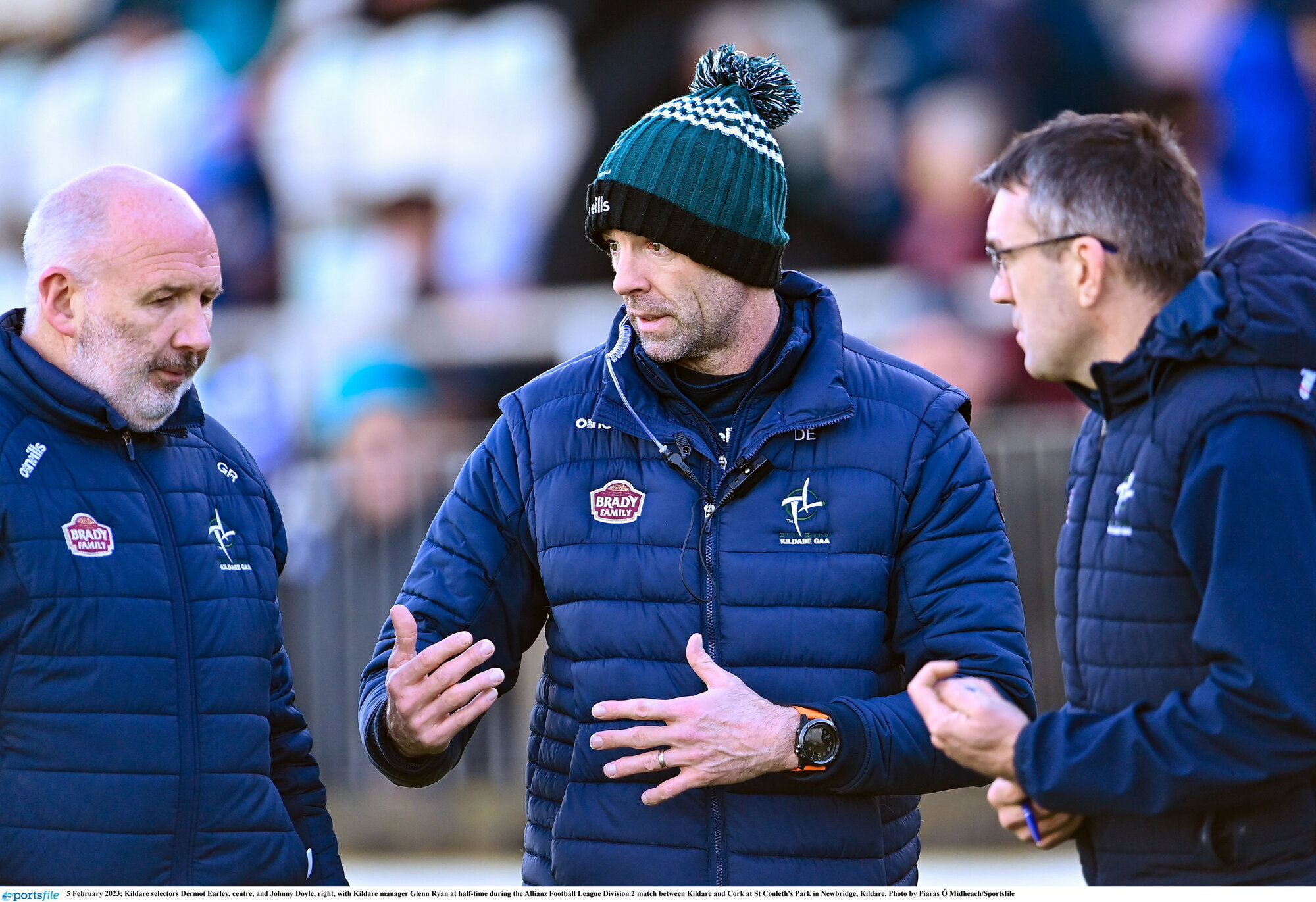
BRAINS TRUST: Kildare selectors Dermot Earley, centre, and Johnny Doyle, right, with Kildare manager Glenn Ryan. Picture: Piaras Ó Mídheach/Sportsfile
In certain noisy places Gaelic football’s evolution is depicted as an assault on the game’s heart and soul. We’re about to step right into that culture war. Efficiency, expected scores, conversion… warts and all. Turn back now if that is not your bag.
Kildare’s remarkable late show in Cusack Park last week left many with one main takeaway: how the hell did Clare lose that? They led by four at half-time, by six 10 minutes later and were still five clear when Ben McCormack was sent off midway through the second half. There were 2,695 spectators in Ennis and the final whistle left the majority asking the same question.
“It is ourselves that lost the game, not Kildare (that) won it. What we did in that second half there was complete football suicide. That is all it was,” said Clare boss Colm Collins. RTÉ labelled it a “Houdini act in Ennis.”
“Daniel Flynn inspires Kildare to the win. I don’t think Kildare fans have any idea how they won that one, ” observed Off The Ball senior producer Tommy Rooney.
A good old-fashioned smash-and-grab. Gaelic football has experienced plenty down the decades. In practical terms, what does that actually mean? What exactly makes a robbery? There has to be evidence for it to be a crime.
On one level this is not a mystery. Good structure, smart decisions and converting chances are the keys to winning. If a team does all three and still loses, they have a legitimate case.
Another inescapable factor, as last weekend demonstrated, is officiating. After Sunday’s match a clip circulated on social media of a Clare attack through Emmett McMahon. The wing-forward had just stroked over a superb long-range point and followed it up with similar moments later except the referee awarded a free out, seemingly for two hops. It was clear he had soloed the ball.
The situation is complicated by the fact that the tie was not streamed and there were no highlights on League Sunday. TG4 did include it in their Monday night highlights show but for the 120,000 or so who watched that clip on Twitter, that was the sole footage from the entire game they saw. For those who were there, it merely added to their sense of an unjust outcome.
Truth be told such calls have a funny habit of evening out. Clare’s first-half black card came after an off-the-ball incident while they had possession. Only after the play had finished did the referee consult his linesman and discipline Alan Sweeney. That attack had ended in a Clare converted free.
Collins certainly wasn’t laying the blame at the officials’ door post-match: “To be brutally honest, the referee was not the cause of us losing that game. We lost that game ourselves. 100%.”
Is it possible to identity a worthy winner? There are a few clashing dynamics at play here. Start with both teams’ chances. In soccer the term xG has become such a lightning rod that even passing references can result in tedious debate. The accusation is that it is not only nonsense, but essentially the cold hand of nerdy types determined to wash all joy from sport with a wave of spreadsheets.
Really it is the term that people have an issue with, not the concept. Everyone has always assessed games by comparing chances to the actual score. Counting wides or shots dropped short is age-old practice. xG quantifies it. The metric is tracked by most leading analysts in GAA.
On Sunday both teams had a similar number of shots, Clare 23 and Kildare 22. Kildare’s shooting efficiency was 8% better. Their expected points were 1.7 more. No signs of a break in there.
These statistical measurements can confirm what onlookers already know. On his insightful podcast, former Galway and Donegal football analyst Stephen O’Meara recently showed Tyrone’s shooting map and expected points from their loss against Galway. Put simply, Tyrone kicked it away. Their number of phases, shots and expected scores were all higher. For all the advancements shooters still need to be able to put the ball over when the opportunity presents itself.
In the first half, Clare played with a strong wind. Given that threat, Kildare did not press the kickout. So Stephen Ryan went short with every kick bar one and their athletic middle third carried hard and forced fouls. Five of their 11 scores in the opening 35 minutes came from frees. At the other end, they stayed disciplined and forced Kildare to shoot from range.
O’Meara also explained how in-game adjustments on opposition kickouts is now vital. Galway’s change to commit more men to their press against Tyrone was a huge factor on Sunday, the same way it was in the All-Ireland semi-final versus Derry last year.
In the second half, Kildare could press the kickout as they had the wind. Add in that fact that Glenn Ryan’s bench contributed six points while none of Clare’s five replacements scored and it illustrates that Kildare were full value for their two points.
None of this is to be critical of the live response or to say that there isn’t a place for the matchday passion. At the same time, it does further highlight the developing gulf between perception and reality in Gaelic football. The sport has gone to a totally different level now in almost every way. Today’s offering isn’t even in the same household as past generations. At best it is a distant relation.
At the top level, play moves so fast with so many different elements that you have to watch it back several times to figure out what just happened. Analysis is a fundamental part of that. Certain aspects are crucial and even still only apparent when you specifically are looking for them.
At one point on Sunday, someone nearby in the stand observed that much of Kildare’s joy was found down the righthand side. Few live dispatches, including this writer’s, referenced Paddy McDermott’s influence. Crunch the numbers and he finished with four assists. Regardless of the headline scorers and established players, that sort of impact will be celebrated internally.
This sport isn’t as determined by the capability of individuals anymore. It is a contest of systems. One that has never been as fast or detailed. So many ties are decided by razor-thin margins. Few can comprehend every aspect of that. Few want to.
Part of football is a science with specific data units. Much of it will always be an environment of emotion, brimming with human instincts and apprehensions. How anyone digests that is totally reliant on personal taste. Some want entertainment. Others seek explanation. One shouldn’t nullify the other.
But between the white lines, the metrics do matter. A team must do the right things regardless of the result or their immediate response to it. The final score is simple. Everyone sees and feel it. The process that led to it is anything but.
Outside the tunnel after Sunday’s game, Glenn Ryan spoke to the media after reflecting on what decided the tie.
“Stiff breeze allowed us push up with the Clare goalkeeper kicking against that wind, created opportunities from further distance out,” he explained.
“In comparison to the first half we had a lot more turnovers in the tackle which gave us a platform.” Before that he did a radio interview. There he was asked for his immediate reaction on what pleased him most from the 70 minutes.
His response? “The two points.”


CONNECT WITH US TODAY



Be the first to know the latest news and updates