Paul Rouse: Jarlath Burns can do his country some service
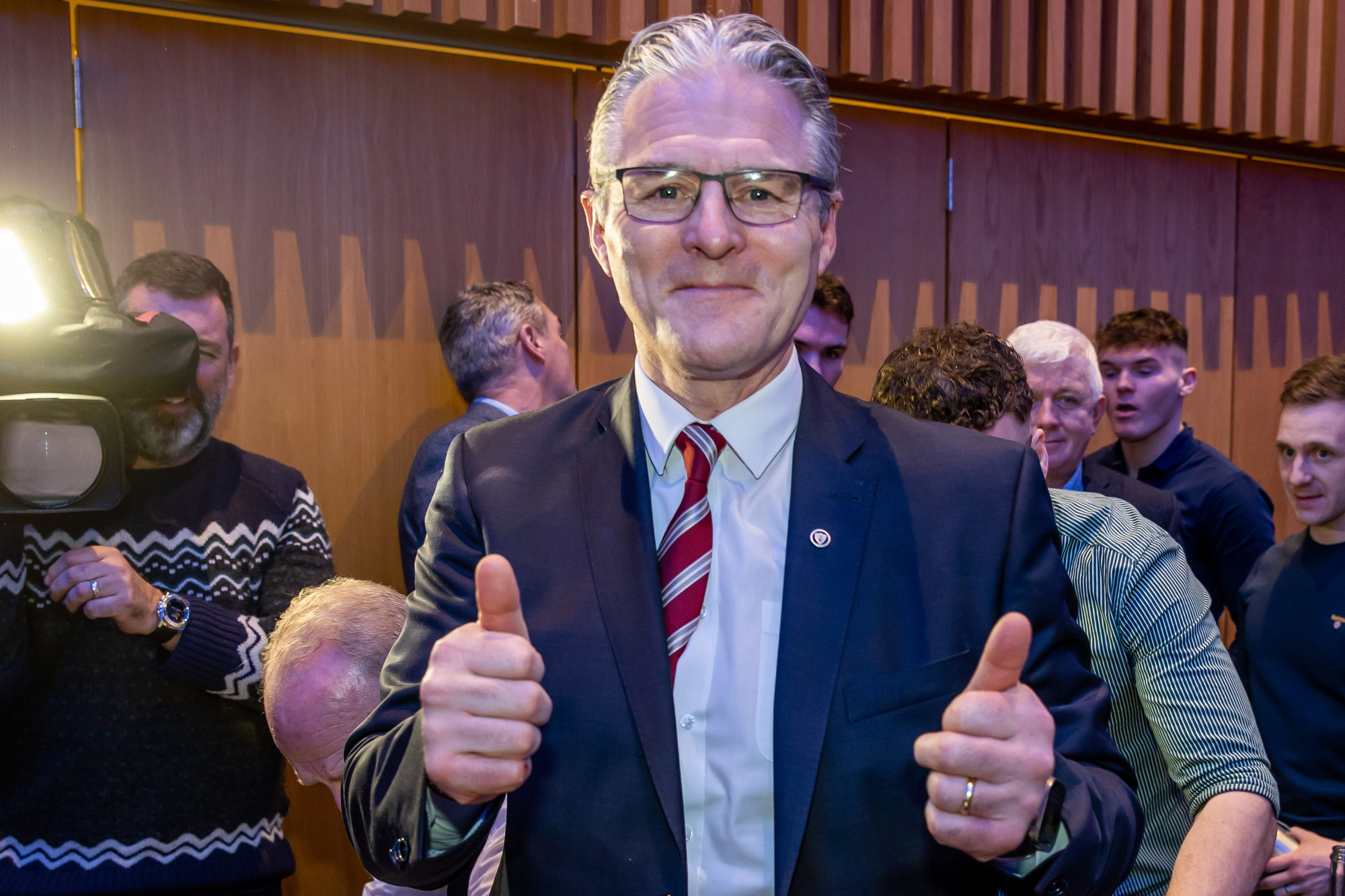
MANDATE: Newly elected GAA president Jarlath Burns is congratulated on his election. Picture: INPHO/Morgan Treacy
After his comprehensive victory in the election to choose the GAA’s next president, Jarlath Burns did not shy away from a question asked about how the GAA might approach a Border Poll. He will not take office formally until next year, but what he says now clearly matters.
It was fascinating to hear his thoughts on the evolving constitutional situation in Ireland in the wake of the turmoil caused by Brexit: “In the climate where there would be a border poll called, it would be incumbent on all civic organisations to take a position on it, and it wouldn’t be shock therapy to anybody to hear that the GAA, who have always ignored partition very honourably, would want to see a united Ireland.
“That is my dream and it is not a subversive dream to have. It is a very valid perspective, particularly in the context of Brexit but we would have to do it very responsibly. If you look even at the last independence referendum in Scotland, both Celtic and Rangers, two big sporting organisations in that country took a position on independence.
“I don’t think it would be unreasonable of us to say that we would want to see our land united because even practically it doesn’t work, partition.”
It seems certain that Jarlath Burns understands the scale of the challenge that faces those who wish to see the island united.
Before Christmas, The Irish Times published the results of twin polls conducted as part of a study conducted by the University of Notre Dame and the Royal Irish Academy, an all-island body.
The polls were the result of a survey conducted last August and September of 1,000 voters across the island. They are the most in-depth study of contemporary attitudes that now exist, allowing for the fact that other polls can show slightly different results.
What the poll showed was that 66% of voters south of the border would support unification with Northern Ireland. It is an arguable point how solid this 66% would be when the inevitable changes to the southern state – its symbols, its political architecture, its taxation, its education system and so much else – become clear in any proposed unification. Nonetheless, it is a clear majority as things stand.
By contrast, only 27% of voters in Northern Ireland would choose to unify with the Republic of Ireland; this compares with 50% who are in favour of remaining part of the United Kingdom.
A striking aspect of this survey was that just 55% of those from a Catholic background would choose a United Ireland.
The remainder were split between ‘Don’t Knows’ and those who preferred to remain part of the United Kingdom – both categories standing at 21%.
When you factor in the views of those who did not identify themselves as either Catholic or Protestant, this amounts to an awful lot of people who will have to be persuaded, or have their minds changed, if there is to be a Border Poll held at all – and then still more if that poll is to be won.
It is a simple fact that Nationalist Ireland has no plan as to how this might happen. The government does not have a plan, Sinn Féin north and south of the border does not have a plan, and the remainder of the opposition parties do not have a plan.
In general, there are platitudes mouthed, flags flown, t-shirts worn, ballads slurred, all manner of the usual posing and entrepreneurial patriotism – but no plan of any substance.
More even than not having a plan, Irish nationalists are in largescale denial about the scale of what needs to be undertaken if there is to be a prospect of a United Ireland. Magical thinking abounds, a sort of post-Brexit delirium.
It is in this context that words spoken by Jarlath Burns on the ‘GAA Social’ podcast to Thomas Niblock should be considered. They offer the kind of analysis that is now marginal, but will have to become mainstream, if persuasion is to be successful.
This was Jarlath Burns two weeks ago. Asked some very uncomfortable questions in this podcast. He answered them.
— Thomas Niblock (@thomasniblock) February 17, 2023
The new President of the GAA pic.twitter.com/7CqRLN82YE
“We need to be curious of and interested in other people's culture. I have a serious curiosity and interest in British culture and in the unionist culture, in Orange culture. I’ve the Orange Order in our school all the time talking to our young people to get them to understand what that is about. What parading is about, what walking to give witness to their sincere belief in the reformed faith is about. “If we show in our organisation that we have sympathy and an understanding for the culture of the Protestant people in Northern Ireland, maybe when we ask them to respect our culture, they will. It can’t be our culture and nobody else’s. There is a significant British population who reside on this part of Ireland and they feel under siege. And they are misunderstood in many respects. And they become outraged and furious about (many things) because they feel their backs are against the wall.
“Because we are becoming a majority, we cannot do 'yahoo! what we want now with our flag and anthem. The GAA is a good example of how you do those things sensitively. We are proud to be Irish. The flag is my flag; it’s not everybody’s flag. I would be open to a situation in a new Ireland that wants to be fully inclusive of all traditions and faiths that it may be a compromise we have to make. It may be a compromise that we have to make and it wouldn't be a very big one for the big prize of having a united Ireland, which would be a dream for me.”
You do not have to agree with every sentence in those words to understand the importance of the sentiment.
Again, it is abundantly clear that the challenge here is enormous. An interesting place to start would be the ‘Mission Statement’ on the first page of the GAA’s Official Guide, the legacy of history and the language of a very traditional form of nationalism is obvious.
To this end, do the great majority of GAA members agree that their involvement in the GAA is, ultimately, the expression of their preference for “native ways” over “imported ones”, as is stated in the Official Guide?
Or are they just playing a game that they love for themselves and love for their children?
Where does the balance of sentiment lie on these questions?
After all, we are endlessly told that the GAA is so embedded in Irish society as to be representative of it. The logical extension of that is that there are a lot of GAA members who are either not in favour of, or indifferent to, a United Ireland.
The Border Poll as set out in the Good Friday Agreement is a legitimate aspiration as a means to progress what those who support a 32-County Ireland wish for.
But the text of the Good Friday Agreement begins by referring to the ‘tragedies of the past’, ‘the profound ‘legacy of suffering’ and the importance of remembering those who have died or been injured, and their families.
It continues: ‘We can best honour them through a fresh start, in which we firmly dedicate ourselves to the achievement of reconciliation, tolerance, and mutual trust, and to the protection and vindication of the human rights of all.’
How can the Association better live up to these noble aspirations under the leadership of the incoming president? It all boils down to a simple question: what is the vision of the future and what are people prepared to do to realise this vision?
In adequately leading a debate on those questions, Jarlath Burns will do the sort of service to Irish society that is sorely needed.


CONNECT WITH US TODAY



Be the first to know the latest news and updates