Christy O’Connor: Why the north-south divide in Gaelic football?
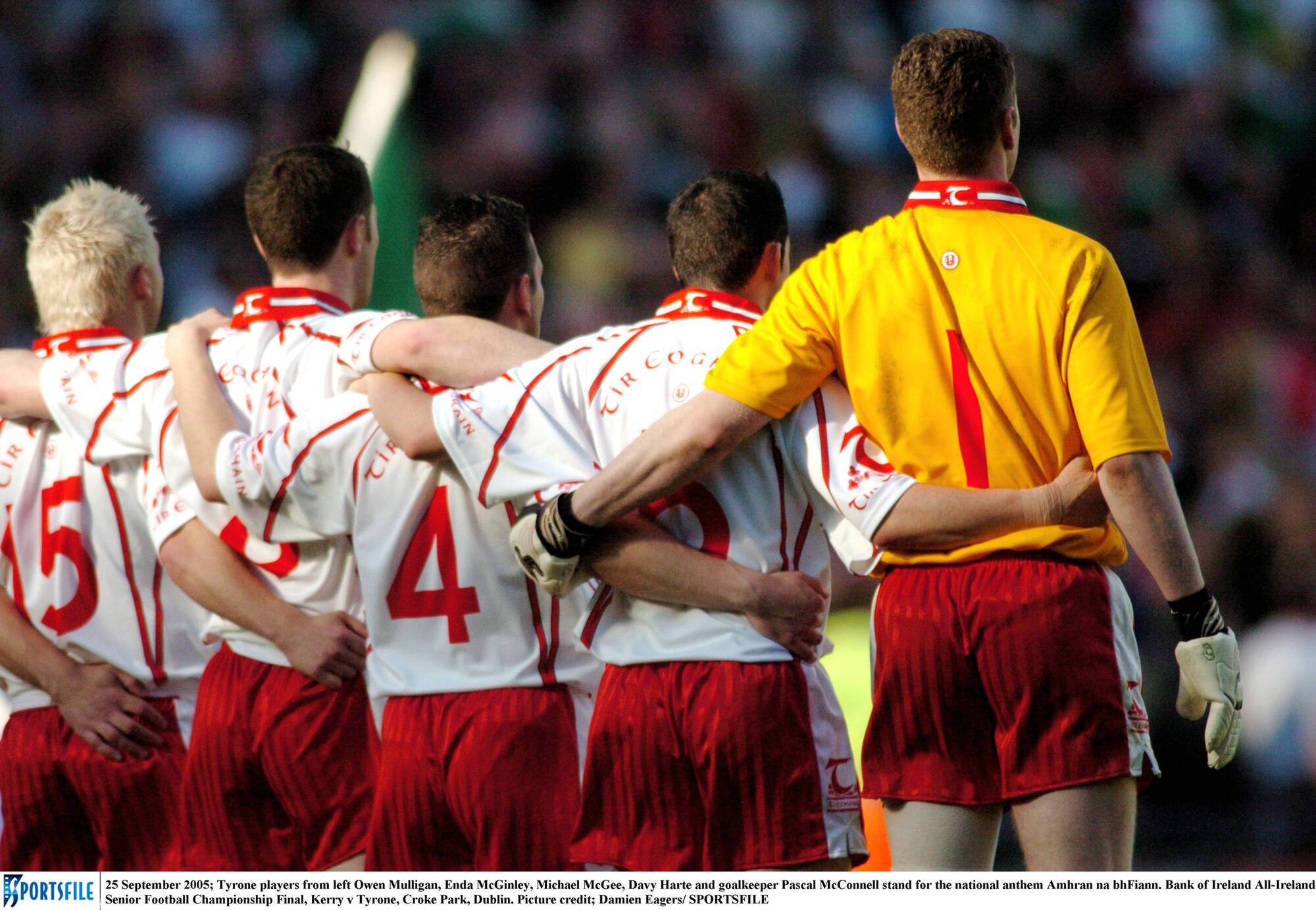
BROTHERS IN ARMS: Tyrone players before the 2005 All-Ireland decider. Picture: Damien Eagers/ SPORTSFILE
On the day that Tyrone won their first All-Ireland in 2003, the love they received was nowhere near as strong as the outpouring of emotion and goodwill Armagh got from the same position 12 months earlier.
The triumph of maiden All-Ireland winners is so rare that it is vicariously embraced by neutrals everywhere. Tyrone though, were never wrapped up in that giant communal hug. Their brand of football was too sharp and in-your-face to garner true affection.
By the time Tyrone won two more brilliant All-Irelands in 2005 and 2008, they were playing a much more open and attractive brand of football. Taking down Kerry in the two best finals of that decade should have raised affections levels, but Tyrone were still never able to establish themselves as a side loved by neutrals. The rest of the football community couldn’t shake off those first impressions.
When they won a fourth All-Ireland in 2021, Tyrone were still struggling to gain that universal acceptance. Speaking on the BBC's GAA Social podcast this week, Conn Kilpatrick stirred the pot on that debate of Tyrone’s un-loveable status.
"I just think that other counties don't like to see us doing well,” he said. “It might have come from the noughties team that nobody really liked and it's just building and building and it has just stayed with a lot of people.
"I think especially because we're up in the north, we got a lot of attention from down south. And it's not just us, all the teams do.”
When Thomas Niblock, the host of the podcast, along with Oisín McConville weighed in on the topic, they felt that south-north divide and, southern bias, was evident in the recent Glen-Kilmacud Crokes saga. “I thought that the rhetoric that was going to be positive has turned out quiet negative towards Glen,” said McConville.
“I just find that there is a sense of south v north in that,” said Niblock. “I don’t want to come to that conclusion. I’m trying my best not to because I feel that is almost being very simplistic... but I have found there is a lot of negative stuff towards Glen. Tyrone sometimes find themselves in there. I think it is an Ulster thing.”
McConville went even further when expanding on that viewpoint: “I would actually go so far as to say that when Tyrone won the 2021 All-Ireland, it was very quickly put to bed, let’s move on to the next one and get some real champions there almost. There is a little bit of that going on.”
Is there? On Colm Parkinson’s excellent ‘Smaller Fish GAA’ podcast the following day, Parkinson, Aaron Kernan and Brendan Devenney tried to excavate deeper, which was facilitated by Kernan and Devenney’s experiences and insights from Ulster football.
Devenney admitted that Donegal were almost a semi-outlier in the conversation because they are not one of the six counties, but he fully understood how the history and socio-political situation would naturally alter perception. “Does that (history and politics) make people in the north not able to tolerate anything that is thrown at them?” he asked.
Was it just media bias or something even deeper? Kernan told a story about either the 2011 or 2012 All-Ireland club final (he couldn’t exactly recall which one) where Crossmaglen Rangers were denied access to Croke Park for a training session beforehand.
Yet a friend of Kernan’s, who was doing the Croke Park tour, sent Kernan a video of either St Brigid’s or Garrycastle (Kernan couldn’t remember which side) training on the pitch. “The first thing you say is, ‘We’re from the north’,” said Kernan.
Crossmaglen were told that they had been in Croke Park before, whereas the opposition had not. It still sounded like a flimsy excuse, but Parkinson asked Kernan if Ulster teams were still hyper-sensitive to any perceived bias.
“Definitely within the six counties, there is that chip on your shoulder, you can’t say anything about us at all,” said Kernan. “If we play defensive football, you have to accept that that’s not everyone’s cup of tea. You have to look at it both ways. We find it hard to look both ways because we do just automatically get a chip on our shoulders.”
Kernan spoke about how his father Joe Kernan, the former Crossmaglen and Armagh All-Ireland winning manager, often referenced the “patronising” attitude southern teams had towards Ulster sides, especially before they were successful. Yet Crossmaglen were a cherished team all over the country because of their brilliant style of football, just as Ulster football was rightly lauded and embraced when Ulster sides won four successive All-Irelands between 1991-’94, playing a quality brand of football with a real swagger.
The style was different back then, just as the style and attitude and look is different now from Ulster teams, which was largely started by Tyrone 20 years ago. First impressions have certainly been hard to shake off.
In the modern history of the Dublin-Mayo relationship and rivalry, which defined so much of the last decade, their 2012 league meeting in Castlebar is often referenced, not just because Mayo beat Dublin so comprehensively, but because it was one of the few times Mayo beat Dublin in the league or championship across that period.
It was a re-fixture at the end of March. Both teams still had one game to play, where Mayo drew with Kerry and Dublin lost to Cork, but that result in Castlebar was effectively the difference between Mayo edging Dublin out of the 2012 league semi-finals, where they went on to beat Kerry after extra-time, which is often acknowledged as a pivotal turning point in Mayo’s journey throughout that decade.
That win against Dublin though, was also important in halting a trend that was developing as Mayo had lost their two previous home games in MacHale Park that season. In James Horan’s first year in charge in 2011, Mayo had also won just one of their three home league games in Castlebar.
Mayo did go on to defeat Galway by six points in the 2011 Connacht semi-final in MacHale Park and, while their championship record at the venue remained pretty positive throughout much of that decade, Mayo’s win-rate in MacHale Park over the last ten years has been nowhere near as high as they would have liked.
It is still a decent 58%, with Mayo having won 29 of their last 50 home league and championship games over the last ten seasons between 2013-’22. Yet with Mayo having won so many qualifiers there at the venue, Mayo’s league record remains average at best, especially considering how much of a fortress MacHale Park should be with the county’s huge support. When Mayo were relegated from Division 1 in 2020, they lost all three of their home games in Castlebar.
When Mayo play Kerry on Saturday evening they will be looking for a first home win in Division One in nearly four years. On the other hand, there is an asterisk beside that stat as Mayo spent the 2021 season in Division 2 while they didn’t play any league game at home last season as the MacHale Park pitch was undergoing resurfacing work.
They did beat Monaghan in the qualifiers there last June and, while Mayo drew with Galway in their first league game in January, it extended Mayo’s failure to record a first home league or championship win against their neighbours in Galway’s last five visits, stretching all the way back to 2014.
With Kerry arriving in town now, and especially after last year’s All-Ireland quarter-final whipping, this is as good a time as any to start making MacHale Park into the league and provincial fortress Mayo need it to be again.
Before Roscommon played Offaly in the All-Ireland U-20 final in August 2021, Roscommon manager Liam Tully told an interesting story about Conor Carroll, the Roscommon goalkeeper, the basis of which was framed around the aftermath of a Ted Webb final (an inter-county U-16 competition) between Galway City and West, and Roscommon.
Carroll plays with Oranmore-Maree in Galway but he has family connections in Roscommon. After the game, a group of family and friends were taking a photograph with Carroll where some of the group had Galway and Roscommon jerseys.
Tully spotted an opportunity. “I said ‘I have a Roscommon jersey with me if you ever want to wear one’,” recalled Tully before that U-20 final. “There was another chap also, another very good Galway footballer in the photograph, and he said no. But your man (Carroll) said: ‘Well, I wouldn’t mind wearing one’. And I said: ‘Well, I’ll keep that in my head’.” It still took a while for anything to happen. Carroll was sub ‘keeper on the Galway minor team that reached the 2018 All-Ireland final, which they lost to Kerry. A year later, Carroll was a member of Pádraic Joyce’s Galway U-20 squad that won the Connacht title.
Galway won the 2020 All-Ireland U-20 title, but Carroll switched allegiance to Roscommon, where his uncle Brian Carroll is the county board chairperson.
After that run to the 2021 All-Ireland U-20 final, Carroll made his debut for the Roscommon seniors in the FBD league semi-final against Sligo in January 2022, where he saved a penalty and kept a clean sheet. He further announced himself the following month as goalkeeper on the NUIG team that won a first Sigerson Cup title in 19 years.
It’s taken him until now to nail down a starting jersey, which he had for the opening two league games. But Carroll is clearly happy to have made the switch. And so are Roscommon.


CONNECT WITH US TODAY



Be the first to know the latest news and updates