Christy O'Connor: Rebels on the back foot already after opening-day defeat
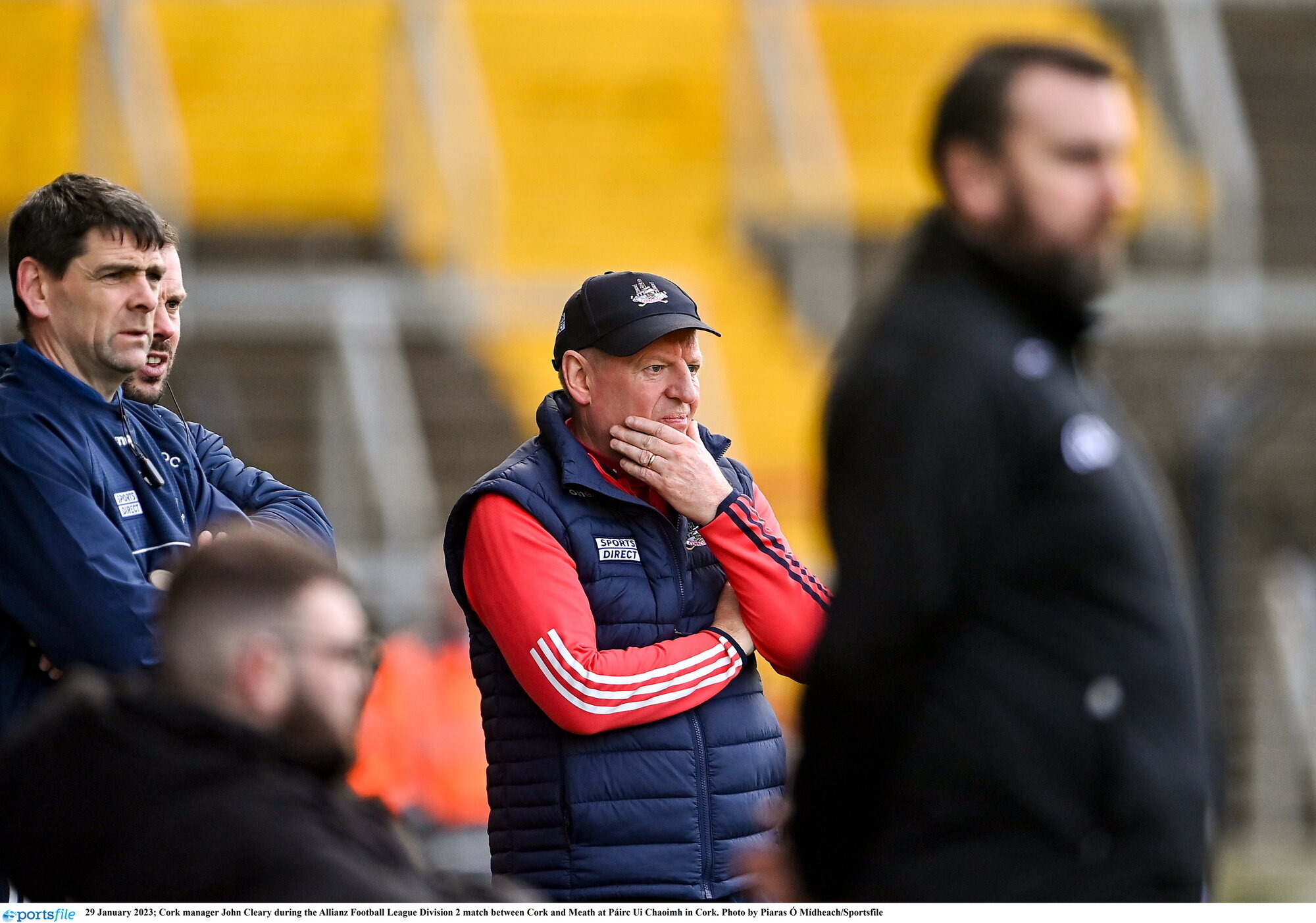
Cork manager John Cleary watches the Allianz Football League Division 2 match between his Cork side and Meath at Páirc Uí Chaoimh on Sunday. Picture: Piaras Ó Mídheach/Sportsfile
From an early stage of last year’s league campaign, Cork’s train was clearly coming off the tracks. They lost their manager Keith Ricken to illness, before their injury list soon became debilitating. At one stage last spring, Cork had up to 15 players on the injury list or treatment table.
In that context, an initial target of promotion soon became a scramble for survival in Division 2, which turned the league into an excruciatingly painful experience. A tricky situation soon got dire, with Cork taking just one point from their first five matches.
A year on though, and there was minimal disruptions compared to the chaos of last spring. John Cleary has had time to get to know the players. Kevin Walsh arrived as coach. A full squad trained really hard over the last few months. And the injury list had dried up.
Some key players with class and experience had returned or were brought back. Yesterday, Cork had the luxury of starting Chris Óg Jones, Brian Hurley and Steven Sherlock in the full-forward line. With Cathail O’Mahony and Conor Corbett also pressing for places in that line, Cork never looked more flush with scoring power close to goal.
For long periods, Cork showed as much yesterday, clocking up 0-19. They had five more shots than Meath (31-26). Sherlock was the highest scorer in the league over the weekend when scoring 14 of Cork’s 19 points. But the same old failings which have been troubling Cork for years came back to haunt them once more – no team is going to win a match when conceding 3-14 in an opening league game in January. Across the four divisions over the weekend, only Waterford conceded more.
The Cork-Meath game produced more scores (36) than any other game over the weekend but, for too long now, Cork have been on the wrong side of those shootouts; in the league against Galway last year, Cork scored 2-17, but shipped 3-22.
After conceding nine goals in last year’s league, there were signs during the championship that Cork were addressing those concerns; they did cough up three goals against Louth and Limerick but Cork kept clean sheets against Kerry and Dublin.
The arrival of Walsh was expected to make Cork harder to beat again but leaking three goals on the opening day was a blow with him on board. Any coach needs time to bed in his philosophy but, already, Cork are up against the gun again.
With promotion a legitimate target at the outset of the campaign, and with their first three games against Leinster sides – Meath, Kildare and Dublin – Cork would have been looking to take four points out of six to legitimately put themselves in the hunt to go up.
Cork certainly don’t have the excuses now that they could use in 2022. But the chase is already on now again to make sure this isn’t another torturous spring campaign.
In his post-match TV interview with Damien O’Meara on Saturday evening, Kevin’s McStay’s delight and excitement with the result was beaming into the face of the camera as brightly as the smile on his face.
“We’re delighted with the point,” said McStay. “It sets us up nicely now for next week. Great battling qualities from our boys, we feel. This is what we love doing, playing national league matches.”
Despite all the close games between both counties, this was the first time since November 1997 that Mayo and Galway had drawn in a league match. Rescuing the match with the last kick was extremely satisfying in that context and, while McStay has always had a positive demeanour and attitude, he was bound to have felt under pressure in his first game with Mayo’s greatest rivals coming to town.
With the championship coming so quickly after the league, and with all teams in Division 1 guaranteed to compete in the Sam Maguire – unlike in Division 2 – nobody was fully sure how every team would take the league in comparison to other seasons. Especially with so many more games now in the championship.
Having had such a long layoff since last summer asked further questions as to how up to speed teams would be by January. But, the local rivalry and historical enmity aside, the ferocity of the contest in Castlebar on Saturday evening buried a lot of those questions.
The intensity and savagery of the tackling was off the charts. The pace of the game was incredible, at times being close to championship level. There was so much heat so often on the player in possession that it was a rich testament to the skill levels and quality of execution that there were only 31 turnovers in the match.
As a contrast – albeit a Division 1 game compared to a Division 2 game – the numbers were interesting when compared to what happened in Croke Park a couple of hours earlier. There were 19 more shots in the Dublin-Kildare game; there were 18 more shots from play in the same game.
But there was zero comparison between the intensity and ferocity of both matches. Will we see that same level of intensity consistently throughout the league? Unlikely. Yet a handful of more contests of that quality will answer a lot of questions posed before this weekend about how teams in Division 1 are approaching this campaign.
Early in the second quarter in Croke Park on Saturday evening, Dublin constructed one of their trademark scores. Ciarán Kilkenny won a breaking ball off a Kildare kickout and after a handful of short passes, Brian Fenton played a deft ball into Con O’Callaghan, who burned Mick O’Grady before fisting the ball over the bar.
For the first time all evening, Dublin looked to be rocking and rolling. It was Dublin’s third unanswered point in four minutes, while they threatened to put the game almost beyond Kildare’s reach shortly afterwards. Fenton booted a long ball into O’Callaghan, who reacted quickest when it landed over his and O’Grady’s heads. O’Callaghan flicked the ball over Kildare goalkeeper Mark Donnellan but it went about two feet wide.
Dublin were finally on a roll but they contaminated that second quarter surge with poor finishing, which was the story of their evening. Dublin’s conversion rate was only 40 per cent; from play, it was just 32 per cent.
Most of their other numbers were decent. Dublin won all but two of their own kickouts while they snaffled five of Kildare’s restarts, a couple of which led to Dublin scores. Dublin only turned over the ball 16 times but their profligate shooting turned what should have been a more straightforward drive into a menacing spin on their own track.
The engine was always bound to cough and splutter after being off the road since early last July but Dublin leaked more gas and clipped more ditches than they’d have liked on their first test drive with a new model. Much of that credit was down to a stubborn, resilient and well- conditioned Kildare side but Dublin’s digits were still way off the standards they’d expect to reach.
From the moment Dublin slipped into Division 2 for the first time in over a decade last March, the easy narrative was that they would rebound straight back up. They still should but the way in which they stumbled over the line on Saturday evening offered more credence to the theory that the journey back to Division 1 may not be as straightforward as Dublin expect it to be.

CONNECT WITH US TODAY



Be the first to know the latest news and updates