GAA talking points: The Kerry-Tyrone edge, Easkey's journey, Kelly's legacy
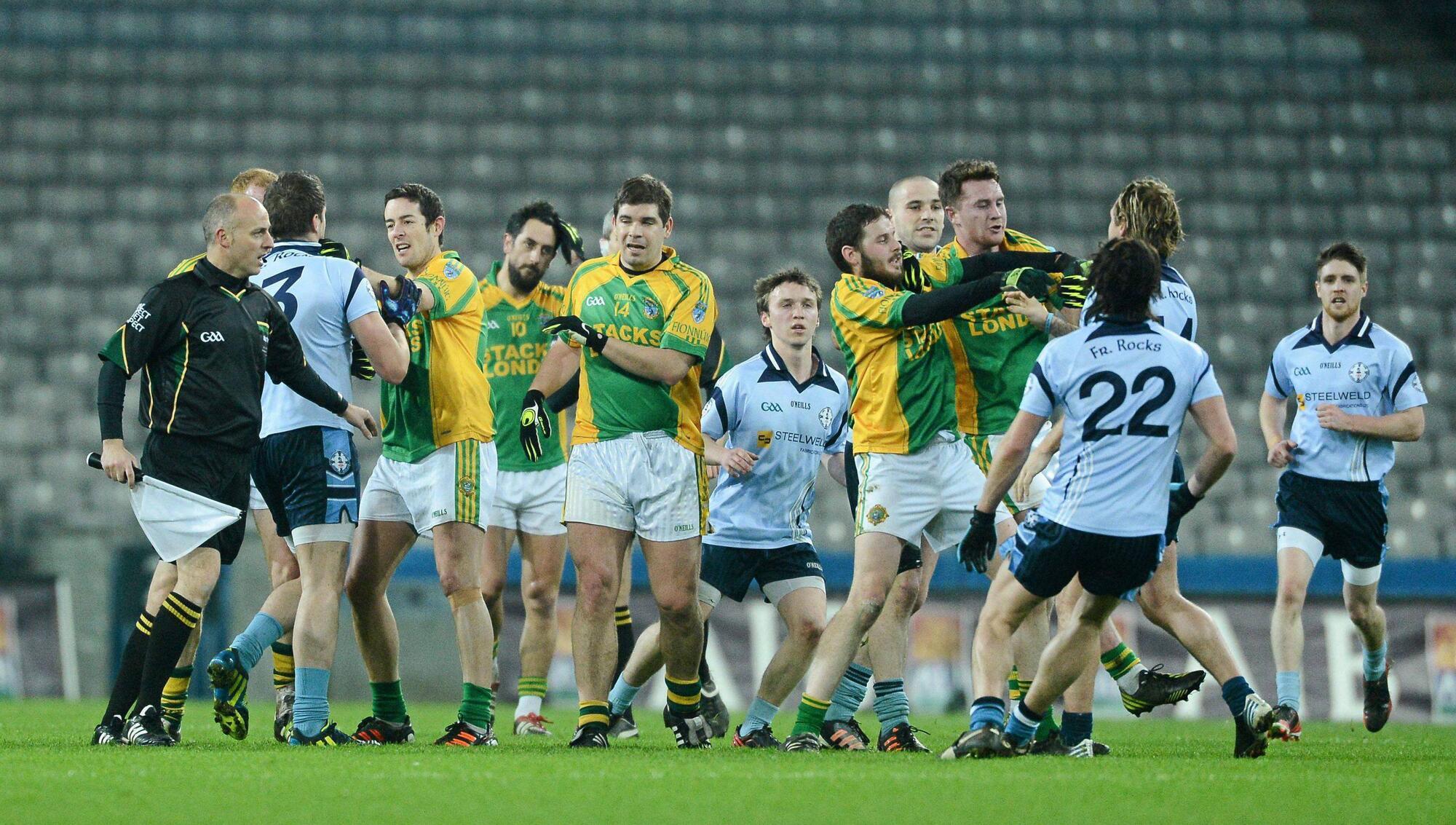
HEATED RIVALRY: The edge between Kerry and Tyrone has occasionally spilt into club action between the counties in the latter stages of the All-Ireland campaigns. There was certainly sulphur in the air when Finuge and Cookstown met in the 2013 All-Ireland Intermediate final. Pic: David Maher/Sportsfile
In the modern and storied history of the Kerry-Tyrone relationship, the dynamic that underpinned football’s most embittered long-distance rivalry radically shifted throughout the last decade. Kerry began to get on top and dominate the relationship but Tyrone grimly reminded them in the 2021 All-Ireland semi-final that they never had any intention of going away.
Tyrone had so many other battles to fight over the last decade that presenting themselves as an irritation to Kerry was no longer a priority. Kerry had their number in the 2015 and 2019 All-Ireland semi-finals but the nature of the rivalry looked to have changed after Kerry beat Tyrone in a massive qualifier in Killarney in 2012.
The deep respect Kerry had for Tyrone was shown in the warm way they treated Mickey Harte afterwards. A few Tyrone players who stayed around Kerry for a few days were feted wherever they went.
Yet when the dust settled, a few sparks flew again. In his 2012 annual report, Tyrone secretary Dominic McCaughey talked about poor refereeing in Killarney and how Kerry's victory was "greeted, amazingly, with tears of joy by some players and wild scenes of jubilation among highly vociferous supporters." The point was clear. A qualifier victory would never match the monumental games Tyrone had won against Kerry.
When Cookstown and Finuge met in an All-Ireland club Intermediate final two months later, both sides got embroiled afterwards in a vortex of retribution and reprisals, involving alleged spitting incidents and making sectarian remarks. It was even more dispiriting in the history of the counties' relationship coming just 12 months after another chaotic club game between Derrytresk and Dromid Pearses.
The trouble in those club games reflected the worst of the rivalry but it never fully infected the relationship. Still, tension was always bubbling beneath the surface. When Moy defeated An Ghaeltacht in the 2018 All-Ireland Intermediate semi-final, Marc Ó Sé later took Seán Cavanagh to task in his newspaper column over an incident for “running snitching to a linesman looking for a fellow player to be sent off”.
Those club games kept the rivalry simmering when it had cooled at inter-county level before Tyrone reclaimed lost ground in the 2021 All-Ireland semi-final. Nobody wants to see any traces of that old tension and bad blood anywhere near Croke Park on Sunday but two Tyrone teams taking on two Kerry teams as underdogs in All-Ireland finals will surely see Galbally Pearses and Newtownstewart Harps bring a Tyrone edge into the games.
A couple of weeks back, Joe Canning drove to Longford to meet and speak with the Easkey players before they played GMIT. Canning’s presence wasn’t just an out-of-the-blue big-name arrival offering his insight and experience before an All-Ireland final because Canning has long had a connection with the club; when most of these Easkey players were young, Canning spent a week in the south Sligo coastal town coaching them.
Their odyssey in reaching Saturday's All-Ireland Junior final against Cork's Ballygiblin is one of the great modern hurling stories, but it’s also one defined by the bottom line of any great hurling renaissance; coaching kids, perseverance, diligence, good structures, real ambition, and an absolute love of the game.
There had been hurling in Easkey in the past but the area was always more renowned for football and surfing. The first seeds spread on barren earth that has since flowered into a lush hurling pasture were sown over a decade ago by a group of people led by Michael Gordon (the current Easkey manager), Tom Evans, Padraig Hallinan and Enda Moylan. Their plan was borne solely from a desire to promote hurling in a proper structured manner.
One of their first steps on the ladder was to apply for a grant from the Irish Sports Council to put a sports floor down in a disused factory which subsequently became a sports hall and a vibrant hub for indoor hurling. They started with an U-12 team in 2009. Parents were excited. The talent was steadily coming through. And Easkey just took off, becoming the dominant hurling force in Sligo at underage.
They won six U14 championships from 2011 to 2016, six U16 championships from 2013 to 2018, and six Sligo minor championships from 2015 to 2020. They also won U16 Connacht Club titles in 2013 and 2015, along with All-Ireland Féile Division 5 and Division 4 titles in 2012 and 2013 respectively.
Those Féile experiences took them into the hurling heartlands but Easkey had never been slow to travel south, east or north to give those young players the exposure required to reach the next level. They were in Ballyhale once when Henry Shefflin and TJ Reid came into their dressing room to speak to the group.
By 2018, Easkey were ready to field an adult senior hurling team for the first time in 35 years. By 2020, they were ready to take over, going on to win three-in-a-row. They reached last year’s Connacht final, which they lost to Salthill-Knocknacarra by four points, but plans were put in place afterwards which targeted winning Connacht and reaching this stage.
It was ambitious but Easkey had every right to be. Fifteen players from Easkey and St Farnan’s were on the Sligo hurling panel in 2022, which reached the Division 2B final, and which was very competitive in the Christy Ring Cup. The outstanding Andy Kilcullen was the second highest scorer in that competition, bagging 3-41 in five games.
It was by design to prepare for today’s final but when Sligo played Roscommon recently in the Connacht hurling league, the team was made up totally of players from Easkey and St Farnan’s. Most of those players played against each other when the clubs met in the 2021 county Intermediate football semi-final, but they have all been operating under the Easkey hurling banner since they first began hurling.
The age profile of this squad now is ideal; their eldest player is only 26, while 12 of the side is under 24. Moreoever, they also have All-Ireland final experience at this level, with 15 of the squad having been part of the Easkey panel which reached the 2019 All-Ireland Junior football final.
In the history of the All-Ireland Junior and Intermediate championships, Easkey are the only club to reach finals in both codes. Trying to win an All-Ireland club hurling title would be a glorious breakthrough for Sligo and Connacht hurling. It won’t be easy but Easkey are entitled to believe that anything is possible.
Seán Kelly’s GAA presidency will always be defined by Rule 42, and the opening up of Croke Park, but the renowned GAA commentator Mícheál Ó Muircheartaigh once said that the formation of the All-Ireland Junior and Intermediate club competitions were Kelly’s “best and most appreciated innovation”.
Kelly acknowledged as much in his book. “I can see his (Ó Muircheartaigh’s) thinking,” wrote Kelly. “Now all players can aspire to winning divisional, county, provincial and All-Ireland medals each year.”
Given that the finals are played in Croke Park, the formation of the competitions was also hugely important in the context of offsetting some of the discord many GAA people felt towards the Association about opening up Croke Park to other sports.
When Croke Park finally opened its gates, and the top rugby and soccer stars had access to Headquarters, it was important that club players across the board were also granted that right.
When the first All-Ireland Junior football and Intermediate football finals took place in 2003 and 2004, they were played in Castleblayney and Portmarnock. The first All-Ireland Junior and Intermediate hurling finals were played in Walsh Park and Thurles in 2003 and 2005 respectively.
After Rule 42 was passed though, and other world sports stars began appearing in Croke Park, the All-Ireland Junior and Intermediate finals were given a permanent slot at the venue.
Having that target to aim for added further credence and importance to the All-Ireland finals. On the other hand, it was no less than what those players deserved. Even if Rule 42 was never passed, the All-Ireland Junior and Intermediate club finals deserved to have the same stage that the senior club finals had every year.
The competitions reached out to the GAA proletariat everywhere. Since the Junior and Intermediate competitions were inaugurated, club football teams from 18 different counties, along with John Mitchel’s from Lancashire have reached All-Ireland finals. Twelve different counties have been represented on the winner’s podium.
In hurling, club teams from 23 different counties, along with sides from London and Lancashire have reached All-Ireland finals, with ten different counties represented on the podium.
The real beauty of the championships though, is their massive breadth. In total, 71 different clubs have played in All-Ireland Junior and Intermediate football finals since the competitions began. In hurling, 62 different clubs have played in those finals. On Saturday, clubs from Sligo and Mayo will play in an All-Ireland club hurling final in Croke Park for the first time.
Croke Park is open to everyone because, unlike the senior championship, the environment for serial winners doesn’t really exist. These competitions certainly are one of Seán Kelly’s greatest legacies as GAA President.
CONNECT WITH US TODAY



Be the first to know the latest news and updates