More than a game: How the country’s leader looked to the GAA during the pandemic
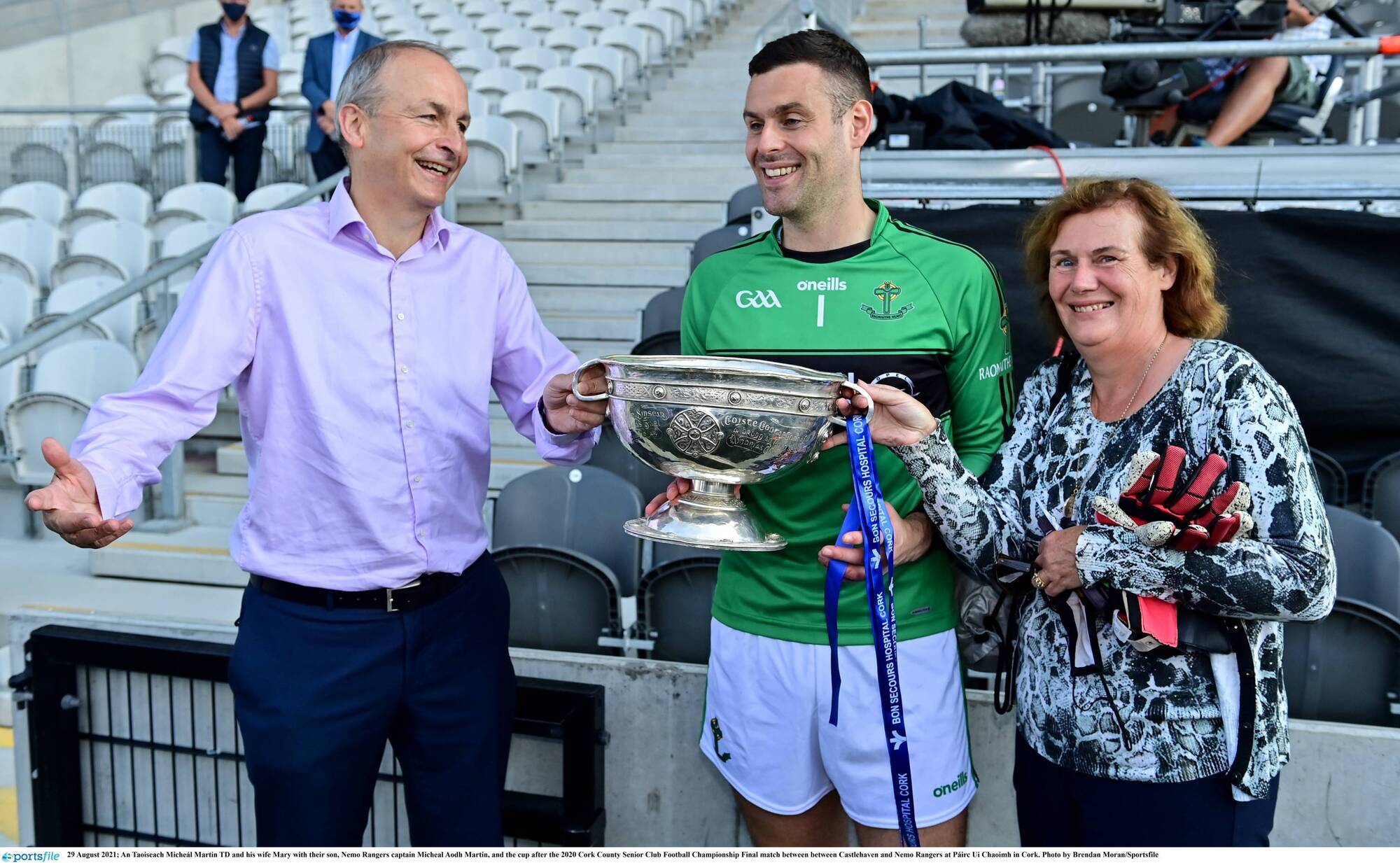
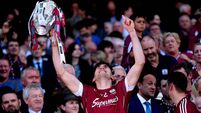
Family affair: An Taoiseach Micheál Martin TD and his wife Mary with their son, Nemo Rangers captain Micheal Aodh Martin, and the cup after the 2020 Cork County Senior Club Football Championship Final match between between Castlehaven and Nemo Rangers at Páirc Ui Chaoimh in Cork. Pic: Brendan Moran/Sportsfile
In April 2022, Taoiseach Micheál Martin rated as the most popular leader in the country.
A survey for the showed that Martin was ahead of Eamon Ryan, Leo Varadkar and Mary Lou McDonald in the popularity polls. His party had seen a steady rise in its approval since its lowest point a year earlier. It had been a tough start for him as Taoiseach, but on a quiet Monday morning in Government Buildings, just weeks after that poll, the leader of the country was totally relaxed and in flying form.
Martin is grounded and has a love of sport that is deeply embedded in his family’s roots. He holds much personal perspective from restrictions, too. The virus prevented his wife, Mary, and their children from travelling to Dublin’s National Convention Centre to celebrate his election as Taoiseach. That was a huge blow to the army of supporters who have backed him since his first election to Cork Corporation in the mid-1980s and seen him climb the political ladder. Twice he missed out on the traditional St Patrick’s Day summit between the Taoiseach of the day and the US president. In 2021, the White House’s strict covid protocols meant that the meeting between the two leaders was held online. In 2022, the Taoiseach tested positive for the virus just hours before he was due to meet President Joe Biden in Washington DC.
Aside from the personal side of it, he had to chart a course for the country through one of the greatest public-health crises in a century. He saw dark days, new dawns and felt the great uncertainty that knocked us off our tracks. It was a period punctuated by ‘state of the nation’ addresses, which either confirmed new lockdowns, re-established restrictions or unveiled road maps to recovery and eventual freedom.
At the tail end of it all, the Taoiseach was able to stand over that outstanding vaccination programme, which he felt offered the country a way out of the crisis.
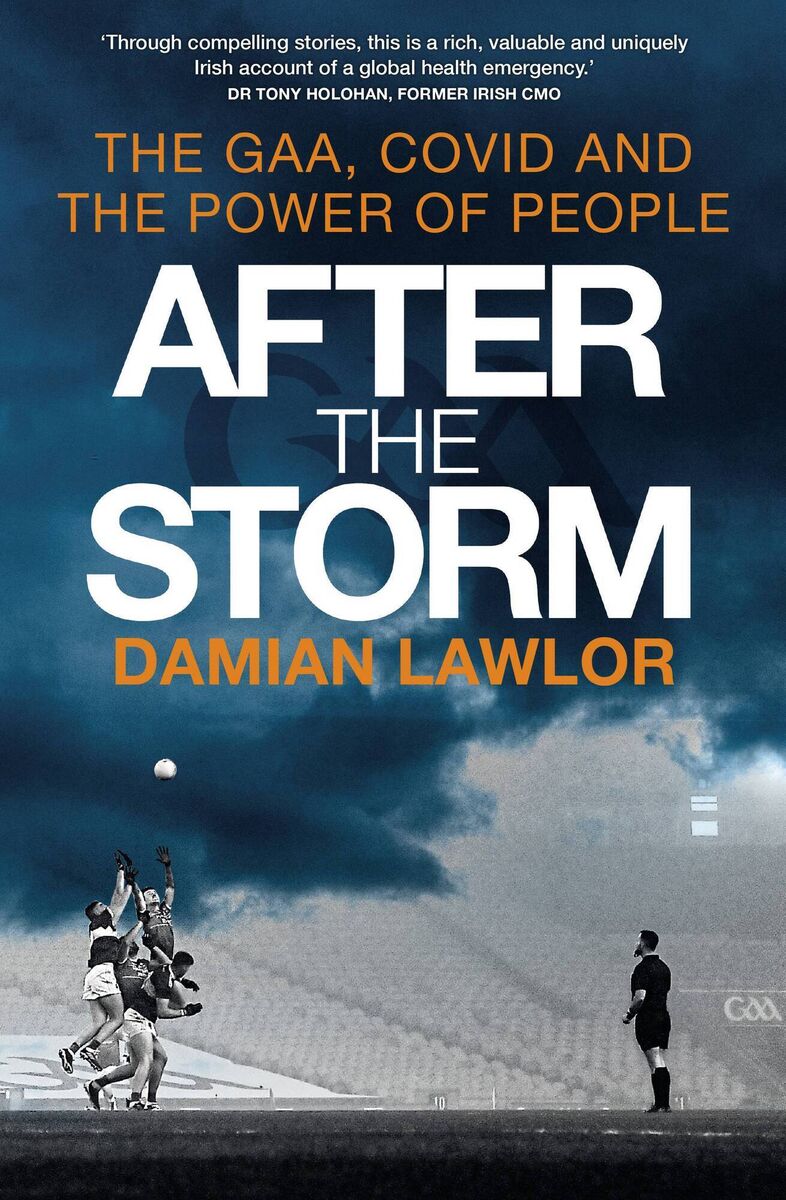
He was also highly instrumental in ensuring that the 2020 and 2021 All-Ireland championships were played and completed. And in making sure people had something to look forward to in testing times.
"It was important to play them," he stresses. "To me, the All-Irelands would stand as a symbol of resilience against the pandemic. The nation was bowed down because of the virus and we needed to lift people’s spirits," he says.
"Even though they couldn’t go, they could watch games on TV. I didn’t want 2020 to go down as the year we had no championships or All-Irelands. History would show that was the year there was no final and I didn’t want that.
"I knew we could do it. It would not be an ordinary championship, but it would be something. I knew we could get there, and the GAA felt we could too.
"And I don’t say this lightly for one second. Having the games, especially in the dark winter of 2020, they were a life saver. They were a life saver for some people. I mean that."
*****
The Martin family have a deep connection with Gaelic Games. The Taoiseach’s son, Micheál Áodh, is the current Cork senior goalkeeper and younger brother Killian is emerging nicely at club level, where he plays as intermediate netminder for their club, Nemo Rangers. The boys’ uncle, Sean, a well-known Cork City councillor, played between the sticks for the county in the 1976 All-Ireland minor final.
Ultimately, the love of sport and Gaelic Games streams back to Turner's Cross in 1969, when he was born to parents Paddy Martin and Lana Corbett. His father was known as ‘The Champ’. A bus driver and inspector with Córas Iompair Éireann, Paddy was among the founders of the National Bus Workers’ Union and a gifted amateur boxer who represented Ireland 13 times, often headlining events at City Hall in the 1940s and 1950s.
After his primary education in Chríost Rí, just around the corner from O’Connell Avenue, the future leader of the Irish Republic progressed to secondary school. With his brothers Paudie and Sean, he joined Nemo Rangers as a kid. "There was one small hut on Patrick’s Street which served as a games room, and then the club would bring us out to play games at the Tramore Road. It had galvanised sheds where we could change, and we walked out to play there," the Taoiseach recalls.
"I think we were very lucky to grow up at a time when Nemo was really taking off. Chríost Rí were in several finals, Nemo were going well, Cork were going well – we would make paper hats as kids, go to the games to support, and it quickly became a cultural thing.
"We had a teacher called Br Colm, who was from Donegal. He trained teams at the school for decades and won 50 Munster titles for the school across all codes and levels. He was my history teacher too, and I developed a passion for the subject from him. When we entered secondary school in 1973, he spent the first month strategising how Cork could win the upcoming All-Ireland final against Galway. He would stand at the blackboard and go through the team layout. He reckoned the team had a strong spine – with the likes of Humphrey Kelleher, John Coleman and Denis Coughlan – and that would be enough."
* * *
From the outset of the pandemic, the Taoiseach says there was a huge focus placed on mental health.
"The early phase, those first three or four months, for people who were unaffected by the virus, was almost something of a novelty in a sense.
"We didn’t know what we were dealing with, and we had to be cautious, hence the lockdowns. We were very conscious of people’s mental health and the impact that restrictions would have on young people. Spring and summer are times for young people to be out there on pitches or whatever they like to do.
"We were restricting all of that and it was a big concern for us. The elderly were confined to 2km and 5km limits too, and they were nervous. But I still reflect that young people had it worse in a way. I have a 20-year-old at home [Cillian] who is in third year in college and I know what they missed out on." With the target of helping to give people a lift, the government met with Croke Park officials in August 2020 to discuss the prospect of games being played that year.
"We were impressed with them," the Taoiseach says. "They needed financial help and we gave them €15 million in 2020 and €20 million in 2021. We helped other sports, too. Like with enterprise, we didn’t want shells at the end of the pandemic.
"We had to keep businesses intact, and we wanted to keep sporting organisations intact too. The FAI had a horrendous time pre-covid, with all that happened in their association, and we were anxious to give them a fair wind as well.
"What impressed us was that the GAA knew what was realistic in terms of the 2020 championship, what was possible and what was not. Overall, we didn’t have difficulties in saying we would fund sport. We knew that clubs of all codes up and down the country were the heartbeat of the land." Martin admires how the association held firm when huge pressure came on at different junctures to open club premises to locals, as young people especially struggled with the lack of an outlet.
"They shielded the government well, put it that way," he says. "They said, 'We’ll look after our operations – but we need X, Y and Z.'"
The GAA were obviously not the only ones taking heat for not opening their facilities. Most of that shrapnel flew in the Taoiseach’s direction. He didn’t have too far to travel to face it either.
"I was getting advice everywhere. My two lads at home were giving me lots of counsel, for a start. They were watching the science all along, in fairness. Initially, they were all up for having a zero-covid policy in the country, before changing their minds on that later.
"Cillian was telling me that the training pods were a stupid idea, that no one was obeying them. I was saying, 'I don’t want to hear this!'
"Everyone was telling us what we could do. Advice was there, left, right and centre, but, look, that’s understandable."
As he reflects, he is in no doubt where and when momentum shifted in the country’s fight against the disease. And in the ability of sporting organisations to be able to resume games, with crowds back in large attendance.
"The vaccination programme was the game-changer," he states without hesitation. "The big concern was that the virus was very transmissible in a congregated setting and that made it hard for sport to make quick progress. But public-health officials were conscious of the benefits of sport too, so we were all of one frame of mind.
"The vaccinations changed everything. It meant we could phase back towards normality.
"Another important decision was our move to deem GAA an elite sport, even though it is not professional. It was important to include the GAA players in the category that was going to be allowed to return to sport during Level 5 restrictions. It was important for the players, and I think the county needed sport – even if just on TV – to lift themselves.
"And it did lift people. And with the split season, you can see that legacies have come out of the whole thing."
Trying times for the organisation have already been outlined, including that tentative period when they lost that elite status.
But the over-zealous county final celebrations, training breaches and invite to Dr Glynn to present the empirical evidence which led to the association curtailing its activities and crowd limits were very high-profile matters. The Taoiseach is sanguine about most of those and has his own insight into one of those episodes.
"We opened pubs in September 2020 and club finals were held around that time," he says. "Following one weekend’s celebrations which were well publicised, John Horan rang me to say, 'Taoiseach, we are cutting out all county finals now. They are gone'.
"Now, Nemo were due to play Castlehaven the following Sunday in the Cork senior football final." The Taoiseach laughs again. "So, there was pure silence on my end for a good few seconds and then a few more again," he says. "I was thinking of the calls I would have to make to Cork that night and in my mind I was like, 'Are ye sure about this?'"
When he went home, his son, who had been diligently preparing for the big game, was all out looking for answers.
"I got desperate flak at home from Micheál Áodh." He laughs.
"I said, ‘Hang on, we didn’t ask them to do it.'
"Although I must say the headline 'Taoiseach intervenes to save Cork football final' did enter my head for a minute," he jokes. "That was before I decided 'Taoiseach stays shut up about Cork final' was probably a safer bet.
"At the end of the day, you were right in the middle of it and none of it could be helped. I would imagine the GAA were very anxious about the negative publicity that the final celebrations would gain.
"One of those cases was with the Rockies [Blackrock]. But in fairness to them, they had planned for all the celebrations to be curtailed and limited to their own premises until some fella tweeted that the team were walking down Church Road – and half the village then went out and walked the other way to meet them," he says.
"Look, I don’t get hot about it. A lot of that was human nature."
Regarding Croke Park officials asking Ronan Glynn to explain why bigger crowds couldn’t be allowed to attend games, the Taoiseach says Dr Glynn dealt with the issue in an admirable way.
"Public health personnel, including the Chief Medical Officer Tony Holohan and Ronan, took a lot of heat. People were wondering, 'Why is this happening?' Everyone can be an expert.
"In general, we worked with the sporting alliance group of the GAA, IRFU and FAI very well. Lessons can be learned from that – all bodies working with government in a sensible way to ensure the phased and gradual return of sport.
"That earns trust. We were confident in their capacity to do what they said.
"With the GAA and the celebrations and mask-wearing, people have to be realistic about human behaviours, too. The whole two years was a massive human behavioural experiment. We got the public to hold tough and the extraordinary thing was they held tough for so long.
"The phased returns, the controls, the constant messaging on health and safety, it did work. And in getting back to play games, the GAA adopted a similar policy."
* * *
The Taoiseach was in his back office when Mark Keane scored late in the 2020 Munster semi-final to give Cork a dramatic, late win against raging favourites Kerry. He let out a whoop of celebration and immediately hit the phones to chat to friends he would normally be at the game with or might share a pint with afterwards.
In 2021, he was in the stands watching Micheál Áodh take punishment from the same opposition, as they lost the Munster final. It can’t be easy watching your son compete at the highest level – especially in the most testing position of the lot.
"I’m becoming more philosophical about it." He laughs. "As he’s a goalkeeper, its murder watching – the pressure is on. Micheál Áodh himself would say that Stephen Cluxton raised the bar and changed the role of modern goalkeeping. He came up to Croke Park to watch him closely and look at that famous kickout he had, where he would find half-forwards in space.
"He played soccer with College Corinthians and got great goalkeeping coaching at FAI level from Steve Bermingham. On that Corinthians team – among others – were Eoghan O’Connell, who later signed for Celtic, and Brian Lenihan, who played for Hull City. They were a great team, and lucky that they all came together at the one time. I’ve followed his teams since he was 10 or 11, though I knew he would get serious with Nemo at around 16, when there was no real future with soccer.
"The Nemo lads quickly put him in goal and he pulled off some brilliant saves in an U16 match against Douglas, who had Tony Davis in charge. Tony recommended him for the Cork development squad. He has been playing for Cork teams since. He has great application through all the ups and downs. He learns all the time and stays at it.”
The Taoiseach’s face clearly lights up when he speaks of those moments and what those sporting memories have done for his family.
"You can resonate with other parents and it’s great to be part of that community. So, it’s total joy and it has helped us through all our difficulties and traumas in life."
Does the son take any advice from the father? "Not a bit," the Taoiseach replies.
"Mary is mad as a hatter at games, so I have to try to keep her cool," he jokes. "That’s about my role in the whole thing. When he was 11, College Corinthians asked Micheál Áodh and a few others to present medals to under-8s and at the same time the Nemo under-13s were playing. He wanted to go to the medal presentation, but I told him he couldn’t let down his other team.
"That evening he asked Mary, 'Does Dad think he is going to dictate the rest of my life?' He was only 11." The Taoiseach smiles. "But message received and fair point, too. It was a great lesson for me. Back off – he has a life to lead. Fathers make a mistake at times; they can put too much pressure on kids.”
With his tenure as Taoiseach set to complete at the end of 2022, the Corkman is glad that sport helped people through such a turbulent time.
And the legacy of it all?
"I mentioned the split season. But how well the sporting organisations came across when they all worked together was impressive. It was very important that there was strength in unity and an alignment between the organisations. They behaved professionally and sensibly instead of shouting and roaring and throwing brickbats. They showed the spirit of what they were about, and it does augur well for sport here going forward.
"You can see Stephen Kenny’s Irish soccer team, from what they put into it, that every player wants to be there. Hopefully there are great days ahead there also. I look at Chiedozie Ogbene, who played with Nemo, and see how happy he is to wear the Irish shirt. What a footballer he was. His biggest strength was that he knew how to tackle without fouling. His speed, too. Micheál Áodh was always ringing him, but eventually soccer came calling."
Fundamentally, the Taoiseach feels that what Covid illustrated is the centrality of sport in our lives and from a mental health and physical health perspective.
"Completing the 2020 championship is something I was very determined to make happen. In my heart I was saying, 'These games must go ahead.' It was almost as if we had caved into this thing if we couldn’t have an All-Ireland. The championships had to happen. It’s who we are."


CONNECT WITH US TODAY



Be the first to know the latest news and updates