Kerry v Dublin talking points: Manner of victory may prove to be Kerry's greatest success
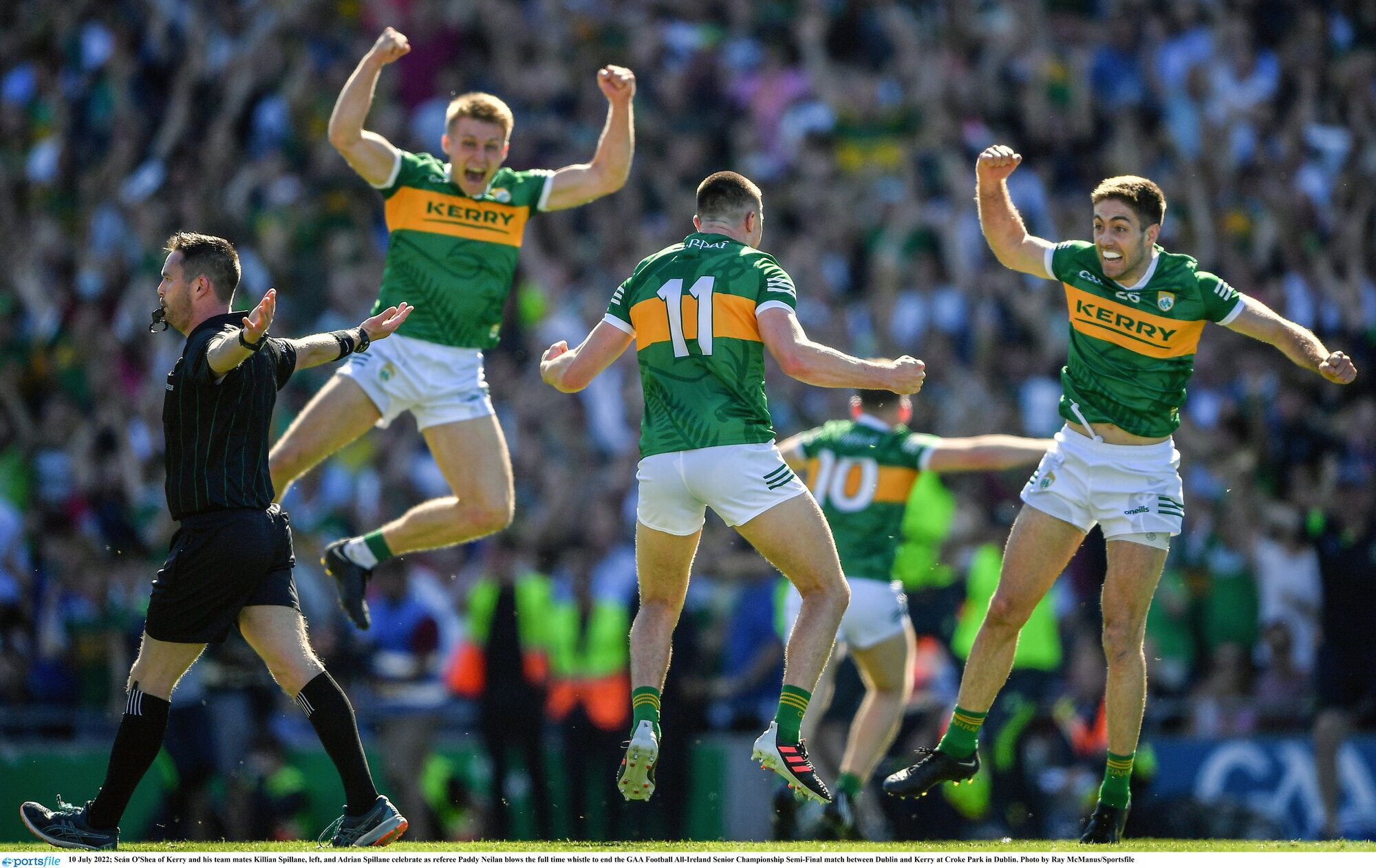
JUMPING FOR JOY: Seán O'Shea of Kerry and his team mates Killian Spillane, left, and Adrian Spillane celebrate as referee Paddy Neilan blows the full time whistle to end the GAA Football All-Ireland Senior Championship Semi-Final match between Dublin and Kerry at Croke Park in Dublin. Pic: Ray McManus/Sportsfile
The irony was dripping all over the moment. The twin narrative of Dublin’s odyssey of dominance, along with Kerry’s decade of misery and oppression beginning with a late winning free kick from almost the same spot as Stephen Cluxton’s iconic free in the 2011 All-Ireland final was laced all over Seán O’Shea’s late booming winner.
It was almost a fitting way for Kerry to finally staunch the Dublin bleeding but it was even more important in the context of the trend of the game, and what another defeat would have meant given the grip Kerry had on the match early in the second half.
How would Kerry have responded if they had gone down here? Marc Ó Sé said on ‘The Last Word’ on Friday evening that a defeat would have “set Kerry back ten years”. That was an overstatement but it would have been a colossal setback. In his TV co-commentary just before the match began, Kevin McStay listed off the sorrowful mysteries of defeats Kerry had suffered in recent seasons. “This has to stop,” said McStay.
That it finally did in the circumstances made the sensation all the sweeter again. Kerry looked to have burned Dublin off when they went three ahead in the 60th minute but Dublin had shaved the margin down to one just three minutes later. Kerry only scored two points in 30 minutes of the second half. When Dublin twice levelled the match after the 69th minute, they were in territory they have become so comfortable operating in, while Kerry were in a tricky place they have consistently failed to negotiate their way out of in recent years.
But they found a way. And the manner of it was the ultimate denouement, or as Kerry would like to believe, the perfect new beginning.
When Kerry played Dublin in the league on a wet miserable evening in February, Kerry’s kicking game was at the core of their seven point win in Tralee. When drawing with Kildare a week earlier, Kerry had gone away from that core tenet of their game which Jack O’Connor was ultra-keen to return to Kerry’s style. Doing so against Dublin was a further endorsement of the direction which O’Connor wanted this team to take and they proved as much again on Sunday.
Kerry signalled their intent around that policy from the opening minute when David Moran’s first instinct in possession was to look up and see what was on inside. His first long kick-pass inside was turned over and Dublin mined their opening point from that source. That direct kicking game is always a risk, especially when Dublin had a rotating sweeper, but Kerry never wavered in their conviction around that strategy.
In the first half, Kerry kicked eight long balls into their full-forward line and won five, mining 1-3 from that possession.
They continued with that policy in the third quarter when winning every one of the nine balls kicked in, and translating that possession into three more points.
When Dublin got a grip midway through the half and Kerry were sucked further back the field, Kerry were forced to run the ball more. They didn’t kick the ball in again throughout the fourth quarter but they did when the need was greatest. Kerry’s last two scores came from long direct balls, with O’Shea and David Clifford fouled for the two late frees converted by O’Shea.
At the business end of the championship, quality always beats quantity, especially when it’s polished with clinical execution. The wind was a factor but after just six minutes yesterday, Dublin had seven shots to Kerry’s two but they still trailed by one point. The wide count was 4-0 to Dublin after only 15 minutes, while Kerry didn’t have their first wide until the 18th minute. At half-time, Dublin’s conversion rate was just 43%, with Kerry’s running at an impressive 69%.
Dublin only turned over the ball on six occasions in the first half but five of those turnovers were sloppy and Kerry mined two points off that possession, with the penalty also stemming from that source.
By the end of the match, Dublin had more attacks (38-36) and more shots (26-23). They created 22 shooting chances from play but Dublin’s overall conversion rate was a paltry 54% compared to Kerry’s 65%.
When Dublin were winning All-Irelands, their conversion rate was always above 65%. It was nowhere near that level yesterday, which further underlined Con O’Callaghan’s loss. Yet, even so, all Dublin needed was for their shooting to be a handful of per cent higher and they would have won the match.
In his man-of-the-match interview after the 2021 Munster final, Paudie Clifford was asked by RTÉ’s Damian Lawlor if he felt his chance had passed to play at this level, never mind excel at it. “Mmmm…maybe, maybe,” said Clifford. “Yeah, I did maybe, yeah.”
His breakthrough year was all the more sensational again because nobody saw Clifford coming like the whirlwind he whipped up in last year’s championship up until the All-Ireland semi-final. Clifford went into that match in the driving seat for Footballer-of-the-Year. The odds on that player being a Clifford would have been short at the outset of the championship but Paudie wouldn’t even entered a debate that would have been dominated by his brother.
That’s the shadow Paudie has always operated in but he stepped out of it - for a period anyway - yesterday when winning man-of-the-match. From 28 possessions, Clifford scored two points from two shots and had four assists.
David played well too, especially in the first half when he scored four points (from play or a mark) from five shots, with that missed shot striking the post which resulted in the penalty. He had two wides from play in the second half but David was fouled for that late free.
Overall, the contribution from the Cliffords was massive.
As one of Dublin’s greatest and most influential players throughout their golden era, Ciarán Kilkenny made his name as the ultimate footballing point-guard. His volume of possessions were always on a different level to everyone else. Possession numbers often carry an inflated importance because they can only be fully measured through output, but Kilkenny was still always the guy Dublin looked to because he was their on-field orchestrator.
Mayo showed the importance of shutting Kilkenny down in the 2017 All-Ireland final when Lee Keegan stuck to him like a leech and he only had a handful of possessions. Kerry didn’t have any designated man-marker on Kilkenny yesterday, with the job equally shared by Graham O’Sullivan, Brian Ó Beaglaíoch and Gavin White but Kilkenny’s possession numbers (24) were nowhere near his normal levels.
He did score three points from five shots, which was more scores from play than any other Dublin player. Kilkenny also had one assist. Kilkenny did well in the circumstances, but the fact that Dublin needed more from him further illuminated just how brilliant Kilkenny has been for so long, and how important he always has been to Dublin’s success.


CONNECT WITH US TODAY



Be the first to know the latest news and updates