'Any day I hurled with Galway was a happy day. I always believed.'
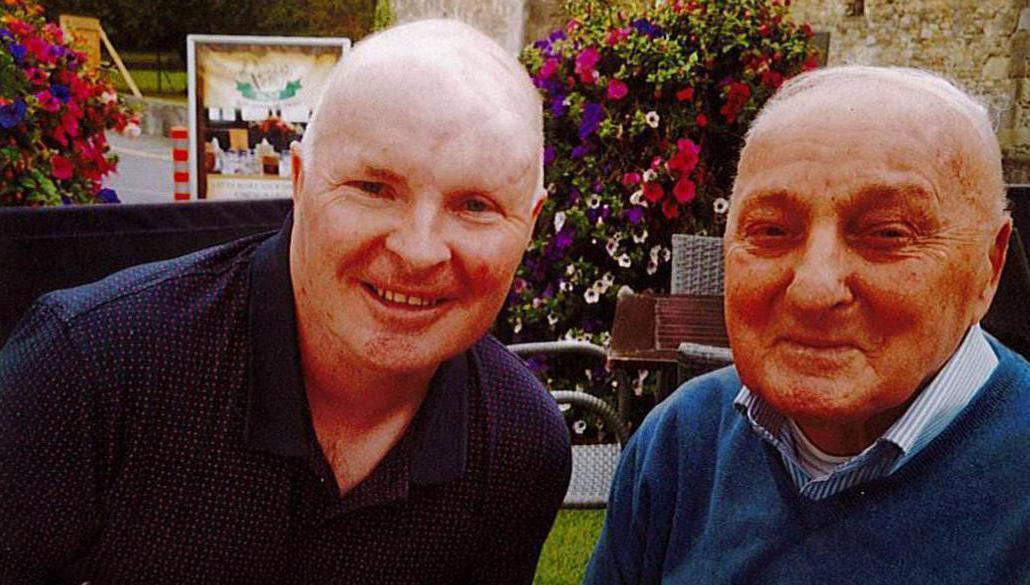
Father and son: Séamus Duggan and Jimmy Duggan in 2022.
Jimmy Duggan is getting swept away, carried out on to St Brendan’s Park, Birr.
No resistance made. The young man believes Galway are in the All-Ireland Senior Final. He thinks his native county has seen off Kilkenny by two points, that they will now meet Cork or Antrim. Duggan had just captained a Minor team that beat Dublin by two goals in their All-Ireland semi final.
But July 27, 1947 did not end up one of Galway hurling’s headline days. The referee has whistled for a Kilkenny free rather than for full-time.
The game restarts, crowd cleared. Panache from Terry Leahy and Jim Langton means three Kilkenny points and their famous margin, a single point, 2-9 to 1-11. They manage the same gap against Cork in a legendary Senior Final.
How did that moment feel, his county trembling on the brink?
“I was young,” Duggan states, his smile rising a couple of notches. “Just gone 17. At that time of life, you just look forward. We thought Galway’s day would come, and I just hoped to be part of it.
“Seán, my older brother, was already there, as goalkeeper. He had captained Connacht to the Railway Cup in 1947. He played really well against Kilkenny in Birr.”
This man is 92 since last January. Yet 75 years have not clouded recall: “Galway put in a great 60 minutes, and almost had it won. The referee, of course, hadn’t blown up. Actually he was a soldier up in the Renmore Barracks. But everyone thought the match was over and that Galway had it. We all went mad out on the pitch. There was a couple of thousand that ran on, because there was no sideline barrier.
“But it was no good. That was a big disappointment. The County Board here had a meeting. They decided to appeal to Central Council, to get a replay. Their decision was that the referee’s decision is final in all things, including time.”
Finding a structure that maximises Galway’s contribution is an eternal conundrum. Duggan looks back and looks forward: “The lack of championship games always went against us. You only had the one match nearly every year, an All Ireland semi-final. If they got over that one, you were going into the All-Ireland Final more or less cold. We got a bye into two All-Irelands in the 1950s, against Wexford in 1955 and against Tipperary in 1958. Same story. You hadn’t even one match behind you.
“Of course, Galway came good in the end, winning the All-Ireland in 1980. But I’d say lack of match practice was the major factor, over the years. Galway should have won more.”
He summarises: “We had a fine team at times but just couldn’t get ourselves properly planted. Kilkenny and Cork and Tipperary and all the rest always had at least a couple of matches in the Leinster Championship or in the Munster Championship before they met us. Sometimes they’d had three matches.”
This native warmly supports current structures: “I was disappointed with Galway against Kilkenny in the Leinster Final. They didn’t play up to the standard required. But it has been a serious innovation for Galway to get into the Leinster Championship, back in 2009. I think it’s doing them good. They get excellent quality games. I have my doubts they’d have won the All-Ireland in 2017 if they weren’t in the Leinster Championship.
“I think Leinster hurling suited Galway more than Munster hurling did in my day. We went into Munster for ten years, from 1959 to 1969. But we didn’t do any good at all in there.
“But I’m not pessimistic about Saturday. If Galway can improve on that Leinster Final, I think they will trouble Cork.”
September 1951, Jimmy Duggan is sitting in a plane. He was a sub on the panel that recently beat Wexford in the ‘Home’ NHL Final, a young hurler growing into his surname. “The first Galway team that ever went to New York,” he notes. “I was only 21, one of the youngest. Seán [Duggan] and Hubert Gordon and John Killeen were seasoned men. They had a lot of service put in with Galway and they were coming near the end of their time.
“It was a fierce occasion, because none of us had ever been in a plane. We thought it was marvellous. We were out in the middle of the Atlantic, so many miles up in the air, and there were lads taking a few drinks and having the laugh, chatting and talking.”
Novelty flashed into terror: “Next thing, the plane was going along like that [indicates smooth line forward with his right hand] and then didn’t it go down [indicates a plunge with same hand]. I thought we were done for. By God, it woke me up, all of us up.”
Terror released its spring: “But it was an air pocket. The captain of the plane came on the microphone and told the passengers: ‘There is no need for alarm. There is no danger.’
“We flew into Gander in Newfoundland, to stop off and refuel. We got a bit of a meal and we were back okay, and then we carried on to New York. It was a wonderful occasion. And we came back after the match by ship, and landed into Cobh. We had the best of both worlds.”
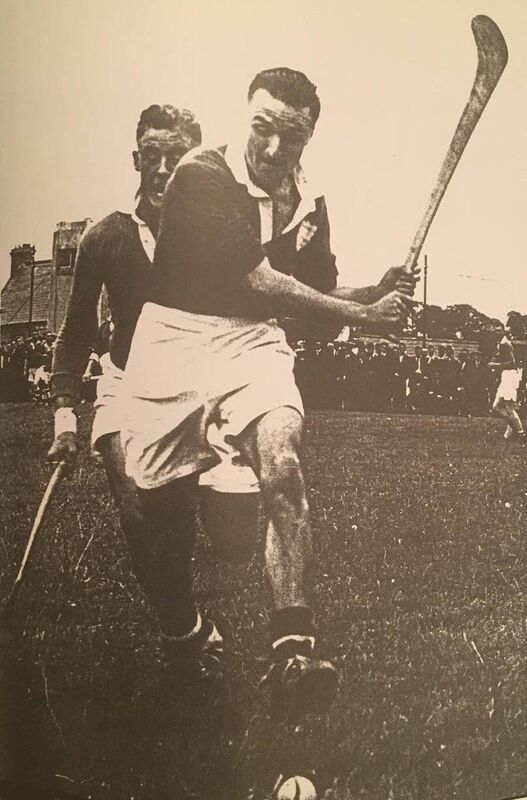
Every match between two counties recalls previous meetings. Cork and Galway contest this weekend’s All-Ireland quarter-final, with the Munster team down as favourites. This assessment generally held over the decades, even though the Westerners succeeded on the last four championship occasions (2009, 2011, 2012, 2015) and in eight of the 14 outings since 1975. That year marked an inaugural championship victory over Cork.
Galway failed to reach a Senior Final between 1930 and 1952. The 1953 season saw them pip Kilkenny in an All-Ireland semi-final. Cork won that Senior Final by 3-3 to 0-8, after a contest most remembered for a substitution. Mickey Burke, Galway’s captain and right half back, went off injured, following a clash with Christy Ring. Punches were thrown at Ring by opposing players that evening and the following morning.
Jimmy Duggan never wanted to be someone, that time or since, dwelling on this incident. “I don’t see the point,” he emphasises, with a gentleman’s simplicity. “Didn’t see the point then, and never saw the point. My recollection is that it happened when Seán [Duggan] sent out a ball that went over the head of Burke and Ring. Everyone, the players and the crowd, had their eye on the ball. Whatever happened then happened.
“I didn’t see it. There were 70,000 or more people there, and maybe not even a hundred saw it. Nearly everyone had their eye on the ball that Seán hit.”
He draws a moral: “I don’t think you could say any one thing cost us that All-Ireland. Where would you stop? I was put back from the forwards to centre back later on in that game. I was on Josie Hartnett, a powerful strong hurler.
“This clearance came down from the Cork backs, at about head height. I can still see it coming, skimming along. My instinct was to pull first time on balls and hardly ever to catch them. So I got ready and had the hurl cocked, but Hartnett came in at the last second and I ended up connecting with his hand and the ball.
“The referee gave a free, which I don’t think it was. And they scored the free, which kept them in the game, at a time Galway were going well. Cork only scored three points on the day… That free was crucial.”
Jimmy Duggan carried on. There were those further disappointments in 1955 and 1958. But Jimmy Duggan carried on. “Any day I hurled with Galway was a happy day,” he stresses. “I always believed.”
He was a stalwart with Connacht in the Railway Cup for a decade or more. He hurled with Galway until he was 37, stayed hurling with Liam Mellows, his beloved club, into his forties. He landed four Senior titles in that jersey.
Duggan was a stylist, a figure equally adept at half back and half forward. “I was only a small light fella,” he laughs. “I wasn’t going to be hopping off big lads, fellas like Nicky Rackard! My approach was to get out first to the ball and play it on, to keep moving and moving.”
I mention the remarkable fact that three of Galway’s forward line in 1953 are still alive. Along with himself, the right half forward, there are the right corner forward and the left corner forward, Ardrahan’s Miko McInerney and Castlegar’s Pádraig Nolan. “The two of them were really good,” Duggan underlines. “Fast and lively. It’s great that three of us are still around. But I don’t think they’ll be looking for us to help out at the weekend!”
Laughter sends us richly towards departure. Séamus Duggan, gentleman to the end, walks with me down College Road, back to the house where his father grew up and until recently lived. He had met me there earlier, a guide to his sister Colette’s house, a short distance away.
I tell him I have rarely met a man as genial as his father, someone whose natural goodness shines with such force. Then I head on down into the city, pausing at the top of Forster Street to look around at Galway under swathes of sunshine. The same pagan place, west of Eden.
Here was where I spent the summer of 1992, three decades ago. Nothing can make you understand how little of life is youth.
A plaque lies on a building to my left. Over for a look and I see, as if by epiphany, the marker celebrates Seán Duggan’s contribution to Galway life. The older brother stayed renowned as one of the truly outstanding goalkeepers. Patrick ‘Mogan’ Duggan, another brother, came on in the 1953 Senior Final. The Duggans count as a sovereign GAA family.
There is something about this part of the world and slant connections. I had known of this plaque but not of its location.
Here remains a special place, uniquely atmospheric. Quay Street ripples with young people, contentedly bleary from last night’s fun. Only the salmon, moving inland, leave Galway unchanged. Jimmy Duggan has lived in this city his whole life, never wanting to be anywhere else.
Hurling is one the elements that makes the Ireland of seven decades ago still recognisable. Youth must always find its choir. Some find a song in sport and some find their music in the centre of Galway, where even the sunshine seems to have an alcohol content.
I am watching the young in their afternoon lull and thinking about two teetotal religious men in New York during the 1960s. America more or less bookended Jimmy Duggan’s career. He was chosen as one of the four hurlers who travelled to New York, Boston and Connecticut in 1965 for the Cardinal Cushing Games, a promotional initiative. The three other men were Paddy Molloy (Offaly), Tom Neville (Wexford) and Christy Ring.
The high compliment involved stands obvious. Jimmy Duggan was a seriously fine stickman.
“We were a fortnight in America,” he outlines. “I was with Ring, in the same room, for the fortnight. It was a proper education for me. With regard to hurling, anyway. He had great ideas about what they should do to promote the game. You could nearly read his mind, because it was working all the time. And he was trying to figure out things to do, to win matches, in his mind.
“There was never any talk about Mickey Burke. Neither of us wanted it.”
Duggan picks out a low-key revelation: “We went down to Mass, in St Colman’s Church. And on each side of the altar they had two flagpoles. One was the American flag and the other one was the Papal flag. At the back of each flag, there was an opening in the wall, with an electric fan in it. So they would put up the flags and put on the fan, and the flags would start blowing and billowing.”
He elaborates: “I was beside Ring and it was getting a bit tiresome for him, I’d say. When the Mass was over, they had the American national anthem, and the flags went up and the fans started blowing them.
“Ring gave me a puck of his elbow. And he says, in his real Cork accent, under his breath: ‘Come here out of that, Jimmy. Let us get out of this place. You’d think we were down in Thurles, at some Munster Final.’
“I thought it was a great statement.”


CONNECT WITH US TODAY



Be the first to know the latest news and updates