Remembering Phelim: The Galway icon who distributed the golden tickets
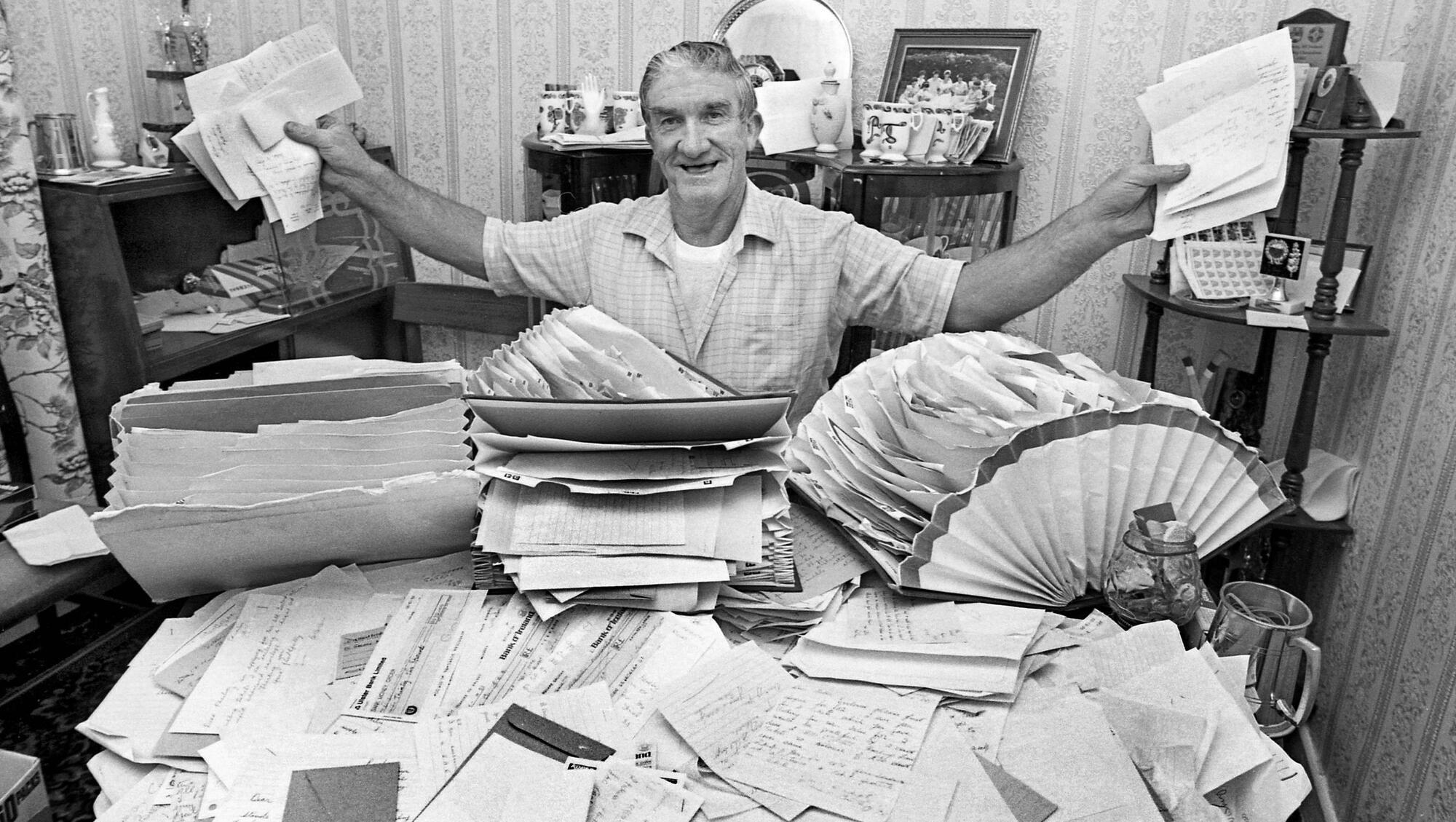
The late Phelim Murphy at his home in September 1988 with some of the vast ammount of letter requests for All-Ireland tickets. Photograph: Joe O'Shaughnessy
As he lay in repose at Our Lady’s Chapel, Lackagh last Monday evening, the throngs of people queuing outside to pay their respects to the late Phelim Murphy was a throwback to simpler times.
Earlier that day, thousands of Galway supporters had queued online from 12 noon in the hope of getting their hands on a ticket to today’s All-Ireland quarter-final. Several ended up empty-handed, the online allocation selling out in minutes.
There was no Ticketmaster or any other online means of distributing match tickets during Phelim’s 23-year tenure as Galway hurling board secretary. The manner in which tickets were handed out was far less sophisticated than today’s system, and one that typically included a long queue of people waiting outside to see Phelim.
For the seven All-Ireland SHC finals Galway reached during his reign as hurling board secretary from 1982-2004, the Murphy home in the tiny hamlet of Waterview, Turloughmore became ground zero for ticket distribution. Even Bernadette Keane who worked in the Galway GAA office in the city used to travel out and temporarily set up camp in Waterview in the build-up to these finals as supporters flocked from all corners in search of a golden ticket.
The former Galway county councillor and senator Jarlath McDonagh was approached by Phelim before the 1987 decider to request that the road down to the house be widened.
“He said to me, ‘If you don't get the road widened, there will be a crash because there are so many people coming looking for tickets’. He also asked that a light be put up outside the house because they were queuing in the darkness,” recalls McDonagh, himself a Turloughmore native and the man who succeeded Phelim as club chairman when the latter moved on from the role after 21 years service.
“The road is a highway down to the house now and the light stands there flickering away, a monument to Phelim.”
But wide and all as the council made the road, it was insufficient to deal with the volume of ticket-chasing cars in the days before the 2001 All-Ireland final against Tipperary. Such was congestion the Wednesday of final week, with up to 50 cars parked in the area at any one time, that gardaí had to close it to traffic.
“Frank Sinatra sang ‘I did it my way’ and I’ll tell you one thing, Phelim did it his way. He had his way of doing the tickets, and he’d call in all the daughters to help,” said Cyril Farrell, who had Phelim as one of his two selectors along with Bernie O’Connor when he returned for a successful second spell in the Galway hotseat in late 1984.
“He had a full battalion there in the house and they'd have all the tickets laid out on the couches and on the floor. There would be a queue going into the house. Phelim knew the people that were going to the matches, the genuine people. The others had to sweat a bit.”
The 2001 decider was his last as hurling board secretary, the heavyweight administrative figure stepping down in 2004.
Roles held during his time in office included three years as Connacht Council president (1997-99), which brought with it the title of GAA vice-president. And as was repeated to this reporter by several different people in recent days, it brought him immense pride to serve as a vice-president of the association during fellow Galwayman Joe McDonagh’s time as GAA president.
“The amount of work he did away from Galway hurling on the National Development committee, people probably don't fully realise that,” said long-serving Connacht CEO John Prenty.
“He went from a small farmer in Waterview to vice-president of the GAA, and that took some doing,” remarked Seamus Murphy on Galway Bay FM this week, Murphy a member of the Turloughmore six-in-a-row county winning team (1961-66).
Phelim came in as Turloughmore chairman during the first of those six successful campaigns, his an all-encompassing brief that stretched to manager of the club’s all-conquering seniors.
And as he would do in the decades after at county, provincial, and national level, Phelim led from the front, driving a professionalism within the club scene that was years ahead of its time.
Players were brought home from England, teams were fed after games, with Seamus Murphy even mentioning on local radio that they had a physio in their backroom team.
Money to pay for all of the above came from the Turloughmore carnival spearheaded by Phelim and Frank Fahy, a nine or 10-day annual event where crowds would flock to hear the finest of showband music.
“He had a great mind,” Farrell continued. “For a lad whose education didn’t go beyond national school because his father died young and he took over the farm, he was a very able man.”
The professionalism he brought to Turlough extended to Galway when he became a founding member of the county hurling board in 1971.
“When it came to looking after players in relation to gear, hurls, food, and hotels, Phelim brought a new dimension to it,” said three-time All-Ireland Galway winner Noel Lane.
“There were other counties where wives and girlfriends wouldn't be allowed in for dinner after league matches or bused up to Dublin for championship games. Phelim and Galway were ahead of the posse in that respect.
“You had managers, chairmen and other officials, but Phelim was in charge. He honoured that role by delivering to a high standard, and he took great pride in doing so.
“I was manager for a spell in the early noughties and I didn't always do things that he wanted me to do in his way. That would lead to fractious situations, but we never fell out. It was important that irrespective of what differences you had that you'd keep him on your side.”
Along with hurling and family, the other pillar in Phelim’s life was his religious faith.
There was never a Novena in Esker he wasn’t present for, while his wife Nellie was famous for stitching miraculous medals into Galway togs.
One final anecdote from Farrell: “The players didn’t want to be doing anything on a Bank Holiday Monday so I told him not to be agreeing to pitch openings. But if a nun or priest rang him to ask if we’d play in a pitch opening to raise funds for this or that, we were snookered because he wouldn't turn down religion.”
Throughout the piece, you may have noticed that we only ever referred to the man in question as Phelim. When someone is known exclusively by their first name, as Phelim was, their status in life and the legacy they leave behind is assured.
“He was an icon and a legend,” said Galway GAA chairman Paul Bellew.
Indeed, he was.
CONNECT WITH US TODAY



Be the first to know the latest news and updates