Christy O'Connor: How Kerry have adapted to Gaelic football's New World order
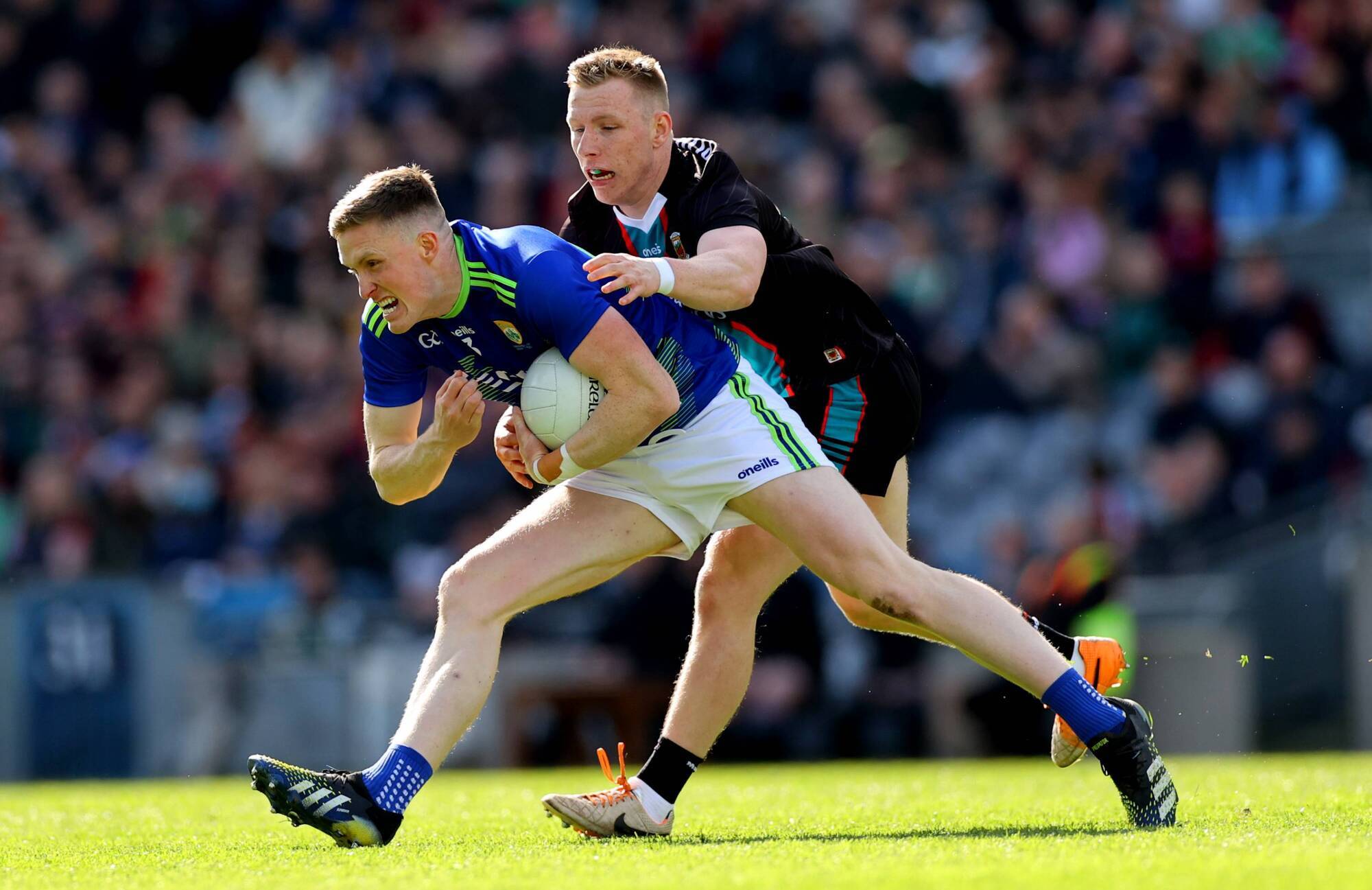
In the stride: Kerry’s Jason Foley breaks past Ryan O'Donoghue of Mayo in the Allianz Football League Division 1 final at Croke Park
The standout moment of the league final was David Clifford’s goal. The execution was a beautiful fusion of Clifford’s brilliance: the balance, class, skill, power, and finish all conjured in a streak of magic to provide more confirmation of his genius.
No other player in the game at the moment would have been able to engineer a goal from his starting position, from that distance and angle, inside seven seconds. Clifford is the most dangerous weapon in football, but Kerry would have been just as pleased with the launchpad of the score long before Clifford pulled the trigger.
Mayo were on the attack when a long ball from Kevin McLoughlin intended for Cillian O’Connor was cut out by Tadhg Morley. O’Connor was being closely marked by Jason Foley but McLoughlin’s ball never had a chance of getting near him; Kerry had three players inside the D, excluding Foley; they had four more players coming back either just about to enter the D, or within a handful of metres of it.
After making two quick link-passes out of defence, Tony Brosnan picked out Clifford, who was one of just four players on the field within 55 metres of the Mayo goal at that exact moment. Mayo had four players sprinting back but Padraig O’Hora wasn’t able to slow Clifford down before the chasing cavalry got anywhere near him.
The build-up to Kerry’s third goal was also highly instructive as to the new creed Kerry now abide by. As Mayo launched one final desperate attack, out of pride than any attempt to rescue a long lost cause, all of Kerry’s 15 players were within five metres of the D.
Only two of the 15 – Clifford and Brosnan – weren’t inside the D or the 20-metre line. When Conor Loftus tried to work his way through the roadblocks, it was inevitable he would be turned back. As soon as Gavin Crowley forced the turnover, Morley was on the 13-metre line, while Foley was inside the Kerry square.
Once the counter-attack began, Morley and Foley took off. Once Kerry got close to the 45 metre line, Morley was available to take the offload from Micheál Burns before passing to Brosnan. He shot for goal but the rocket was parried by Conor O’Shea before landing in Foley’s lap just outside the square.
It was just a tap-in for Foley but the real beauty was in the timing, speed, desire, intent and construction of the score; from when Kerry forced the turnover to when the ball hit the net at the other end, just 21 seconds had elapsed. Kerry effectively ran the ball the length of the field into the net.
In any debate or analysis about Kerry’s new defensive set-up or parsimony, the key point missed in that debate during the league were some of the scorelines Kerry were racking up.
Kerry scored 13 goals. As a comparison, Tyrone, Mayo and Dublin, last year’s other All-Ireland semi-finalists, scored 13 goals between them. Nobody took any notice because that is what Kerry do. But they’ve never done so before in such high numbers by conceding so little at the other end.
Kerry only conceded an average of 0-13. They only coughed up an average of 21.5 shots per game, with just an average of 13 from inside 30 metres. The opposition only managed an average of 0.6 goals shots per game. Mean. Very mean.
Everything is connected in the modern game because the quality and slickness of the top teams is governed by how they marry transition play with defensive stability.
Kerry have always had brilliant footballers. They want to play attacking football, to win with style, but adapting to that New World Order has been a constant challenge. Jack O’Connor improvised in his first coming as Kerry manager and has done so again now in his third coming.
Kerry will always look to dominate possession but Kerry were seen as a team often set up to be turned over, and ruthlessly punished on the counter-attack. The team’s structural organisation has rectified that risk but it’s also given them a licence to dominate possession even more.
In the league final, Kerry dominated on kick-outs. They only turned over the ball 17 times. Yet three of those turnovers were shots, while five occurred in the last quarter when the game was long over. In basic maths terms, more Kerry possession means less possession for the opposition, and less opportunity for them to inflict more damage on the scoreboard.
Getting huge numbers behind the ball may seem anathema to the Kerry creed, but they couldn’t continue to talk about the need to become harder to beat unless they were structurally set up to do so.
Any team can get 13 men behind the ball but a team with Kerry’s attacking threat can only consistently have that many players inside their own 45 if the team in possession have been sufficiently slowed down to enable those barriers to be erected.
Kerry may have wished to implement those principles in the past but they can’t be enforced without complete buy-in from the forwards. As well as denying that easy out-ball in the middle third, that consistent wave of bodies filtering back enables more players in the middle third to drop off and back into more of a protective shield. And once the ball is turned over, Kerry have the pace and kicking ability to shred teams on the counter-attack.
Going down this route was more practical for Kerry anyway when they had seen teams with inferior players to them, but a more cohesive system, consistently and routinely punish them in that manner. In last year’s All-Ireland semi-final, Kerry turned over the ball 35 times, but 30 of those turnovers were in Kerry’s attacking third. Tyrone bagged 2-9 from that possession. Massive.
What has changed? Paddy Tally’s arrival seems like the obvious answer. To date, all the key tenets of Tally’s philosophy are smeared across Kerry’s new style; defenders never being isolated one-on-one; always retreating into shape when the opposition are on the attack; rapid transition and counter-attack.
Tally has enjoyed various levels of success with the teams he has coached for 20 years but his greatest achievement was guiding St Mary’s to a first Sigerson Cup title in 28 years in 2017 with an abrasive counter-attacking system.
If Tally could guide a team picked from less than 200 male students to that title against all the hugely populated and highly resourced universities and IT’s, trying to adopt a similar system with a team of Kerry’s depth and talent was the most attractive proposition in the country for him.
O’Connor and Tally have been friendly for years. The word was that Tally was going to Kildare with O’Connor before he departed to take the Kerry job last October. As soon as he did, O’Connor declared his intent for Kerry to be better defensively set up by announcing that Tally was coming on board.
O’Connor has never been afraid to learn from the Ulster way, which he openly admitted doing after the 2005 All-Ireland final defeat to Tyrone. He courted Ulster opinion. O’Connor found tackling drills on the Ulster Council website and rigorously applied them to Kerry training, which was a radical cultural shift for a Kerry coach or manager.
O’Connor hasn’t been slow to return to Ulster again for the answers after another big defeat in Croke Park to Tyrone, albeit not on his watch. Yet it is also too easy to say that a new coach and an altered philosophy has turned Kerry into the mean machine they have become.
A year older and wiser, the team has also got physically stronger and better conditioned, as any top team does with so many players still under 25.
Jason Foley is a prime example. He was always a good footballer with searing pace but Foley was physically broken up with cramp in extra-time of last year’s All-Ireland semi-final. Foley looks stronger now, but, with such protection in front of him too, he doesn’t have to expend so much energy chasing forwards one-on-one and has plenty fuel in reserve to join the counter-attack.
There is a meaner edge to Kerry all over the field, especially in the tackle and in contact, but there is also a greater tactical awareness of the system on the hoof. Against Mayo, Jack Barry spent the first 15 minutes as a plus-one before Paudie Clifford took over that role from centre-forward.
Kerry often had two players in that protective role, but rotating their plus-one gives Kerry more flexibility, fluidity and unpredictability within the system. A player goes into that plus-one position when he is in that place and it is the right thing to do.
Having such pace and athleticism in their defence now also increases the licence players have to get forward when Kerry force the turnover. Conversely, when Kerry are turned over on their own counter-attack, they have the pace and power to slow down the opposition’s counter-attack and get into their default position of having 13 behind the ball inside their own 45.
A lot of that trench work in the league final was done by Adrian Spillane, who was immense in slowing down Mayo when in possession. Spillane has been a revelation. So has Morley - who didn’t start any championship game last year - since being redeployed to centre-back. Kerry are working much harder together as a unit now where their selflessness all over the field are ensuring they are abiding by the modern defensive code of facing, not chasing.
It may have only been the league but all of the numbers are turning in Kerry’s favour. In the final against Mayo, Kerry mined 3-9 from turnovers, with all three of their goals originating from turnovers inside the Mayo D. Kerry also could have had another two goals.
They also look to have settled on their goalkeeper during the league final in Shane Ryan. Shane Murphy is an excellent ‘keeper, but his kicking game came under pressure at stages, and he didn’t have the same physical presence under high balls as Ryan during the league. That was obvious in the number of high balls Murphy punched away. That stuff leads to turnovers, and Kerry don’t turn the ball over as often anymore.
The league final wasn’t an accurate gauge because Mayo were so poor. The real tests will come down the line, especially if Kerry are put on the backfoot towards their own goal. But the system is designed to firewall those risks now.
The new creed is the new code.


CONNECT WITH US TODAY



Be the first to know the latest news and updates