Liam Griffin: Nickey Rackard did more for hurling in Wexford than anyone did for any county
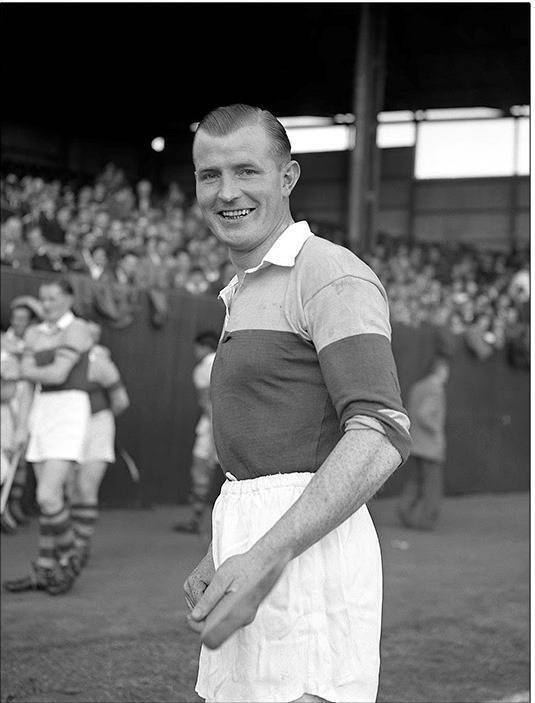
SHARPSHOOTER: 65 years after his retirement, Nickey Rackard remains the leading all-time championship goalscorer.
The hand that held the stick of ash
The man who led with style and dash,
Oh! Carrigtwohill once felt the crash
And Bennettsbridge and Thurles.
And when in later life you beat
The Devil, on that lonely street,
Then showed us how to take defeat
With dignity and courage.
The last parade was long and slow,
The last oration- spoken low,
And as on green fields long ago,
The ‘Diamond’ stood beside you.
Old comrades flanked you side by side,
The tears they shed were tears of pride,
An ash tree toppled when you died
And scattered seeds at random.
Poem by Tom Williams
Legacies matter in hurling. They matter in Wexford more than in most places. Nickey Rackard was born on this day 100 years ago. If he had never existed, would the sport still be played in the county?
I’m not exaggerating, not by much anyway, and I’m not trying to be controversial. Wexford have won six All-Ireland senior hurling titles. Were it not for Rackard they might have only one to their name.
That’s how much Nickey Rackard did for the game in Wexford. More, I’d suggest, than any individual ever did for the game in any county.
The Ireland of the 1950s was a place of recession and high emigration rates. The Wexford of the 1950s was a place of no recession, its population inoculated against hardship. That’s what it felt like, at least. It was the kind of thing that can happen when a team comes out of nowhere to rule the land.
Younger readers may not realise this but up to then Wexford had only ever been All-Ireland champions once. That was in 1910 – the mists of time when viewed from the ‘50s. Rackard and his colleagues changed everything. They made Wexford a leading hurling county and the echoes resound to this day.
They were no overnight success story. They spent years knocking on the door. Wexford had been a hurling desert throughout the 1920s and ‘30s. A chink of light finally appeared in 1940 when the county won the Leinster junior title with a midfield duo of Rackard, who had made his name as an outstanding colleges player with St Kieran’s in Kilkenny, and Paddy O'Connor, the father of George. Rackard was still a minor but he lacked nothing in size or confidence.
That humble junior triumph of 1940 created ripples. A number of strong teams gradually emerged: Cloughbawn, St Aidan’s in Enniscorthy and the Rathnure of the Rackards, Martin Codd and Jim English. Rackard cajoled players into thinking big and persuaded the County Board that Wexford could win an All-Ireland.
The notion of Wexford winning an All-Ireland, and proving themselves better than Cork and Tipperary and Kilkenny, was too much for the County Board. They simply didn’t believe it was possible. But Rackard did.
In 1950 Wexford reached the Leinster final for only the second time since 1916, running Kilkenny to a goal. They had arrived in the big time. The following year they went one better, becoming provincial champions for the first time in 41 years.
But in the All-Ireland final they conceded seven goals to Tipperary and in the 1952 Leinster final they conceded seven goals to Dublin and in the 1953 Leinster final they were beaten by Kilkenny. Every step forward seemed to be followed by a step back. And every year Rackard was a year closer to the end of his career.
They regained the provincial title in 1954, only to lose to Cork in September in front of what remains the record All-Ireland final attendance (84,856). Twelve months later they got over the line at last when beating Galway.
Now the monkey was off their backs and they were able to reach even greater heights. One of them was scaled in the 1956 National League decider, a remarkable match which they won against Tipperary after trailing by 2-10 to 0-1 at half-time. Not a typo. Wexford were 15 points down midway through.
Not only did Rackard give a stirring half-time speech in the dressing room, he backed up his words with a superb goal shortly after the restart, beating three Tipp defenders and firing the sliotar past the great Tony Reddin. An example had been set and the other Wexford players followed. Leadership of a high and rare order.
To be regarded as true champions they needed to beat a Munster team in an All-Ireland final. Come September they did. Wexford 2-14 Cork 2-8.
If anyone thinks that Nickey Rackard relied only on power and strength, have a look at the footage of his old and grainy goal near the end of that final.
The game is in the melting pot. Tom Ryan handpasses a ball from distance to Rackard who grabs it, sidesteps the Cork full-back John Lyons and blasts a rasper to the back of the net. Game over. Wexford have beaten a Munster team on the big day. It is their finest hour.
Every competition Wexford entered that season they won. National League, Leinster, All-Ireland, Walsh Cup, Oireachtas. Every question had been answered.
Incidentally, 65 years after his retirement, Rackard remains the leading all-time championship goalscorer. Astounding.
***
Right from his teenage years Rackard was a leader. He may or may not have hailed from the same house as Kelly, the Boy from Killane immortalised in the rebel song. But when the 150th anniversary of the 1798 Rising took place it was Rackard who was chosen to represent John Kelly, riding a white horse in the procession in Enniscorthy.
He was a big man in every sense of the word. Big in stature, big in personality. There’s a terrific photo of him with his brothers Billy and Bobby. They look as though they’ve just walked off a film set and onto the Wexford team. He was also a fine footballer, winning a Leinster medal in 1945 and featuring in the Railway Cup in both codes.
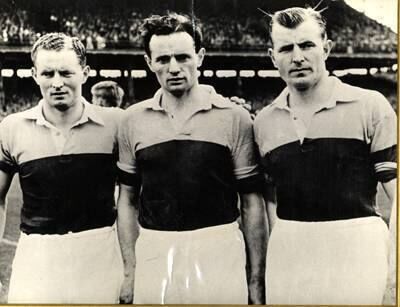
Above all he was a sportsman. Never booked, never sent off. He shipped some ferocious punishment in an era when the rules were far less strict than they are now. He rarely if ever retaliated. “I have no regard at all for dirty players,” he wrote. “Mean tactics by individual players may occasionally bring victory to a team, but such methods will leave a stain on the reputation of even the guiltless majority that takes many a year to erase from the memory of the sporting public.”
In civilian life Nickey was a vet. He took his time about it, spending the period from 1940 to 1949 in UCD. One positive to emerge from this was the experience it gave him of playing with and against players from the top hurling counties.
In his biography of the player, Tom Williams surmises that Nickey reached his peak between 1940 and ’44. That was when he had speed and athleticism. Before he was a household name. Before the combination of a bad knee injury, weight and his lifestyle slowed him down. Before he was expected to score goals every day he took the field. Nickey himself reckoned he was at his best at 18. “Everything worked well at that age,” he once said.
It was all or nothing for him, not just in hurling but in life. The 1957 Leinster final, which resulted in a heavy defeat by Kilkenny, marked the end of the intercounty road for him and a number of his colleagues. Retirement meant no more adulation from the crowds. Was he, as Nicky Furlong wondered in his book , prepared for the silence that followed? Surely not.
It was not altogether surprising that a slide into alcoholism followed. But, Rackard being Rackard, it was not in the least surprising that he conquered his demons and subsequently did trojan work counselling recovering alcoholics.
Following a lengthy battle with cancer he died in St Vincent’s hospital in Dublin on April 10th, 1976. He was only 53. The entire county of Wexford came to a standstill on the day that his death was announced. Nobody felt the pain more than his family, who had known hardship and heartache in his alcohol-fuelled years. Those many lost years meant their time with the real Nickey was far too short.
“When I heard the sad news of the death of Nickey Rackard,” Christy Ring wrote, “I felt a personal loss. Nickey represented to me all that is good and fine about Gaelic games. He was a fierce competitor on the field but was always fair and manly in his bearing. I will miss him.”
On the Tuesday after the 1996 All-Ireland final the Wexford captain Martin Storey and myself brought the trophy to Nickey’s grave to pay our respects and to say a silent prayer of thanks. Without Nickey Rackard there would have been no MacCarthy Cup in that lonely Bunclody graveyard.
What a legacy.
35 championship appearances
60 goals (43 from play)
91 points (50 from play)

CONNECT WITH US TODAY



Be the first to know the latest news and updates