Liam Griffin: 'Kate Middleton got more hurling training than lots of young kids'
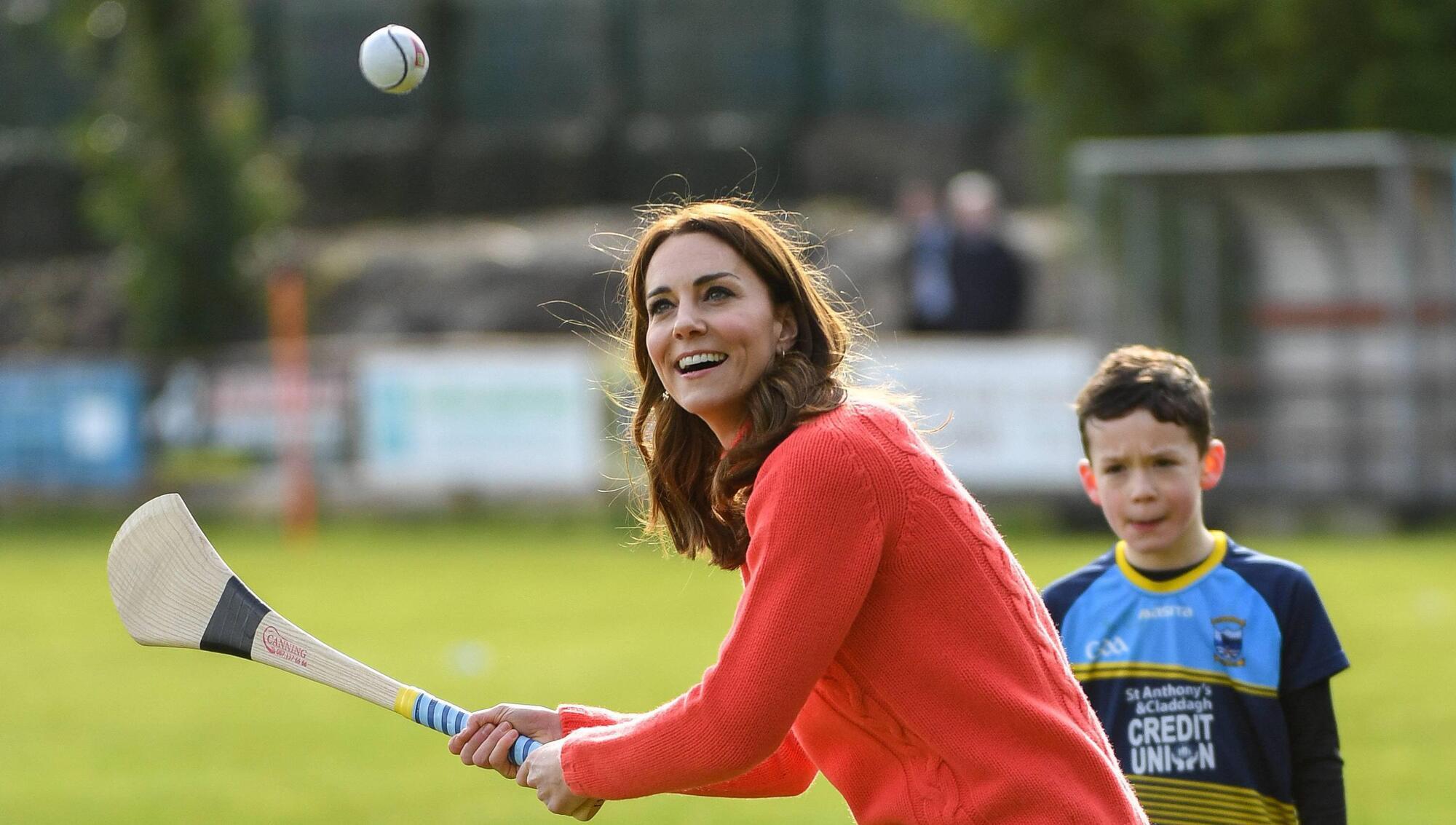
5 March 2020; Catherine, Duchess of Cambridge makes an attempt to hit a sliothar with a hurley during an engagement at Salthill Knocknacarra GAA Club in Galway during day three of her visit to Ireland. Photo by Sam Barnes/Sportsfile
Liam Griffin has proposals in train to try and combat the continuously sliding levels of participation in Gaelic games, in particular hurling and camogie.
Wexford’s 1996 All-Ireland SHC winning manager has fashioned two motions, one aimed at fully identifying the problem and the other to begin addressing it. The intention is for them to be on the Clár of Annual Congress next year.
Griffin had initially been alarmed by the 2013 ESRI report 'Keeping Them In the Game' which showed the drop-out rate in hurling/camogie between the ages of 21 and 26 was 60% and Gaelic football 70% due to a loss of interest.
He became further perturbed by the Sport Ireland commissioned Sheffield Hallam University study of last year, 'Researching the Value of Sport In Ireland', which revealed hurling, a game that had been played by 2% of the Irish population in 2008 when it was among the top 10 sports activities, had dropped out of the top 10 by 2019 - Gaelic football retained its spot with 2%. Those figures were sourced from the 2019 Irish Sports Monitor.
In his work with the Club Players Association, Griffin highlighted these concerning statistics. The first motion passed by his club St Mary’s, Rosslare calls for fixtures analysts to conduct an annual survey of participation rates among all codes and levels.
“We need to commence intelligence gathering so that we know ourselves what’s happening and every club should have a database of dropout. If people in the GAA are not accepting of the ESRI report or the Sports Council/Sheffield Hallam University report, then we have to produce our own.
“The organisation has a responsibility to be accountable for the growth and development of hurling but what we’re doing is not working, we’re not extending it out. There should be a report on every county’s performance in relation to the fundamentals of the association each year. Have some intelligence gathering rather than nobody being held responsible. It’s not unfair to ask that, is it?”
The second motion calls for every GAA club to be required to have or establish a hurling nursery for children up to and including the age of 12. To accommodate football clubs who have relationships with hurling ones, it will be tweaked for Wexford’s annual convention at the end of this year.
“If we are truly a Gaelic Athletic Association and we truly value hurling and football, we have a responsibility to keep both sports going,” insists Griffin. “Every child in the country has the right to play hurling. That is either enshrined in what we do or it’s not.
“Kate Middleton got more hurling training than lots of young kids,” he says in reference to the Duchess of Cambridge’s visit with her husband Prince William to Salthill-Knocknacarra GAA club in March 2020.
“Muhammad Ali comes to town and gets a hurl. The Chinese vice-president goes home with one. That’s the hypocrisy of it. I don’t want to diminish the point I’m making but is it wrong to say these things?”
In this newspaper at the start of January, outgoing national hurling development manager Martin Fogarty — whose position has yet to be advertised — spoke frankly about the challenges facing the game in non-stronghold areas.
“The word I wrote down after reading that article was ‘frustration’,” says Griffin. “Are these positions tokenism or is there a real bite to them with the support system underneath it to do it? If that’s the case, then we’re honest in what we’re doing but other than that it’s dishonesty and we’re never going to spread hurling out of the traditional hinterlands.”
Time and time again, Griffin hears gushing compliments about the game but with little in the way of action to exploit its popularity as a spectator sport.
“Why should our great national game be played by less than 2% of the population? Why should we drop out of the top 10 if we have the greatest field game? It’s often said that’s where our position is but is it true or are we just kidding ourselves?
“It’s not to be difficult or awkward other than to say please can we try and introduce the game to every child in the country to pick up a hurley and play the game. I’m involved in different circles to the GAA and the number of people who say they would have loved to play the game but they never got the chance. We should be giving everyone that chance.”


CONNECT WITH US TODAY



Be the first to know the latest news and updates