'The Shamrocks could have done even better, if they had started a bit earlier'
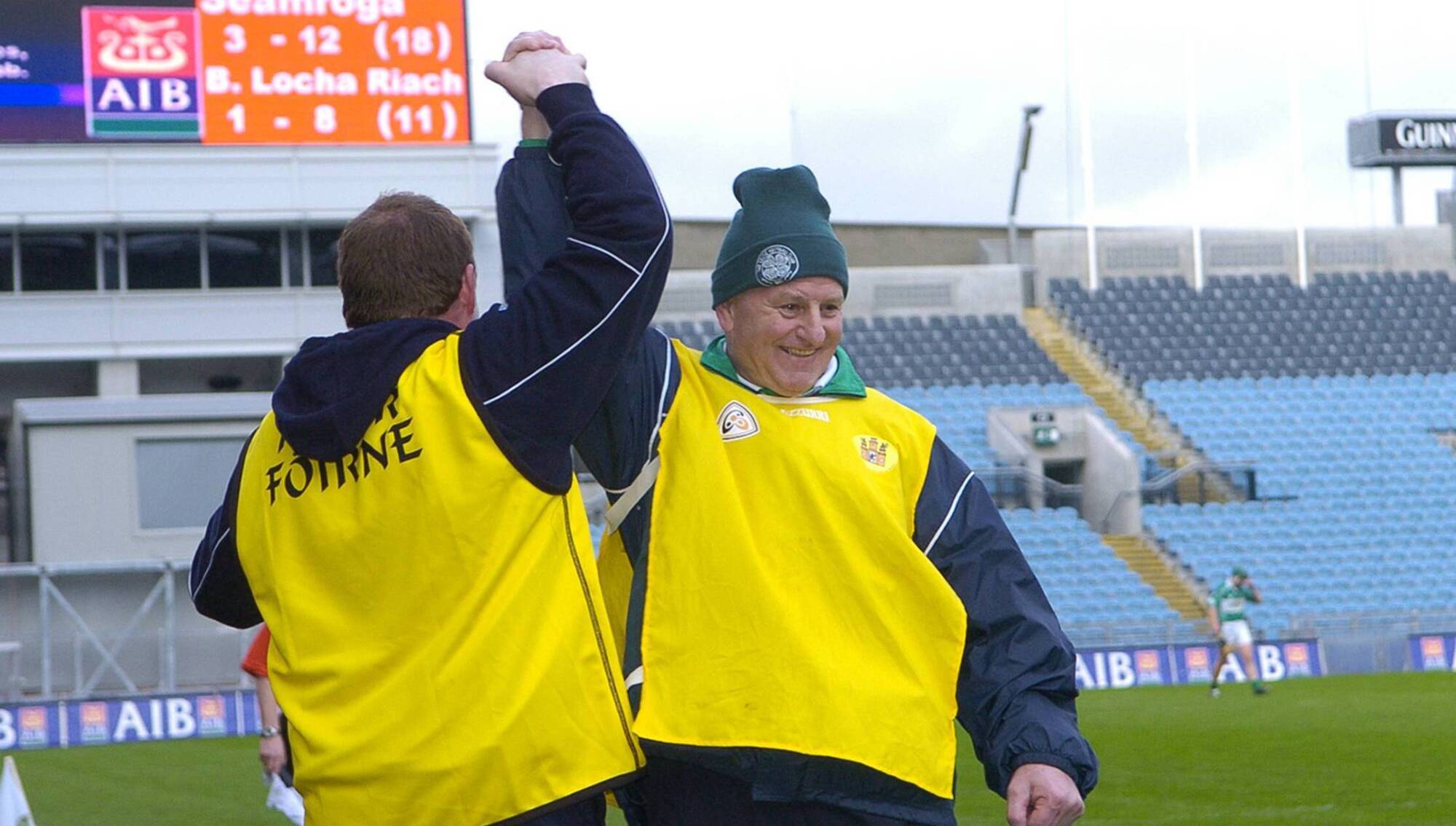
Maurice Aylward and Michael Fennelly Sr, two men to manage Ballyhale Shamrocks to All-Ireland glory, trace the roots of unprecedented glory and assess tomorrow's prospects
'The Shamrocks could have done even better, if they had started a bit earlier'

Maurice Aylward and Michael Fennelly Sr, two men to manage Ballyhale Shamrocks to All-Ireland glory, trace the roots of unprecedented glory and assess tomorrow's prospects

With sport, as with food, contrast encourages appetite.

Tomorrow’s All-Ireland Final between Ballygunner and Ballyhale Shamrocks is not so much sweet and sour as the raw and the cooked. The Waterford champions arrive into this occasion as pilgrims, seeking inaugural victory not just for themselves but for any Déise outfit at senior level. Meanwhile the Kilkenny champions enter their tenth final, fixed on a ninth title, an unprecedented three in a row. The 20-odd miles between these two places involves an intimate gulf.

“The Croke Park factor is there,” Maurice Aylward acknowledges. “Our lads are familiar with the stadium. Couldn’t be more familiar. And the same point is true of the club in general. Ballyhale Shamrocks know how to hurl on the big day in the big spot, know how to do it both in the past and in the very recent past. Their fathers and uncles did the job before them.”

Aylward counsels caution: “I’m not so sure how the day will take Ballygunner. The scenario is there that they will freeze in Croke Park, like Kilmallock did in 2015. But you also have a ducks to water scenario, that they will fly through the Shamrocks’ cover. Ballygunner have a lot of good hard runners, lads like Peter Hogan, lads who stay running for the hour.

“They have the pace you need in Croke Park, around the middle of the pitch. If they find their feet, watch out.”

This man knows the day’s demands. He managed Ballyhale Shamrocks in 2007, when Loughrea were seen off. This triumph bridged a gap back to 1990. That day, the club took its third senior club All-Ireland, beating Ballybrown in a wonderful team’s last heave. Shamrocks (as the club was then known) had landed a first senior title in 1978 and a first club All-Ireland in 1981, when St Finbarr’s were overcome after a tremendous contest.

“The big tradition cuts mainly the one way,” Aylward notes. “That’s true. But Ballygunner are coming with serious hunger. They have won eight in a row or whatever down in Waterford, but they want to put some polish on the whole thing through an All-Ireland title. I think they are good enough to bring it off. The Shamrocks will have to mind themselves.”

He emphasises tactical pressure: “The Ballygunner half forwards don’t really hurl as a line in the traditional sense. They drift off down the pitch and pick up short ball from their backs, and then run and interpass. I don’t think the Shamrocks have previously met a team with as much pace.

“When half forwards go off down the pitch, management get a decision to make. Do your wing backs travel with them? I don’t think there’s ever a case for sending out your centre back, and Richie Reid has been wonderful for the Shamrocks in that distribution role.

“But you need, if your wing-backs do travel, excellent communication around the middle third. I think your midfielders have to fall back in that scenario, so as to make sure you still have six defenders around the house. You can’t give up space to their inside forwards.”

Aylward continues: “I’m also impressed with how Ballygunner have freshened up their team since they were beaten by us three years ago, in that All Ireland semi-final. I’d say they have produced half a dozen new players in just a few years. But I’d have a question mark over their full back line. I think the Shamrocks could get joy in there. In there will be a crucial area.

“You’d say, overall, Ballyhale Shamrocks look to have more room to improve, on what we have seen so far, after the two County Finals were over. Ballygunner are going along nicely, and a lot of the time better than nicely. They are performing more to their optimum.

“The Shamrocks have been in and out of things, hurling in fits and starts. Very good when good, but unreliable, overall. The half forwards, looking at the St Thomas’ game, need serious improvement, bar Eoin Cody’s first half.”

Michael Fennelly Sr likewise knows this day’s call. A native of the parish, Castlebanny bred, he served as joint manager with James McGarry for Ballyhale Shamrocks’ underdog victory against Portumna in 2010. Fennelly had seen three such days as a player: 1981, 1984 and 1990. Father of Michael Jr and Colin, he is one of a select group who started all nine of the victorious Senior Finals between 1978 and 1991, all three of those All-Ireland Finals.

Here was meteoric advance. Shamrocks had only been founded in January 1972, after Ballyhale GAA Club and Knocktopher GAA Club amalgamated. Himself and his six brothers proved a cornerstone.

“We had great days,” Fennelly allows. “Being the first country place to win it, against [St] Finbarr’s in 1981, was special. But I’d nearly count 1990 against Ballybrown higher, because we knew we were coming very near the end of it and because that All Ireland Final was the first one we hurled in Croke Park.

“I’d also have to say that I was part of a full back line, Frank [Holohan], Wattie [Phelan] and myself, that was over the 100 in combined age. As hurlers, we were pensioners. So that was unusual, as well.”

He swerves to present moment: “But it’s the future that always counts far more. The past looks after itself. For the weekend, we need to sharpen up. Properly sharpen up. We weren’t tuned in against St Thomas’. We were fumbling ball a lot around midfield, giving away possession. That has to go.

“Maybe there was a bit of complacency in the camp, because of how much we beat St Thomas’ by, in the 2019 All-Ireland final. But they learned from that day, in fairness to them, and they had us beaten fair and square, only for a moment of unbelievable magic from TJ. But we can’t keep relying on magic.”

Fennelly highlights attacking possibilities: “I hurled both in the forwards and in the backs. So I kind of always knew what suits a back and what doesn’t. A back likes to be near his other backs. He wants to be able to talk to them without shouting.

“When the Shamrocks are going well, you see space up front. We have the corner men in the corners, the wing men on the wings. They don’t stand out there like statues. They move and support each other, as each attack develops, but they don’t clog up the centre, waiting around. Each man should be able to win his own ball, and then the other forwards arrive in support, running off each other.”

He glosses: “Space means scores. If you don’t create space, you don’t get as many scores as you should get. And where are you going if you leave scores behind you… Hurling has changed an awful lot from when we were at it, especially over the last ten years, but the principles don’t change. The forwards should spread out the backs, make the backs shout at each other. You need to use every inch of the pitch.”

Fennelly believes the All-Ireland semi-final gifted lessons: “We probably ended up against St Thomas’, for the last quarter, in better shape. Credit to James O’Connor and his selectors, they made some important switches at the second water break. Joey Holden went to centre back, which worked. Paddy Mullen was put to wing back, with Richie Reid as the other wing back. Darragh Corcoran went into midfield.

“Darragh is fierce athletic, and made the interception that led to the penalty, after a brilliant run down the centre by him. Maybe Paddy might be better at the moment facing the ball, at wing back, than chasing the ball, at midfield. James and the lads have a few decisions to make as regards best position for some players. I don’t envy them…”

Maurice Aylward offers a similarly sharp eye. Likewise a native, Knockmoylan bred, he was struck by that water break. “I was watching Joey [Holden] in the run up to it,” Aylward relates. “He ran into that huddle with a real go to him. And I saw him going over to James O’Connor. I wouldn’t say Joey said: ‘Put me centre back.’ He wouldn’t be like that. All the Holdens would be solid out.


“But I’d imagine Joey did say: ‘I’ll go in centre back, if that’s what ye want.’ He’d give them the happy option. And he did go in there and he did catch two puckouts in savage fashion, and gave the whole thing a fierce lift. Joey is probably the best leader on the current team. He’s the most consistent performer. I can’t understand how he got so little look in with Kilkenny over the last few seasons. Joey Holden is the real deal.”

Aylward has watched generation seed generation. Born in November 1944, he remains a remarkably fresh man, love of the most beautiful game undimmed. He won two minor All-Irelands with Kilkenny, 1961 and 1962, in his day. A track record in club management gleams. Last season, Aylward was part of the sideline that oversaw Glenmore’s intermediate success in Kilkenny. He managed St Patrick’s (Ballyragget) to junior All-Ireland success in 2012. The following season, Ballyragget fell by a mere point to Kanturk in the intermediate All-Ireland Final.

“I like to stay involved,” Aylward smiles. “Keeps you going. There is always something to do that you haven’t done before. I am in Carlow this year, with St Mullins, and really enjoying it so far. It’s another true hurling place.

“We have won so much and done so much in our parish. But I still think back on what might have been. I was at a meeting in the hall in Ballyhale, in 1967, when we thought we nearly had an amalgamation sorted. But one man walked out after saying: ‘Ye can do what ye want with a new club but there will always be a club in Knocktopher.’ There was an older brigade there, stuck in the past.”

Aylward raises an intriguing possibility: “The club’s first senior title could have come in 1968 rather than in 1978. All the parish’s hurlers together, at that point, would have been fit to take on any

one. Denis Heaslip would still have been young enough to be on that team. And would Frank Cummins ever have gone hurling with Blackrock in Cork in such a scenario? Funny enough, there was room for the Shamrocks to have done even better, if they had started a bit earlier.

“The new club’s foundation in 1972 came that little bit late for Pat Carroll and Pat Aylward, my brother, and myself. You have to remember Pat Carroll was hurling with Kilkenny in 1967. Pat [Aylward] had won a Dublin senior final in 1965. But I was rising 30 by the time we got to win the intermediate in 1974, and the two Pats were older again. By 1978, I had moved to Laois for work and started hurling with Durrow.”

Come late tomorrow afternoon, there will be sweet and sour. Barry Coughlan or Colin Fennelly will be Captain Courageous. The latter’s father cannily returns to the question of raw ingredients.

“We might or might not win on Saturday,” Fennelly states. “I strongly hope we will, naturally. But the parish will still be, whatever the result, a completely hurling place. That factor won’t change.”

He summarises with country eloquence: “We have been blessed with natural talent over the years, which comes from the various families involved. A lot of families have been in our parish for a long time, and the young people generally like to settle there, heel of hunt. You need to have natural talent available, and also that talent coming on. There is no other answer.

“You can improve hurlers but you cannot invent them out of thin air.”

x

More in this section

Cookie Policy Privacy Policy Brand Safety FAQ Help Contact Us Terms and Conditions

© Examiner Echo Group Limited