Kieran Shannon: Players can’t be the fall guys in congested calendar

The GAA has made strides on the fixtures front but further tweaks have to be made
Kieran Shannon: Players can’t be the fall guys in congested calendar

Mayo’s Tommy Conroy takes on Donegal’s Patrick McBrearty in the Allianz Football League Division 1 match at Markievicz Park last month. Conroy suffered a cruciate injury while playing a Sigerson Cup quarter-final for NUIG 48 hours afterwards. Picture: James Crombie

They haven’t entirely fixed the fixtures yet, you know.

The CPA may be gone, having decommissioned themselves with the advent of the split season, but just because the tension between club and county has eased tremendously doesn’t mean players are free from other forms of tug of war. They still can get pulled and dragged in various directions and inevitably some snap.

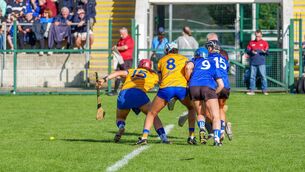
The most obvious and spectacular case of this is Tommy Conroy, who 48 hours after helping Mayo eke out a draw in the mud and sleet of Markievicz Park against Donegal did his cruciate while playing a Sigerson Cup quarter-final for NUIG.

The GAA can’t claim such a possibility wasn’t flagged. Take the warnings issued in this paper alone. Conroy’s own county man John Maughan spoke last Saturday week of how challenging he was finding it as a manager of Offaly having so many players still engaged in third-level competition while his own side was simultaneously starting out on a league campaign that for them was essentially championship. 

He specifically mentioned the case of NUIG, a college he had won a Sigerson with as a player himself, and a former player of his, Maurice Sheridan, was now coaching. Two of his Offaly players had to come off injured playing for that college in a Sigerson game, an inevitable consequence of the demands being placed on them.

The previous Monday Sheridan’s own brother, Colin, referenced the case of Seán Mulkerrin, a Galway panellist, who had to wait 30 minutes in the freezing conditions for an ambulance to attend to a leg injury he sustained while playing for NUIG against Jordanstown. Just why, Sheridan asked, are Sigerson players “compromised by the conflict of which master they should serve — the inter-county manager or their college team-mates?” Try and please both and the price can be very high.

John Kiely has been rightly praised for letting the likes of Cian Lynch have the past weekend off so he can focus on the Fitzgibbon Cup quarter-final he has over the next 24 hours but not every manager can afford or appear to be so generous.

There is no prospect of Limerick, or indeed almost any traditional hurling county, being relegated this spring. In football even a Dublin could be demoted from their division. In hurling, the only championship is championship. In football, the league rivals or even equals the championship in importance and intensity for most counties. Conroy’s Mayo do not want to be relegated again. Mulkerrin’s Galway need and want to instantly win promotion. And should they be relegated once more they risk not even being in the championship, at least as we and they know it.

The fault here lies as it does so often, with the administrators. Despite all the burnout committees and reports and recommendations there’ve been from Croke Park and the various experts they’ve enlisted over the last couple of decades, we still have the ridiculous scenario of too much being loaded on young players in January and February. In fact, this year it is even worse with the advent of a backdoor in the Sigerson.

There shouldn’t have to be another burnout committee established in the next couple of years to prevent such a scenario. Instead the experts, including key stakeholders like the colleges and inter-county managers, should have been more roundly consulted instead of these fixtures being foisted upon them and their players.

Under the current circumstances, there is an argument that there should be a stipulation much like the one whereby U20 footballers couldn’t play for their senior county team until their U20 campaign was over; until your third-level team has finished their championship, you cannot play with your senior county team. But it shouldn’t even come to that. With the league so vital these days in football, there shouldn’t be such an overlap between Sigerson and league.

The demands are going to be even more manic next year with Congress later this month likely to approve of a football championship that will see the eventual All Ireland champions playing up to a possible 19 games. By deciding not to go with Proposal B or more recently the Red Proposal, the powers-that-be have continued to shoehorn a seven-game national league into the early part of the year, leading to a case where we will now almost have too many county games when for too long we had too few.

The split season ultimately has multiple advantages which makes its introduction overwhelmingly positive. Club teams, managers and above players — and families — can plan their year — and holidays — well in advance without being at the whim of the country drawing a championship game. They’ll get to play games in better weather and in better conditions. The whole season won’t be one long slow burner and drag for them. They can have an off-season and just the one pre-season.

But the worry has to be will there be an off-season for their county players? Or at least an adequately long one? Are they still going to be asked to play from January to December?

The GAA has made strides on the fixtures front, and on player welfare too. But there’s a danger that a leading administrator like Fergal Magill, the GAA’s head of games administration and player welfare has possibly accommodated too much of the former to the cost of the latter.

Further tweaks have to be made, more tug of wars have to be avoided.

As a rule of thumb January should belong to the colleges. From February on then leave the students focus on the county. A five-game national league programme instead of seven should maybe be looked at. The All-Irelands may need to stretch into early August rather than late July.

While it’s good to see the GAA change and even experiment with its calendar and formats, players like Conroy and Mulkerrin shouldn’t necessarily be such guinea pigs and certainly not sacrificial lambs.

x

More in this section

Cookie Policy Privacy Policy Brand Safety FAQ Help Contact Us Terms and Conditions

© Examiner Echo Group Limited