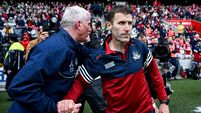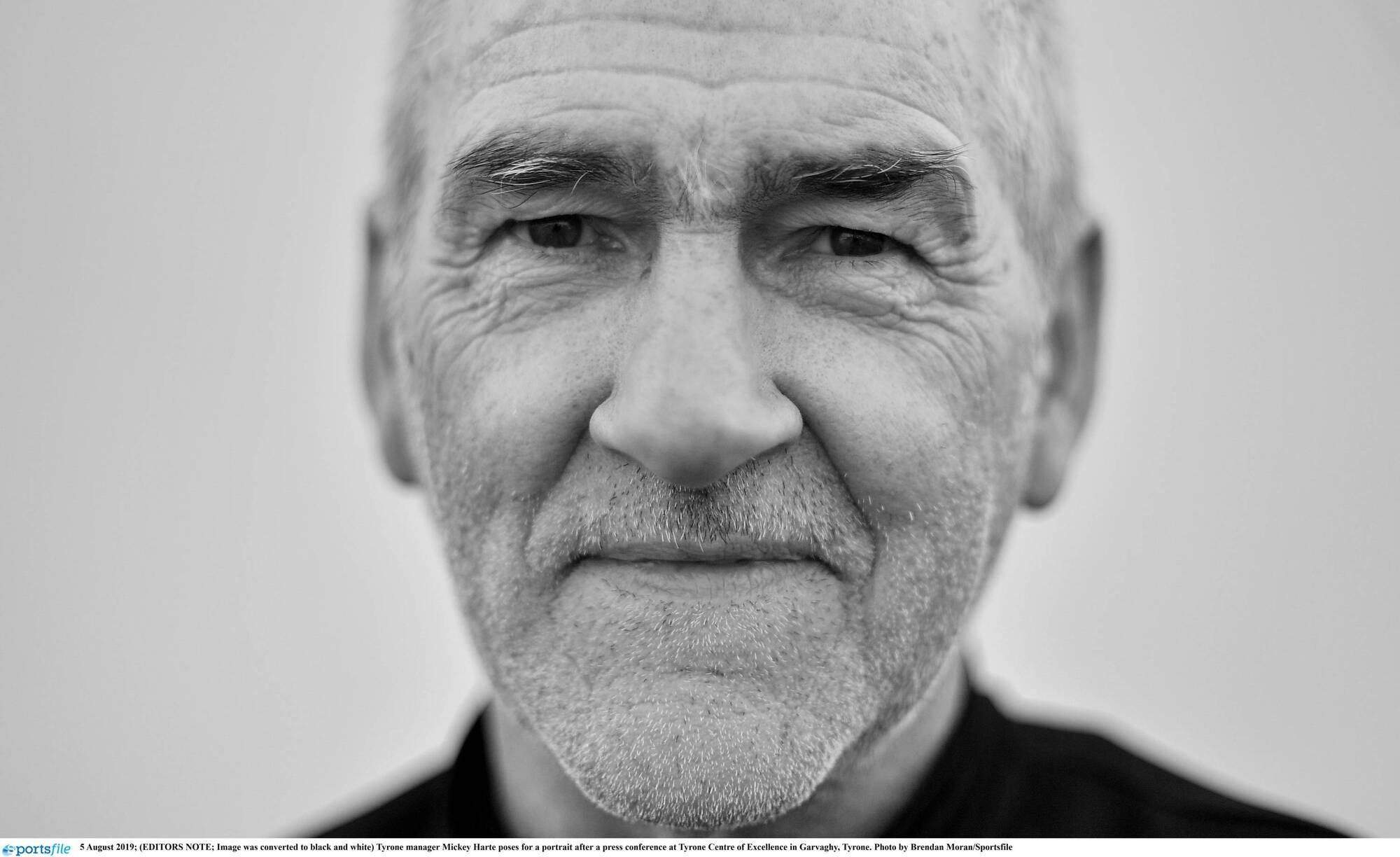
The opening lines of Devotion, Mickey Harte’s latest autobiography, finds him emerging in the half-light.
He rises on the dot of 6am and leaves the bedroom quietly. The way is illuminated by a light shining on a picture of his daughter Michaela. Beside their bedroom is her own, untouched since the morning she walked out of it for her wedding.
“I close my eyes, tripping through time.” He prays beside his daughter, then slips out into his car. Left out of the driveway. Right onto the main road towards Ballygawley. In left to Ballymacilroy and St Malachy’s Chapel.
Where Michaela is buried.
This is where we find Mickey Harte in his 67th year. Spending an hour each morning in Eucharistic Adoration. The Sacristan’s son.
“These mornings are special to me. For 200 years, people have prayed in St Malachy’s. I get a sense of all the believers who came before me. Every time I come here, I walk into history.”
That deftness of touch continues throughout, beautifully conveyed by ghostwriter Brendan Coffey.
As commonplace as GAA autobiographies are, nobody before now has been involved in three.
Yet, you can read all three and you encounter a changing man in each.
In Kicking Down Heaven’s Door, the 2003 season diary, his first in charge of Tyrone that yielded the county’s first All-Ireland, we encounter a man in awe of it all. Openly generous in sharing the motivational tools and dressing room insights to ghostwriter Kieran Shannon.
We were introduced to the wisdom of John Wooden, George Zalucki, and Bart McEnroe. The quick wit and steeliness of Peter Canavan, the wishlist drawn up by his daughter after an All-Ireland minor defeat that All-Ireland titles would follow at minor, U21, and senior level.
Everything is fresh, a novelty.
Go forward six years, to Harte: Presence Is The Only Thing (with Michael Foley) and we meet a different animal.
Harte recognises his peers are fascinated by him. He is a national figure carrying the assurance of three All-Ireland titles in six seasons. He has left behind the world of teaching and running a newsagents. He allows himself to wonder if what he does with Tyrone could work in another sphere, a different environment. The possibilities seem endless.
Within a few years, everything was different. Forever.
Michaela was murdered while on honeymoon in January 2011.
A few months later, Harte helped carry the coffin of murdered PSNI officer Ronan Kerr.
He got involved in various political campaigns. He supported the anti-abortion side in the 2018 referendum. He sent a letter to RTÉ about their choice of commentators.
They ran a radio sketch that used the song, ‘Pretty Little Girl From Omagh’ while mocking a visit Harte and his bereaved son-in-law John McAreavey made to the Dalai Lama as part of their grieving process.
The All-Irelands dried up. The Ulster titles didn’t flow as fast as they did before. While Tyrone remained relevant, occasionally elbowing their way into the conversation of potential All-Ireland winners, the life around the team and their manager became one of the most fascinating things about Gaelic games.
Harte had cancer, and made a recovery.
So, no, Devotion is not a ‘football book’. At times, it feels like walking into the wrong room and seeing something private. An intrusion into a private world. A dark episode turned inside out and upside down.
Enough light gets through. It only enhances the sheer blackness. The narrative is flashed through with the exquisite blend of Harte’s ability and willingness to articulate, and Coffey’s skill at capturing and framing.
“There is a degree of uniqueness about it which is kind of something you are looking for,” Harte says a few weeks after the release.
“Particularly if you have done a book before, if you had done only one book on your life it was going to be unique anyway, but I had done a couple before and never really set out to do any of them, to tell the truth.
Anyone who has read it has told me they felt enriched by it. There is a lot in it, a lot of different perspectives.
“I think it’s a book about life in general, which is what I would always want it to be perceived as.”
And how.
Any autobiography comes with the threat of myopia. In trying to come to quantify what the loss of Michaela meant in a wider sense, there are extensive interviews with her husband, John McAreavey, and Harte’s sons, Mark, Michael, and Mattie, along with his trusted football allies Gavin Devlin and Tony Donnelly.
The picture that emerges is filled out. One of complexity and different layers to grief and loss.
The passages dealing with the discovery and messages of her murder in Mauritius gets hypnotic, disturbing, and devastating, recounting the reactions of everyone in the first person.
“When you look in from the outside you can think that the family is grieving together equally. But they are not. They are different and have different perspectives on all that happened because they have different relationships with the person they lost,” he explains.
Has his wife, Marian, read it?
“No, Marian couldn’t read it. That’s the big issue. The good thing is, she makes tentative enquiries about stuff that’s in it, which she wouldn’t have done for years.
“It would have been a torture to her. A number of years ago, she couldn’t have envisaged it being done and she knew there would have been a big part of it about Michaela.”
Harte continues: “That’s why I wanted all the boys in it as well. I wanted them to be safe in the knowledge that this wouldn’t be any harm to Marian. I think that’s good for her too, her knowing that the boys were involved in the final cut of it. Nothing that she wouldn’t be OK with if she did have the presence of mind to read it.
“She doesn’t like this kind of sensationalism. We didn’t want that in it, that has been secured.
It’s not about sensationalism, it is about reality and life in general.
"About life at a time that not everybody has to embrace, but there is a template for people there who experience a similar traumatic event happen in their life, that they might be able to live in a new place again. Learn from somebody else dealing with that kind of trauma. It might be a resource there to go to.”
Devotion also explores the difference in processing such a trauma even within a marriage. “Marian suffered the most when Michaela died. She went to bed early, usually at 6pm, and slept on as long as possible. Her days condensed at both ends… Losing Michaela affected her bubbly personality. She was in a state of non-being almost, here and yet not here. She just existed.
‘…Marian is going through a process that I started a long time ago. I have been in those places. She might only be a few miles in, whereas I have spent years on this road. I could not understand why every step was such a challenge. Over time, I have become more understanding. I cannot demand that she sees life through my eyes.”
Outside of all this, the family were besieged in other ways. Harte reveals that RTÉ were unhappy Michaela’s funeral would not be broadcast. When it was decided that big screens would be erected outside the chapel showing the images inside, there was a suggestion they would point their cameras at one of the screens.
One RTÉ figure wanted Harte to do an interview. He called him up to 60 times over a single weekend and when all those calls went unanswered, drove right up to the family door.
Harte’s life through his books, although all written through middle-age, have the feeling of a fuller period of history. “It’s a fair summation of what life is all about,” he states.
“The world changes as we go on. The world that I grew up in was a less rushed lifestyle, more domestic if you like, more people in houses, more children in families.
“And then life gets busier. We were married and had children and both working, flying around, the children fitted into our lifestyle. You loved them to bits but you don’t take the time that you would like to take. You don’t spend all the time that you would like to take.
“And now, we are at this stage where we are the grandparents and we have all this time for our grandchildren.
“It’s not about a destination, it’s about the journey. Sometimes you can be a long time living before you come to realise that, it’s not about the destination.
“People talk of chasing after happiness, that it is some place, somewhere, or a thing that is going to give you happiness. But it’s not. It’s the actual journey that the happiness is to be found in, if you open your heart and mind to what is possible available.
“I find that in this stage of my life in the chapel, before the Blessed Sacrament, that’s where I find that contentment. That you don’t need to look any more, you have it there in front of you.
I have this faith that I can appreciate it. I am very content in my life at the minute, despite the fact we have had a lot of challenges in my life, I feel content.
There is a line in the book where Harte says, “Every day, I set out my life to be a Christian.”
What happens then when human nature derails that and he falls short?
“That in itself is a safeguard from becoming too proud,” he says. “If you thought that ‘just what you do now, be an ideal of a Catholic’, so to speak, ‘this is what being a Catholic is all about’ — it’s not at all. It’s about being on a journey. It’s about recognising your faults and failings and accepting that point of view, challenging yourself to manage it better.
“That’s why God gives us the human weakness. If we thought we had it all sussed, that we have it all now, that we were sailing and other people could all be like me, well then that’s the worst thing you could be at, because you would be in a really bad place.
“I am not home and hosed, I have a lot of work to do if I want to be the best of myself in terms of being as good as God wants me to do.
“What do you do with the talents God gave you? Sometimes I used them well. Sometimes I didn’t. So I have to work hard on myself.”
There are moments when you swim back up to the surface. The description of Harte’s childhood is bathed in a golden warmth as he recalls a beech tree outside his house that never seemed to lose its leaves.
“It’s only when I did this and spoke to Brendan that I realised I had a very happy childhood. It wasn’t because we were materially rich in any way, form or fashion. We were ordinary people of the country,” he recalls.
“But I can only think of good things in my life when I was young. I just love looking back on it.
“That story about the beech tree tells it all. It’s only when I talked to him about that, that it struck home for me. Obviously, it lost its leaves, of course it did. But I never remember looking out at it when it had lost its leaves!
“That’s my perception. The sun is always shining on those green leaves and this is a cosy, secure place to be. Sitting in front of the fire, on the range, the feet on the edge of it keeping them warm.
“I see that room where we grew up in, with the Sacred Heart picture, mummy’s May Altar, the Holy Water font at the front door. I just see them, I can feel that place so easily. The key never came out of our front door. You just left the key in the door, the trust that was there in those times.
“But it was a lovely place to grow up in and the security of the family. All these adults, I was the youngest. It was so easy to recall because I had such warm memories of it growing up.”
And then there are some wonderful reflections on football. How any forward could get “a quare touch” from his opponent back in the ‘70s. How his brother Joe treated him to an expensive pair of boots in Portadown ahead of a day in Croke Park leading the line for Tyrone minors.
All that innocence burst into flame as the Tyrone senior manager for 17 seasons. It was extinguished on a dank autumn night as he sat in a car alongside Mattie Donnelly outside the Garvaghey complex, awaiting a text to come back into a meeting.
Eventually, the lights went out and people made for their cars. Nobody stopped. They just pointed their headlights for home and Harte knew it was over.
A few days after, while he was signing off with some interviews, he made a point of saying: “I do believe an All-Ireland is possible in Tyrone in the not-too distant future.” Did he go to watch them in the championship?
He did. For the opener against Cavan he was at the side of the stand in Omagh. Self-conscious? Not really. But it felt odd.
Against Donegal and Monaghan, he did analysis for the BBC.
When it came to the All-Ireland semi-final and final, he was there like any other punter in the crowd.
He knows, by the way.
He knows that some people might allow themselves to say that he would be envious of this team doing it without him as manager.
“It’s natural (that people might say that),” he responds.
“You are delighted that Tyrone are All-Ireland champions. Delighted that the players have got their medals now because I have been saying this for a number of years now; the young people of Tyrone need a new generation of champions. I have been saying that for a long time.
“I believed that could happen and we could have made that happen, and that we were knocking on the door quite often.
But the fact it has been done is more important than whether I am there or not. It is better it has been done.
“I would love to have been there doing it, by all means. There’s a thrill to that like no other. You would love to be there. But short of bring there, the best thing is that Tyrone have done it and we have that new generation of All-Ireland champions.”
Certain things thrilled him. Watching Brian Dooher on the sidelines brought back memories of a million examples of leadership.
“He has that insatiable appetite for getting the best out of himself.
“He (Brian) wouldn’t worry about being any sort of a ‘bad cop’, he just wants the best for the people he is with because he always wanted the best for himself.
“And he is prepared to do whatever it took to be the best. He’s just instilling that philosophy into them by the way he goes about what he does.
“With Joe McMahon there, Collie Holmes, Feargal Logan, and Peter Donnelly, they have a package now of people who are bringing everything to it.
“But Brian, knowing him there is no doubt he would be driving that show along. There is no stopping him.”
And then he throws out an example of why, exactly.
He takes you back to the day Dooher married his wife, Mary. It was in the short days of winter with nothing happening and the new season still some way off.
At the reception, Dooher had a set of crutches.
“He needed an operation on his ankle. Now, anyone else would have waited? Or been allowed to wait?” asks Harte in disbelief even now.
“They would say they would wait until they are married, but he had crutches that day because he had pins in his ankle, that’s the kind of him. He just didn’t waste time over injuries.”
Tyrone is now Dooher and Logan’s gig. Harte is now the Louth manager.
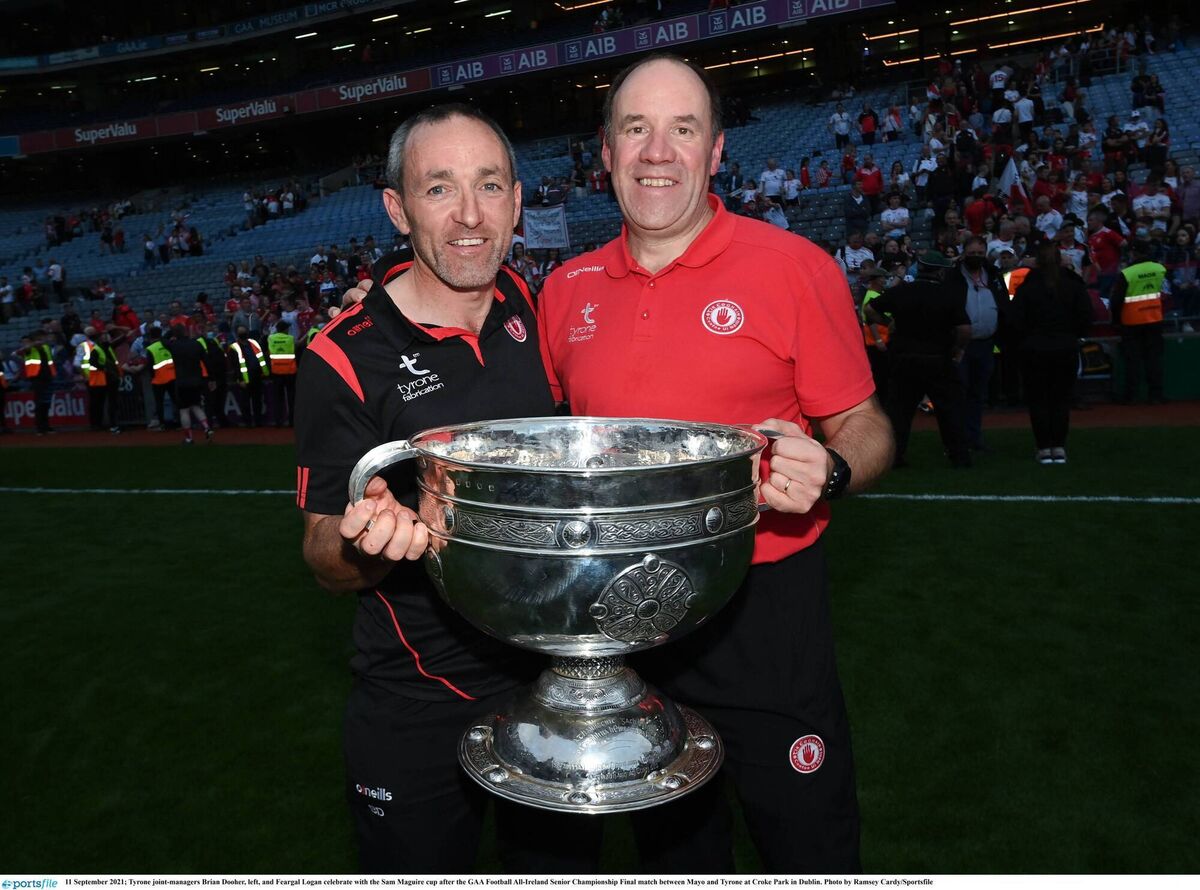
It’s a slow burn with them. When he took over they were conducting trials on the word of other people. Players wore woolly hats and snoods. It was a little rushed and they lost their opening league game when he came up against Antrim and their manager Enda McGinley, a neighbour who lives on the very same road.
And still, they managed to get promotion.
Underneath the hood, there is a lot of work going on. Harte’s presence at so many club championship games took people by surprise. He has been working with the underage academies. Young players are going into the extended training panel.
He and Gavin Devlin rearranged things at their training complex in Darvar. Some stores were cleared out and became communal areas to eat and meet. The corridor leading out has been spruced up with images of famous Louth players from the past. They see the ambition to build a stadium in Dundalk, their side of it is creating an identity.
Devotion was three or four years in the making. Harte, and Coffey never really knew when it would end but they had a thought. Fate disabused them of that.
“You might have wanted it to end in an All-Ireland and sometimes we came close to that and perhaps we could have done if we were there another year. Nobody knows, we might never have got near it if I had been there another year,” Harte says.
“This ‘happy ever after’… the ending is what it is. The ending is now. Life where it happens to be at this moment.
“It doesn’t have to be a climatic scenario. It’s just another stop off in life. And life goes on.”
CONNECT WITH US TODAY



Be the first to know the latest news and updates