Ger Loughnane: 'It was better than the All-Ireland or Munster final. It was deeper'
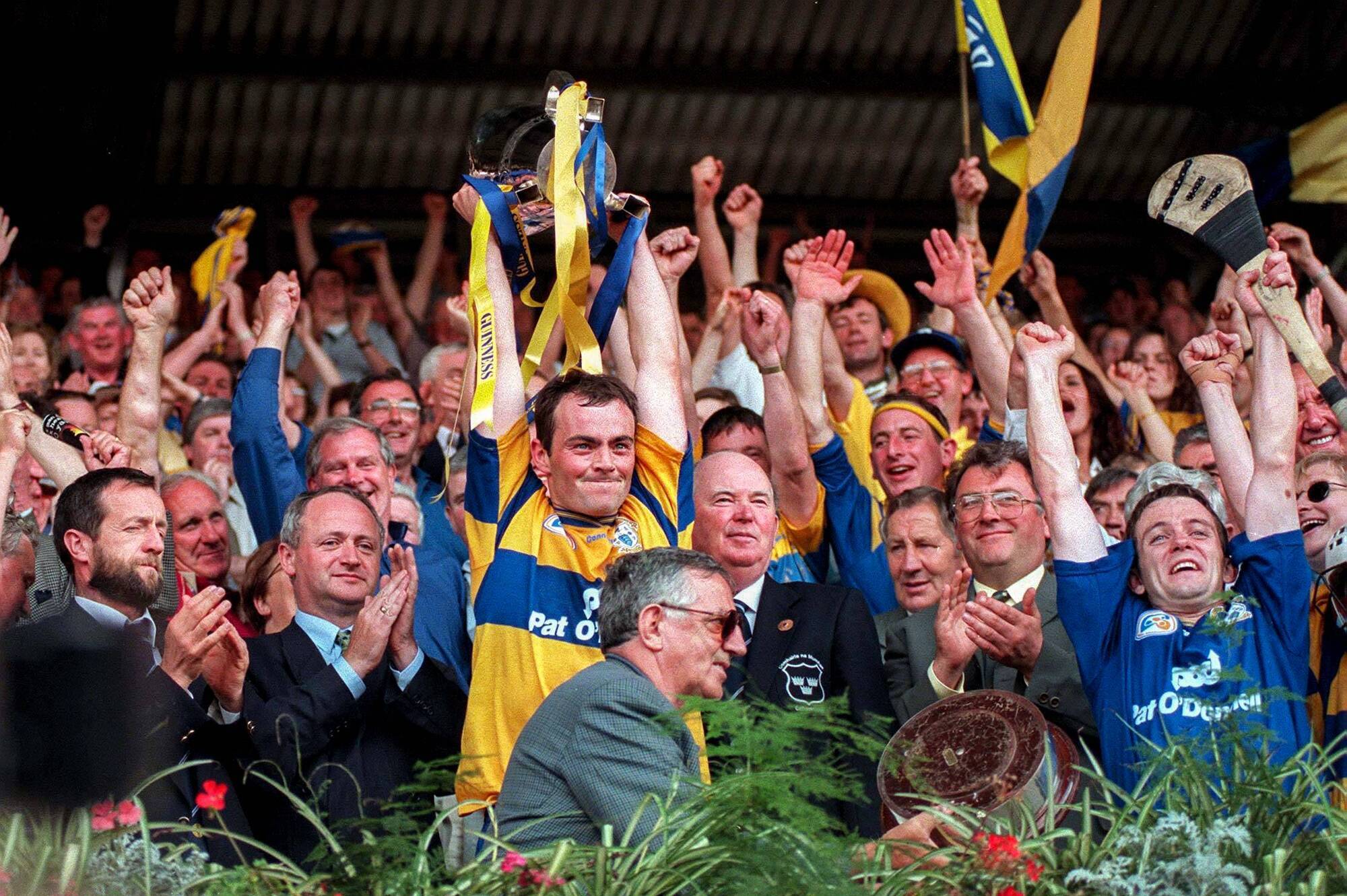
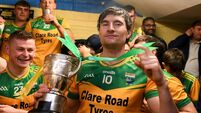
Clare captain Anthony Daly lifts the cup after the Munster final win over Tipperary at Páirc Uí Chaoimh in Cork.
Michael O'Halloran was on a fella called Philip O’Dwyer. I was at the far side of the field and I saw Len Gaynor going up past the Clare dugout and down the sideline. I saw O’Dwyer moving towards him and O’Halloran after him.
‘Jesus!’ I said, ‘I better get down there’.
O’Halloran had been involved in an incident with another Tipperary player in the league match in Ennis. I assume that Len was afraid that O’Halloran would have a dig at O’Dwyer during the national anthem or before it.
The four of us arrived together in the one spot and the band started the national anthem.
O’Halloran and myself roared the national anthem into O’Dwyer’s ear. There wasn’t one word exchanged... and the game started.
I’ll never forget that incident because it was so comical, when you think of it now. Gaynor was looking and saying, ‘What the fu*k is going on?” We didn’t pass any comment.
We totally ignored them in one way, but we let them know that this was going to be our day.
*** *** *** ***
Páirc Uí Chaoimh was like The Colosseum. You could just see the field... nothing else. The field was all you had and you had no space between it and the crowd. They were above you, rather than being away from you. That was the first day that the real link between that team and the Clare crowd was established.
Everybody realised that this was it. We had to beat Tipp.
To meet them in a Munster final, on a day like that ... out on the field before the game, I’ll just never forget the atmosphere but this time it was uplifting. We weren’t oppressed by it.
You’d think that all of the games I played for Feakle and for Clare, and then being involved in management... you’d think it would be very difficult to pick out the game that had the greatest significance. But when it came down to it, it was no problem.
There’s a lot of reasons why it stands out so much.
When you consider how important it was for the reputation of that team and for Clare as a hurling county... the atmosphere that was there that day... the display Clare gave... and the satisfaction from winning.
There is no other game that comes anywhere near.
*** *** *** ***
I’ve always said that winning an All-Ireland is great but Mick O’Dwyer taught me the greatest lesson of all time after the 1995 All-Ireland. There was such euphoria all over the county and it gave us such prominence nationally.
I was at a function one night in 1996 and Micko was there. We were talking about matches and the place was packed. He said, ‘Any team can win an All-Ireland... but it takes a great team to win two’.
He said you could get lucky and win an All-Ireland. The favourites could be beaten and you could win one by chance. He said that if you could win a second one, nobody could ever question you.
He wasn’t referring to Clare, but all the way back home that night I was thinking about it. He was right. If Clare had won in 1995, it would still be regarded in Clare as a brilliant year. But outside of Clare as time goes on, it would have been just a curiosity... Remember Clare winning the All-Ireland in ’95 but they did nothing afterwards.
That kind of stuff.
In terms of respect for Clare as a hurling county, the fact that we won in 1995 made it more important for us to win another one. After being beaten in 1996, people thought maybe it was over for that Clare team.
What was worse was the league in 1997. It was on in March, April, and May. We started out great in March but then we lost four games in-a-row and we were relegated. By the time the end of May came along, people were thinking... They’re gone!
We weren’t anywhere near favourites to win Munster or the All-Ireland. We only scraped over Cork in the Munster semi-final. Stephen McNamara scored a brilliant goal to squeeze us past them.
Tipperary had come to Ennis in a league match in May and they beat us by a point in a ferocious game. That gave Tipp a massive psychological boost and as well as that, they beat Limerick, who were the favourites to win Munster, by 10 points.
They went into that Munster final on an absolute high.
There wasn’t huge optimism that Clare were going to beat Tipp that day. Everybody in the team knew that this was a crossroads and unless we won that day, we were back down the ladder again. If we did win, we were going to open up all kinds of possibilities for the future.
*** *** *** ***
I’ll never forget the bus journey down.
Daly is right... it was like an army going on a mission.
The atmosphere wasn’t a bit heavy.
We went down that morning very early and we stayed in the Hayfield Manor.
We had been down the week before for training in Pairc Ui Chaoimh. Tony Considine and myself had asked a taxi man to bring us to a hotel that would be nice and quiet and away from the crowd the following Sunday. He brought us into the Hayfield Manor, which was very upmarket.
We thought that there would be no hope of staying there, but we met the manager and he gave us a great deal for breakfast and rooms for the players. We wanted them to have a rest for a few hours. We used to always do that in Dublin but it was the first time that we did it for a Munster championship match.
We went down and once the players saw the place, they knew... This is special.
Before the game, we went down to the Mardyke for a few pucks.
Everybody seemed to be in great form. Often you’d have to rouse fellas up and you’d be watching to see who’s a bit nervous or dead in themselves.They knew how significant the day was and we asked them to just give that little bit extra that day. Once we got onto the bus, the mission had started.
They were like greyhounds in the traps waiting to get out. Rather than fearing a Munster final, which I had witnessed so many times with Clare teams, this was going in the opposite direction.
The game started at such a pace.
We should have opened up a big lead but typical of Tipp, they had a lot of players of great character on that team... Brendan Cummins, Paul Shelly, Mike Ryan, Noel Sheehy... and the Bonnars. They were tough men. Then they had the likes of John Leahy, Tommy Dunne, Declan Ryan, Michael Cleary, and Eugene O’Neill... great players.
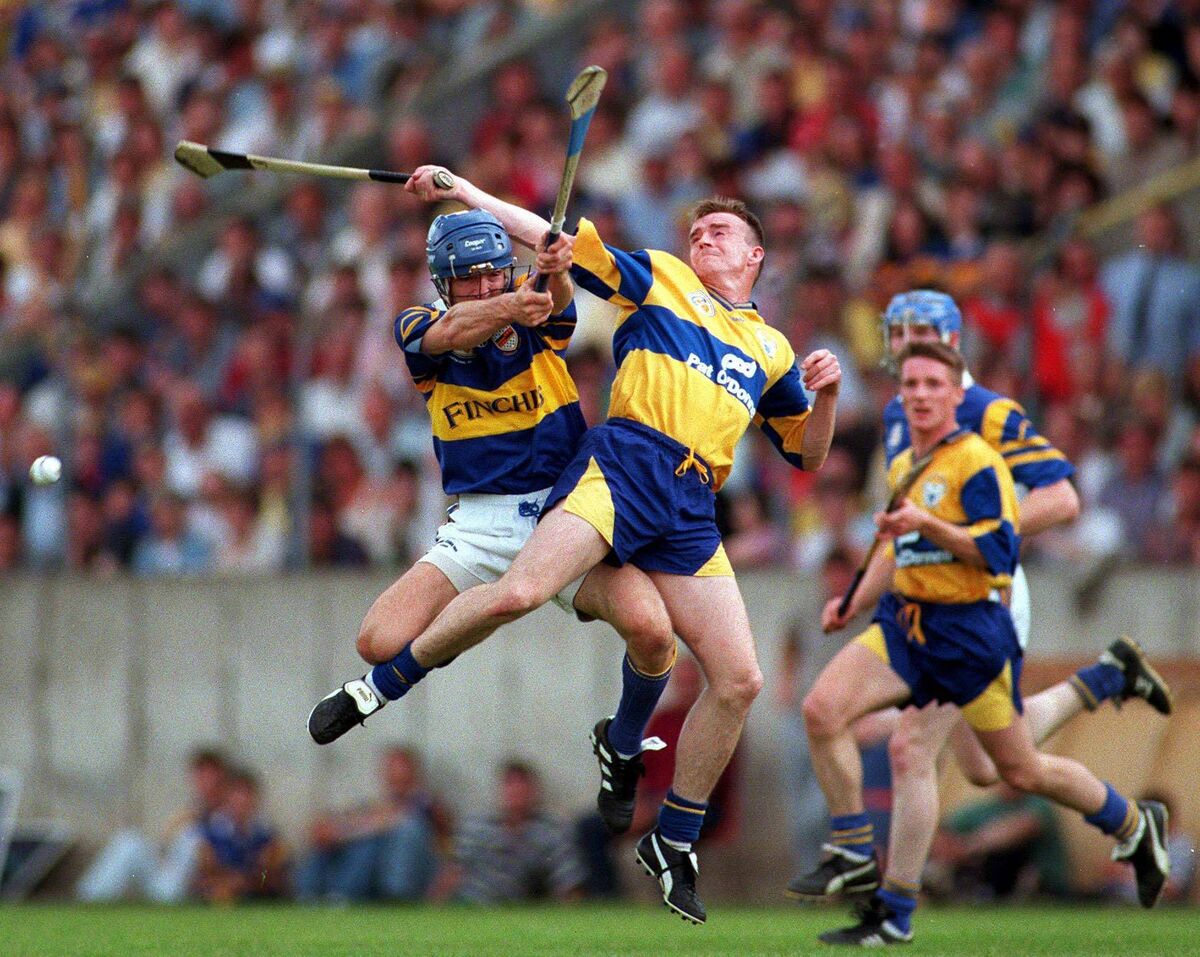
They came back into the game and it turned into a tug-o-war. They’d be on top... we’d be on top. Nobody could open a gap.
*** *** *** ***
The noise!
It was just incredible that the crowd could keep up that kind of din for the whole game.
You had no maor foirne at that time.
I was the one going round the field and the other lads would watch what was going on. I’d come back and we’d have a word about what might need to be done. We were always able to make decisions very quickly.
We made decisions without any huge discussions on them. It worked brilliantly because there weren’t too many people involved.
It’s different nowadays when you have stats men and all of that coming into it. We had to do the stats in our heads and most of it was done by the eye. There was a great trust between the players and the four of us on the sideline, Mike, Tony, Colum, and myself.
It was often in the form of a question, when I’d go out to a player... ‘How do you think you’re going?’
He might say, ‘Leave me where I am, I’m grand!’
And we’d do that. It wasn’t a question of giving orders. That trust and belief in each other was there.
There was something about those players. They could be in a frenzy in the dressing room but they were as clear-headed and as cold-eyed as a shark when they got out on the field. They were ruthlessly cold in their decision-making.
It’s very rare that you get players like that. I suppose it came from the kind of leaders that we had on the field. By pure instinct alone, we all linked in together so well on the really big days.
The decisive moment that day was when Sparrow won the ball out near the sideline. He took on Sheedy and Michael Ryan came to him.
Sparrow flicked it inside... and David Forde buried it.
I was down beside the goals when Forde scored it. The Clare crowd at the City End, Jesus...they went up in the air and you imagined they were going to fly into the field because it seemed as if they were up above you.
Everybody was hyped to the very last.
I thought then that we would go on and win it well, but we didn’t. There was great steel in those Tipperary players and they fought to the very end.
The last five minutes of that game were the longest five minutes I’ve ever experienced on a pitch. Every minute seemed like an hour. Then, of course, Leahy had a chance to equalise towards the end, when the ball didn’t come up right for him.
They had another chance after that, but the referee finally blew it.
When he blew that final whistle, it was better than the All-Ireland or Munster final in 1995. It was deeper.
Jesus... we had beaten Tipp in a Munster final in high summer on a fine day.
That was something that most would have considered beyond Clare for nearly a century.
*** *** *** ***
That is why it was so important. It opened up a door to the future.
If we had lost that game, after playing to the absolute limit of our ability, there would be no coming back. There would have been no All-Ireland, even though it was the first year of the backdoor. There would have been no Munster Championship the following year or none of those great games we had in 1998 or ’99. It was that important.
Daly was absolutely right in what he said in his speech. He was spot on. He always found the words for the occasion. He said we came down on a mission, even though we never said it was a mission. But he was right. We were no longer the whipping boys of Munster but the only way you could prove that was by beating Tipp, above all teams, in a Munster final.
I remember in the dressing-room afterwards, there was no shouting and I don’t remember the cup being in there. But the sense of satisfaction... satisfaction is way better than euphoria.
Satisfaction lasts a lifetime and the satisfaction in that dressing room was something that we hadn’t experienced in 1995.
People could look each other in the eye and say that when the challenge was greatest, against a team we all wanted to beat, we did it. There was no need to shout or no need for any jumping about. The depth of satisfaction after that is something I’ll never forget.
Coming home from Croke Park with the cup was great but the sense of unity within the team and the satisfaction, I’ll never forget. It was the greatest feeling I’ve ever had after any game. We knew it was the ultimate test, and knowing that we had passed it was the greatest feeling you can get in sport.
There was something about that day in Pairc Ui Chaoimh.
That’s the only game really that I can remember in detail. It was such a vital day for Clare hurling. That was the day that the team and the county got respect. They earned the respect of the hurling community. Even talking about it, you’re nearly back there again and you can feel the atmosphere.
- ‘Clare: Game of my Life’ by Peter O’Connell is published by Hero Books and is available in all good book stores (priced €20).
CONNECT WITH US TODAY



Be the first to know the latest news and updates