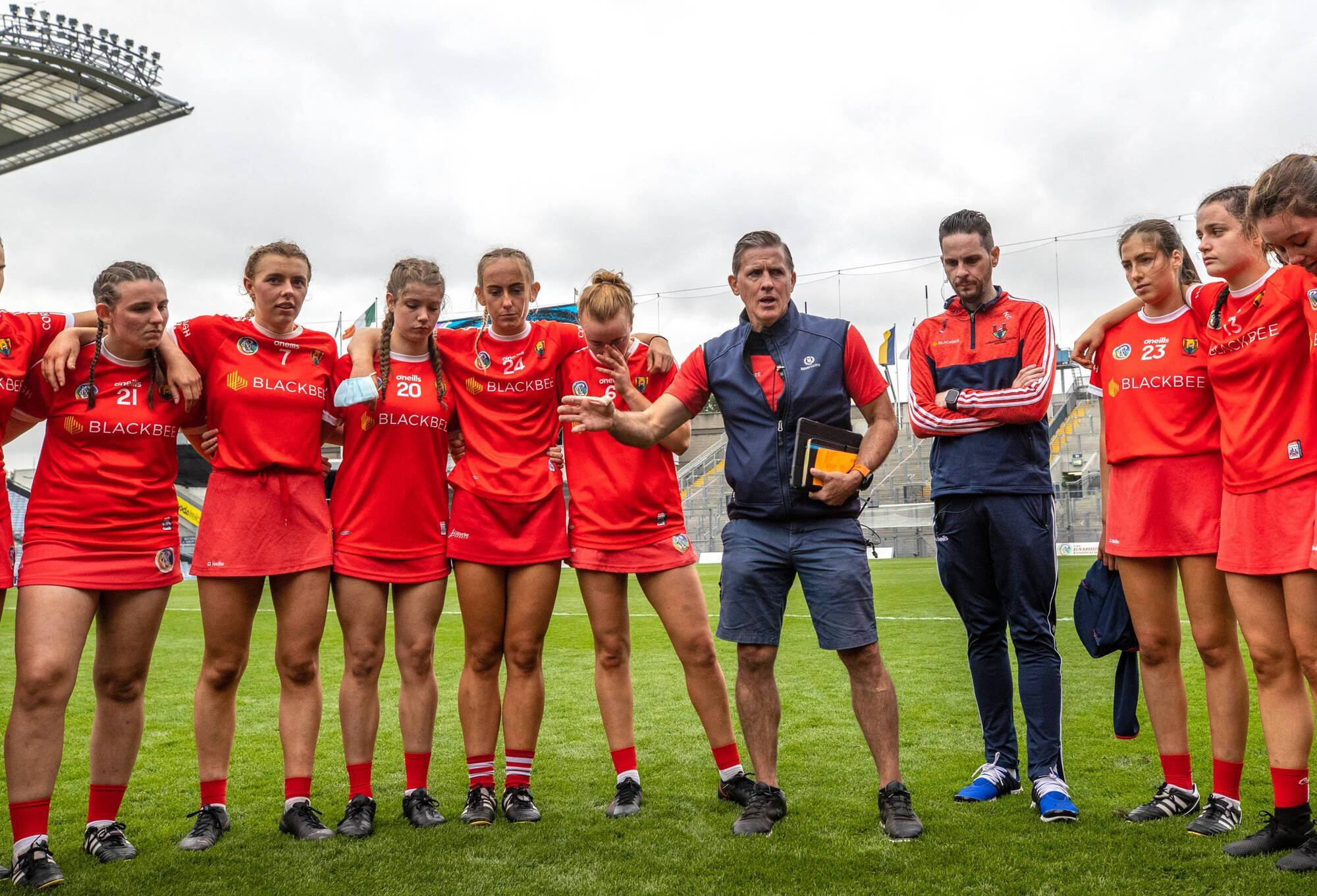
Losing has never sat well with Paudie Murray so after last month’s All-Ireland camogie final finished the way it did, he wasn’t in the mood to stay around Dublin.
“I’m not a drinking man,” he professes, “and it doesn’t sit well with me when teams go on the tear after losing a game.”
And so, with his team having agreed to travel up and down on the one day in these Covid times, but with the kit man wanting to go for a pint or two nearby to soothe the pain of defeat, Murray offered his services to drive the kit van home himself.
Within three hours it was back in Murray’s driveway, beating Jennifer and their two daughters by a bit to spare. The game itself was pretty much parked there and then as well.
“Losing, even if it’s going for a cycle on a Sunday, eats me up, so my way to deal with it is to shut things down very much. I haven’t watched that game back yet.”
Of course it still invariably crops up and plays in his head at times; it still grates that he didn’t win that fifth All-Ireland on his beat. Ask him how he feels about finishing up as Cork camogie manager last week and he describes it as “sad in some ways”.
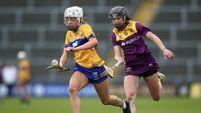
“You sometimes think: ‘All right what if you’d have done X and Y differently in the final’. Our lead-up was good, our training exceptional. Tactically we did a lot of things right, and we put ourselves in a position with 10 minutes to go to win the game. But we maybe slipped away from our structure a bit at the end and drew Galway onto us (to lose 1-15 to 1-12).
“So that’s probably still eating me up a small bit. I always had this feeling about rebuilding the team a third time to win another All-Ireland. And we came very close to pulling it off. But in the end we failed.”
In a way it was apt as well as being very Murray that after a decade at the wheel his last act as manager would be to still be driving something for the cause. And what a journey it was.
In his 10 years over the team, Cork contested seven All-Irelands, winning four. The other three years they exited at the All-Ireland semi-final stage, having lost by either a point or two. As long as he was there, they were there or thereabouts.
He’s now set to drive another bus; though it hasn’t been officially confirmed yet, he’s set to become manager of the Cork minor hurlers. But as he’s about to receive the keys for that journey, he maintains that’s a very good Cork camogie bus he’s handing over.
“I’d be very excited if I was taking this group. Certainly on the conditioning side of things they need to improve greatly but they’re extremely young and the culture is really good within the dressing room. All our players come with notebooks and iPads to any meeting because they’re so focused on getting better, whereas that wouldn’t have happened seven or eight years ago.”
He’s seen some change over his time at the wheel: In Cork, in all of the sport. He remembers his first championship game over the team back in 2012, a game in a club field in Clare where they scraped a one-point win over the home side.
“I arrived on the bus and three girls had driven down from a Robbie Williams concert they’d been at the night before. And that’s not me having a go at them; that was just the culture at the time, that’s how they had been treated and so that’s the way they treated their preparation.
“Then we arrived at the ground, the only part of the grass that was cut was to mark the lines of the pitch. In front of the goals there were two craters that I know I wouldn’t want to be diving in. And then you went into the dressing rooms to find they were filthy.
“You compare that to now, where our first championship match is either played in Christy Ring Park (Páirc Uí Rinn) or Páirc Uí Chaoimh. The Cork County Board has taken a lot of stick down through the years, some of it justified and some of it maybe not. But for me, particularly in the last number of years, they couldn’t do more for Cork camogie. I remember going into the 2018 All-Ireland when Páirc Uí Chaoimh was just open (and Frank Murphy was still CEO) and they couldn’t give it to us often enough to train there.
“Now One Cork has come into it which covers camogie and ladies football as well as the hurling and football so there’s very much a family feel about it. I know (current Cork CEO) Kevin O’Donovan is a big believer in that idea of being all one family — which is the way it should be.
“So the game is unrecognisable now, off and on the field. Players prepare differently now, prepare better now, so the game has changed for the better. If you look at the last couple of All-Irelands, it’s a spectacle that everyone can sit down and watch whereas a few years before that they couldn’t.”
Murray credits that improvement less to the Camogie Association; he feels they’ve been “maybe pulled and dragged” into making rule changes, and maintains that the consistency of refereeing is still too far below the standard of play.
The biggest drivers of change have been the players.
A case in point: Their ability to strike and score from range. In 2016 Cork lost an All-Ireland final by seven points to Kilkenny, who played a defensive system Murray wasn’t enamoured with but had to live with; instead of just complaining, he had to change. “Girls were only able to puck the ball over from within 35 yards of the posts. That was their scoring range. And when we looked at that in detail, the thing that stood out was that the girls weren’t striking the ball correctly.”
So they went back to basics and he went back to his roots. Murray and his brother Kevin come from football country. Dohenys. Dumanway. Step outside their family home and you’d find the spot where Sam Maguire was born staring back at you.
He only took up hurling when he became a boarder in St Finbarr’s, Farranferris. He just missed out by a year being coached by the legendary Canon Michael O’Brien, but he had the good fortune of being tutored by Seán O’Riordan.
“Seánie would take footballers from West Cork into a ball alley with a squash ball and within five years turn them into Cork minor hurlers (Murray himself played in the 1988 All-Ireland final). Technically he was miles ahead of his time, just getting our feet and first touch right. And so the girls will laugh at me saying this, but the spring after that Kilkenny game we went back to doing what Seánie would do with us in Farranferris. We’d go up to the ball wall in Sarsfields at quarter to eight on Saturday morning with a squash ball.”
It paid off the following September. We all remember that equalising, injury-time point from 65m by Gemma O’Connor, but just how exceptional it was for even her we probably didn’t appreciate. At the time she was already a seven-time All Ireland winner and a nine-time All-Star, yet ask Murray had O’Connor that shot in her locker in 2016 and he doubts it.
“She worked on that. And if you slow it down and look at that strike, technically it was spot on — her hips and shoulders pointing to the target. The following year then you had Amy O’Connor win a ball when we were a point down with five minutes to go and her feet and hips changed straight away. That ball was always going over the bar because her technique was so perfect from her work with the squash ball.”
Murray also upgraded his management team in the wake of the 2016 final defeat. His brother Kevin won an All-Ireland as a player; indeed there was something very fitting that both Murray brothers would establish an auctioneering firm, Murray Browne, with Alan Browne, who, like Kevin, came off the bench to score a
critical point in Cork’s famous win over Kilkenny in 1999.
“It’s funny,” smiles Paudie. “Kevin was a very calm corner-forward and sometimes got the crap kicked out of him for it, whereas I was the corner-back that would the tear the head clean off you. It’s nearly the opposite now: I’m the calm guy on the line whereas Kevin can go off his head on the line! But as a coach, he’d be 10 times better than me.”
Paudie would now see himself more as a manager, even a co-ordinator, than a coach. “There has to be a separation.”
So he’s more the John Kiely with Kevin more like a Paul Kinnerk.
He doesn’t have selectors, never will. “The word drives me crazy. I just do not know why that word is still being used. It reminds me of the guy standing with his O’Neill’s jacket on and his hand in the pocket and having a bit of craic with a couple of other guys — and he gets to pick a team? I’d be of the view that every person has a specific role.”
He seeks specialists. Like Niall Collins, his performance analyst that, along with Kevin, he’ll be bringing to the Cork minor set-up. “We had a view within the camogie management team that we were the best-prepared Cork team leaving Cork. Now we were on a really limited budget but we felt it was achievable — and there were several years we achieved it.”
He knows his own personal managerial style wasn’t as warm as the great Eamon Ryan, as well as they got on, trying to accommodate the aspirations of so many dual players. (“We had a great relationship with Ephie FitzGerald as well,” he says. “But I think at this stage we have reached a crossroads where if I had happened to be staying on in Cork camogie, there’d have to be a call made by our three dual players. I hate to say that because I have a dual background myself but it’s just not physically possible. It doesn’t help that you have two separate governing bodies that seem to work against each other more than they work with each other.”)
Ask Ryan’s former players how they viewed him and they’d all volunteer that he was a father figure. Ask Murray what he thinks his players would say and he knows he wouldn’t evoke that sort of response, just as he didn’t invite it. “They would probably say I’m quite cold. I suppose a manager can’t be their friend. I wouldn’t be an emotional character with them. But I would hope to think they would say that I was fair, honest. And that I gave it everything I had.
“When I took over you’d look at the other management set-ups that were out there and you’d study them. And even in the early months of 2013 I was fascinated with the Dublin football setup under Jim Gavin. His organisation, his planning for different scenarios that might arise in a game, which we would have done a lot ourselves, and just his emotional control and demeanour on match day.
“When I was younger, I would have been very emotional on the line. But it’s something I worked on big time. I had to reinvent myself. And every year I stayed on with Cork camogie I had to reinvent myself. People would ask why you go back for another year to the camogie but the way I looked at was that every year I was learning and improving. I couldn’t be the person I was the previous year.”
In 2021 Murray was again a different — better — manager to the one who had won another back-to-back All-Ireland in 2018.
“I brought two guys in that were very much arm-around-the-shoulder and very good with the players. Because players coming into the set-up now are different to players who were coming in to me 10 years ago. I call them the Celtic Tiger babies — when they were naughty they were given an iPad. And those two guys were also able to relay to me things the players weren’t happy about or wanted changed: They felt there were too many video sessions being done, so we had to get our message across in a different way.”
Intuitively too, he was attuned that managing female players was different to managing male players. “I might be killed for saying this but the science shows that women are more emotional and value a social connection with each other more than men do. But if you give them an instruction and they buy into it, they will give it everything and do it, whereas in a men’s dressing room there can be more egos.
“I think it’s a shame that some coaches shy away from the female game. I’d say it to anyone: Go and train a female team because it puts you into a different environment where you have to learn quicker.”
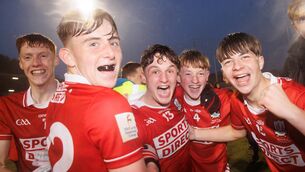
Now he’s crossed over exclusively to the men’s game after a couple of years co-ordinating Cork U15 and U16 hurling squads. Murray’s appointment is a measure of Cork hurling’s ambition — but also limitations. For all the talent there is in the county, he is able to provide an external and internal perspective which deems Cork has to up its game.
“I think as a county we’re still a bit off it. Yes, there is an air of optimism and there are some good young players coming through, especially that exciting (2021) minor team. But I thought that optimism was too high going into the senior final this year; I just couldn’t see it happening.
“I’ve looked at a lot of games in the county the last couple of years, especially underage, and I know people talk about our conditioning isn’t where it should be and I’d 100% agree with that, but I think there’s a bigger issue in relation to how we coach and view the game. Coaches need to become more aware of how to teams set up.
“I was at a recent colleges match where a Cork team was playing a team from another county who set up with a very defensive structure. And the Cork team kept beating the ball down on top of them. My view is that the only reason someone talks about a sweeper is because the opposition made that sweeper look good. We have a lot of educating to do on that side of things because it’s still very pervasive, that old traditional Cork mentality to beat the ball down the field and use a 37-inch hurley.”
And so he’ll continue to go about his work in a non-traditional way. When he was over the U15 development squad, Murray ensured the net was spread as wide as to cover as many as 130 players, at least twice as many as normal. A similar principle will apply with the minors.
“We all know someone can come late to the party so why close the door on them prematurely? Even at 17 it’s too early to judge whether they’ll play (senior) for Cork. How many of them will play adult level with their club? That’s the first real test. So it’s about development first. I’m looking at young fellas who are very good but don’t have the bulk of some guys who are beside them but less technically skilled as them.
“So it’s important not to lose sight of the guy that needs to bulk up because that (bulk) is going to come.”
Murray knows all about the long game. He’s 51 now and yet for all his experience and nous, this is his first time over a men’s Cork team. But he’s been better for the wait. And so has Cork camogie.
CONNECT WITH US TODAY



Be the first to know the latest news and updates