Karol Dillon: Is natural talent and ability all that natural?
It is true that in terms of the eternal question, genetics versus hard work when it comes to skill development, there is a genetic component involved. But it's not as simple as people may think.
Karol Dillon: Is natural talent and ability all that natural?

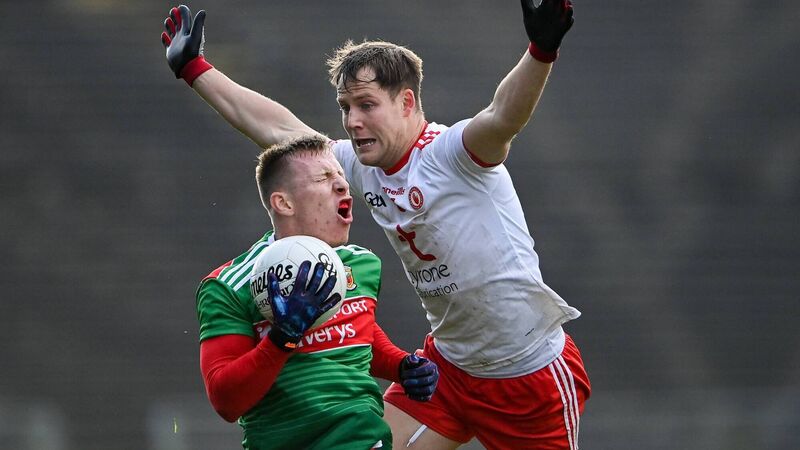
Mayo’s Ryan O’Donoghue under pressure from Tyrone’s Kieran McGeary during the Allianz Football League match between Mayo and Tyrone at Elverys MacHale Park in Castlebar, last year. Picture: Piaras Ó Mídheach

A household name is being interviewed for research on the non-dominant side in elite Gaelic football, when he’s asked how much he thinks that non-dominant side is down to genetics versus hard work.


His whole demeanour changes.

This is clearly something that has irked him; the notion that he had won some DNA lottery which meant he didn’t have to work hard.

“As people say, I had some amount of natural ability,” he finally responds. “I think that natural ability came from my upbringing and for me to be never without a ball. Like, my mother said ‘go down and get a bottle of milk in the shops’, and I was chipping a ball going down to the shop. Then I was soloing a ball with the bottle of milk coming back up. And that’s not a boast. It’s not an exaggeration. That’s just a fact like, that’s the way I lived my life.”

A current inter-county player is also very pointed on this very issue. “I think genetically if you’re given a gift, fair play, but you have to work on it,” he tells me. “There’s no such thing as a free lunch with regards to sport, and definitely not inter-county GAA because everything you get what you work for and you earn it.”

To further stress that, this was reiterated by another former well-known player who noted: “I don’t like buying into this ‘ah it comes naturally to him, it comes easy to him’, I don’t really like giving a fella an excuse.’”

Indeed one star of the sport goes further with a retort, when using the analogy of a Gamer (video games experts). “Do you think those people were born with a gift to play computer games?” he asks rhetorically. “They became good because they never stopped playing.”

The problem many struggle with when getting heads around this though is that mere practise in and of itself isn’t sufficient to get to such levels. The quality of such practise is sometimes overlooked.

For example, Malcom Gladwell’s 10,000 hours to become an expert has become a lazy cliché at this stage, because it’s an over-simplification which fails to recognise the difference in types of practise and the age at which people start practising. Crucially, Gladwell fails to differentiate between informal practise carried out in the back garden for instance, and the more pressurised deliberate practise which higher-end athletes tend to carry out.

An example of this deliberate practise was seen in my own research when a former player described in detail the painstaking nature of their free-taking sessions, and the accompanying internal monologue which was a Leaving Certificate Gerard Manley Hopkins poem from his past.

“A poem we were thought, the part of the plough that goes through the land,” he recalls. “And because it’s working so hard, it’s getting shiny as it’s working, you’re ploughing. So, when I was doing the f****** mind-numbing routine of 27 (kicks in a row over the bar) and going back to zero and if you don’t get to 27, it’s always in my head.

‘Sheer, plod, sheer, plod, will make you shine’, for the performance, you know.”

In this sphere, one player would use his individual practise sessions to mimic game situations. “I’m kicking it into you to make passes,” they say. “I’d say you kick it into me I want to just reach and grab and hit and get it down on my toes now because I want to be able to chip it up to myself. Everything was game-focused.”

A crucial question however is can all players honestly say they practise with a specific aim, to improve their non-dominant leg for example, or are they heading to the field to tick a box?

Dr Ed Coughlan of MTU has done excellent research into the efficacy of deliberate practise in Gaelic footballers. In his study, back in 2014, he divided two groups of players into expert and intermediate. The expert group engaged in practise aimed at improving the skill they were weakest at (by choice). The results from the expert group were significant in that they managed to maintain their level of improvement after their re-test. However, these participants rated the practise as taking more effort, being more mentally draining, and being less enjoyable compared to the other training group.

As for that other group, the intermediate group, the players mostly practised the skills they were already strongest at and, notably, did not maintain their initial improvement in the longer term.

The results of the Coughlan study should act as a valuable lesson for modern-day players who are already being stretched to the maximum.

Are they getting the most from their individual practise time with a ball?

Are they clear on his objectives from such sessions?

If a player is on his own kicking, and his technique is wrong, what good is that kicking session doing? It’s merely reinforcing his own poor technique. But the issue of technical feedback to players, to heighten the quality of their practise, is also a major issue in an organisation which relies so heavily on volunteers.

Throughout my research, it was commented on by a number of participants how lip service from coaches, managers, and selectors, is the bane of players’ lives. As one said, “You might have some selectors, who it’s almost the default thing to say, if they’re looking to have an input. ‘Work on your bad leg.’ So, it’s a stock bit of feedback you get from management.”

In many instances players are crying out for specific, technical feedback via an iPad, or an equivalent. The same player alluded to this by saying, “I would say very few managements have tried to put the thing in place where it’s easy for players to go and improve their weaker side.”

In rugby there is a designated kicking coach at every elite team. Why then, in a sport where kicking is absolutely critical, is Gaelic football not doing the same?

There are outliers, of course, in terms of technical coaching ability. Dublin senior women’s manager Mick Bohan recently revealed that he brought in a biomechanist from DCU to look at the kicking technique of the Dublin women in 2017.

Former Kerry and Dr Crokes manager, Pat O’Shea, and another Killarney man, former Kerry goalkeeper and senior selector, Johnny Culloty, of Killarney Legion, are other positive outliers. Players who have dealt with both these men still speak fondly of the detail both were able to impart to elite senior county players; from kicking with the instep, angle of their shoulders, release of the ball, to how far from the body they are holding the ball, and, of course, their follow through.

It is true that in terms of the eternal question, genetics versus hard work when it comes to skill development, there is a genetic component involved. But it’s not as simple as people may think.

As an example, what some participants in the research undoubtedly showed was a ‘rage to master’ — a genetic predisposition to obsess over wanting to be the complete player. By extension, this meant being able to kick and hand-pass the ball on both sides. As one player outlined, “I was motivated because I wanted the complete skill set so nobody could say, ‘ah he’s lovely but he can only kick with one leg’ or ‘he’s a nice player, but if you get physical, he can’t deal with that. He’s a nice player but when it rains, he can’t show his skill level.’ In the back of my mind I said no one will say this about me. And probably I never mastered all of those things. But I certainly had the ambition to master them all.”

In fact, in my previous life as a primary school teacher, I saw how the so-called most talented boys and girls, even at such young ages, always had a ball.

And that a player in love with the game will practise more, and this kind of love, like love of any kind, depends on the person. A former pupil of mine spent three years copying Kerry’s James O’Donoghue, from his dummy to the way he walked, while another one kept hitting the post when shooting for goal, until he told me he was trying to copy Gooch’s style of stroking the ball into the net.

One retired inter-county player describes the purity of kicking a ball, an almost magical experience. “That’s the biggest thing I miss from the game myself, not being able to kick the ball the way I used to. I don’t miss the training or anything else. But I do miss the kick.’ The kid on the playground, and the retired intercounty star, both sharing a love for the game.

That’s where genetics is undervalued.

If my own research shows anything from the transcripts of the participants, it’s that commentators, journalists, and supporters alike, need to choose their words carefully when talking about natural talent in players. Thousands of hours, from the time that player could walk, went into this ‘natural talent’. The beautiful follow through of David Clifford when he’s kicking a point didn’t come about by accident, nor did the ease with which Diarmuid Connolly could go from left to right in milliseconds. Thus, we look at genetics for the wrong input because the key to such personal make-up may in fact be a love for the game, and an obsessive desire to be the best they can be.

- Karol Dillon is a PhD candidate in the area of bilateral skill development in the University of Limerick under the supervision of Dr Phil Kearney and Dr Ian Sherwin.

x

More in this section

Cookie Policy Privacy Policy Brand Safety FAQ Help Contact Us Terms and Conditions

© Examiner Echo Group Limited