Recounting the famous day in 1981: 'We thought Kerry were wonder men coming to Tyrone'
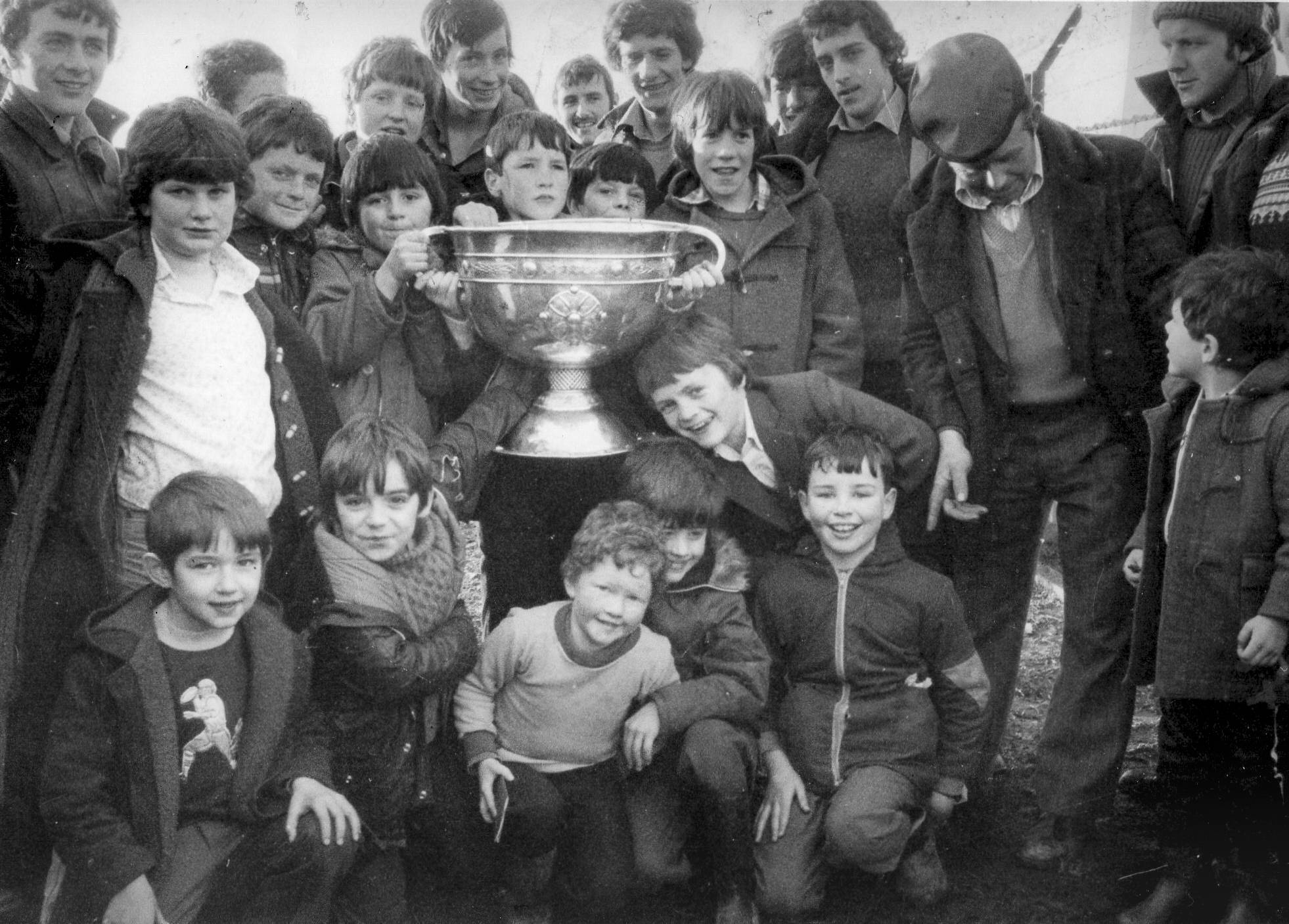
Young Tyrone fans pose alongside the Sam Maguire during Kerry's visit to the county in March, 1981. Picture: McSorley via Jason McCartan
As game week draws to a close, the Kerry and Tyrone squads are cocooned inside their own worlds, blithely ignoring the noise while the mortars and scuds are flying across newsprint, podcasts and radio, shelling their walls.
The two-week delay has everyone tetchy, tense, antsy. On a war footing. You could hardly believe there was a time that Kerry were worshipped in Tyrone.
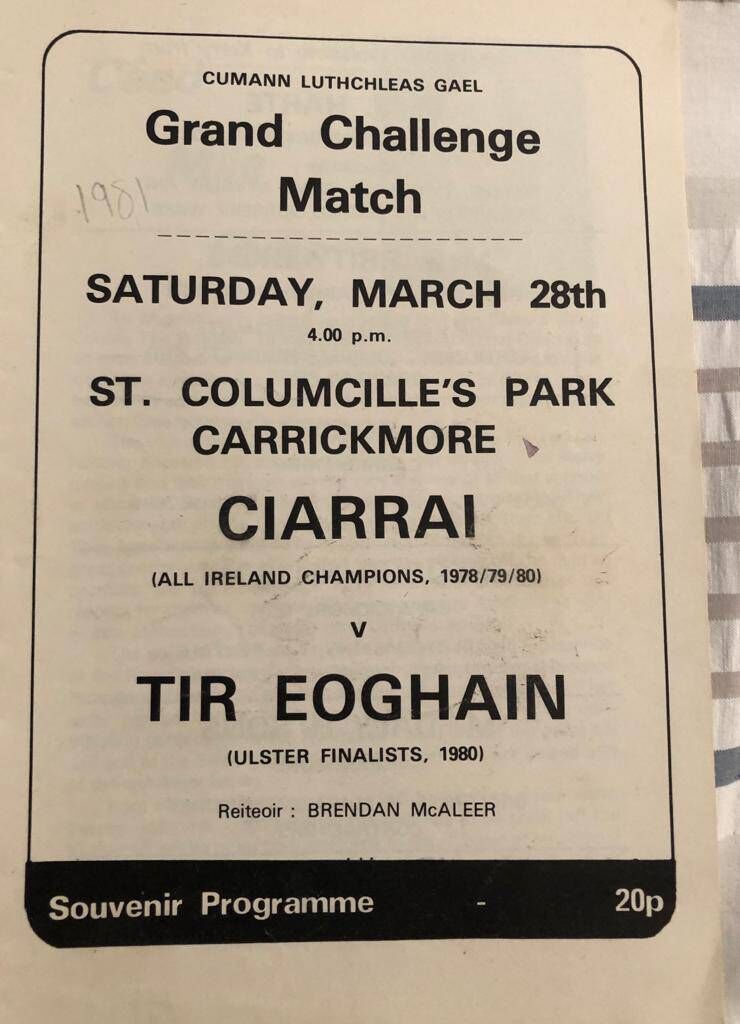
Forty years ago on March 28, 1981, Tyrone hosted Kerry for a challenge game in Carrickmore. The Kerry team were in fundraising mode to offset some of the costs for an upcoming round the world tour to mark their three consecutive All-Ireland wins.
The itinerary began with a fixture against Down in Burren on the Friday evening.
After staying with local families they had Tyrone on the Saturday, then Louth on Sunday. They would entertain the masses, sing songs, hammer over a cricket score, coach youngsters and leave with the gate receipts and a few buckets filled to brimming with shrapnel.
“The image they had of us was we’re fabulous athletes,” recounted Pat Spillane in Michael Foley’s ‘Kings of September.’ “Suddenly we went up and we were drinking for Ireland. They couldn’t get over that, and still go out the following day and beat the living daylights out of whoever.”
In the matchday programme, the freshly-appointed Tyrone chairman Brendan Harkin penned this: ‘The Kerry players and their manager are the very epitomy of all that is good in terms of dedication, commitment and sportsmanship. Their achievements on the field are the just rewards for their efforts. They have rightly earned the acclaim and fame that is due to all great sportsmen.’
For those along the sidelines and even inside the white lines, there was a genuine awe. It wasn’t Kerry’s first time in Tyrone. They had another three-in-a-row team that arrived into Annagher Park, Coalisland on September 11, 1932 to play Wexford for a set of commemorative medals presented by Central Council. Hard to believe now with roughly a dozen thriving and busy clubs within a 10-mile radius of Coalisland, but it was hoped the game would stir something in the locals where interest had waned badly.
Even to get Kerry across the border was a fraught operation at the time. On the day of the game Bobby Sands was into his 28th day on Hunger Strike. Unrest was a permanent state of mind.
Most teams coming north for league games had a policy of overnighting in Monaghan or Cavan, before continuing the journey and crossing the border on matchday.
On their way up, Kerry passed through Clones and hopped out at Barry McGuigan’s gym. His brother Dermot brought them in and they studied all the apparatus before getting into the ring and trying out some sparring themselves. Before they left, the late Dermot handed them two Mars Bars each to calm their nerves.
Kerry had no fear of coming north but previous experience left them with a sharp awareness.
In 1979, they had played a pitch opening in Down, heading back down through Warrenpoint. The lack of fuss at the checkpoint had them wondering just how much The Troubles impacted on everyday lives.
Two days later, the IRA ambushed a British Convoy on the same road at Narrow Water Castle, killing 18 soldiers in the deadliest attack by the PIRA on the British Army.
“A bit of an eye-opener,” says Eoin Liston. Using his nickname ‘Bomber’ wasn’t the most sensible thing up around these parts.
On the Friday night, they stayed among Burren club people before leaving early for Tyrone.
The two had never ever met in Championship football. In fact, they had only played once at senior level, a National league meeting on April 7, 1974 that Kerry won 2-14 to 0-12. Coming off the bench that day was a very fresh Mickey Harte.
By the time they rolled into Carrickmore, Harte was one of the established Tyrone players.
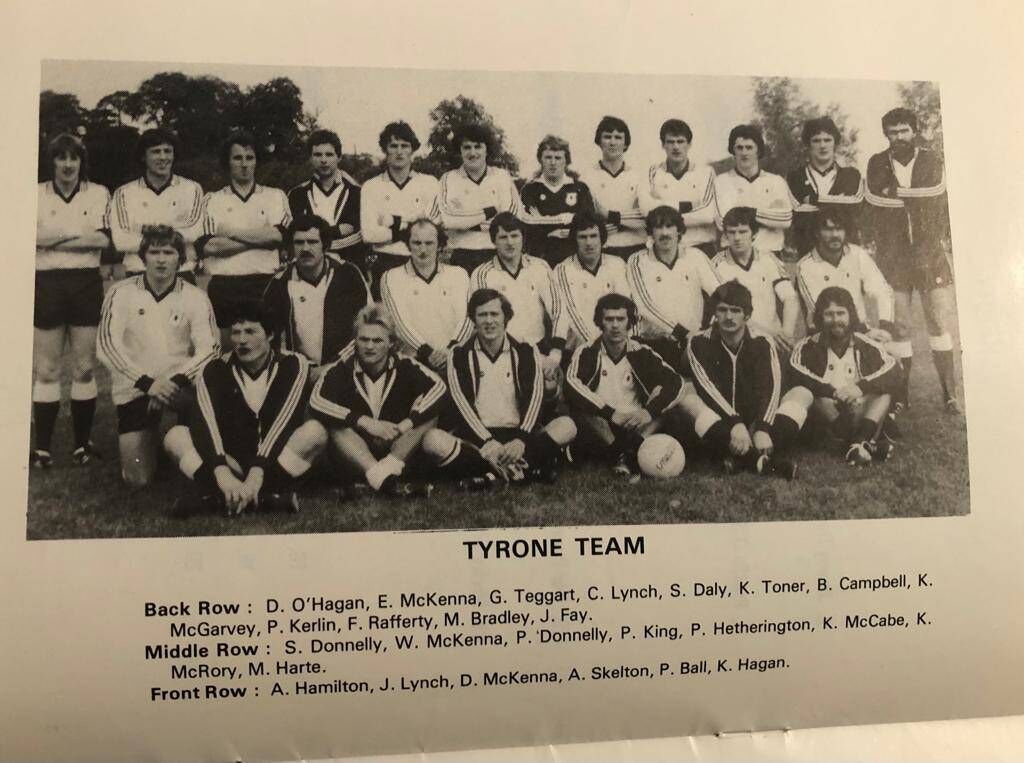
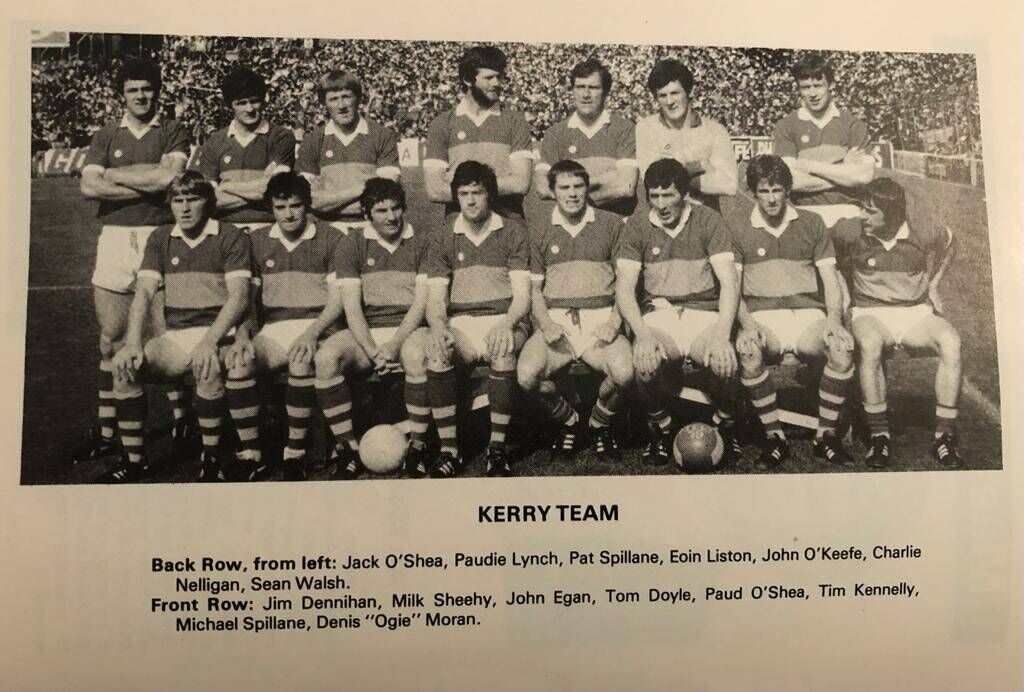
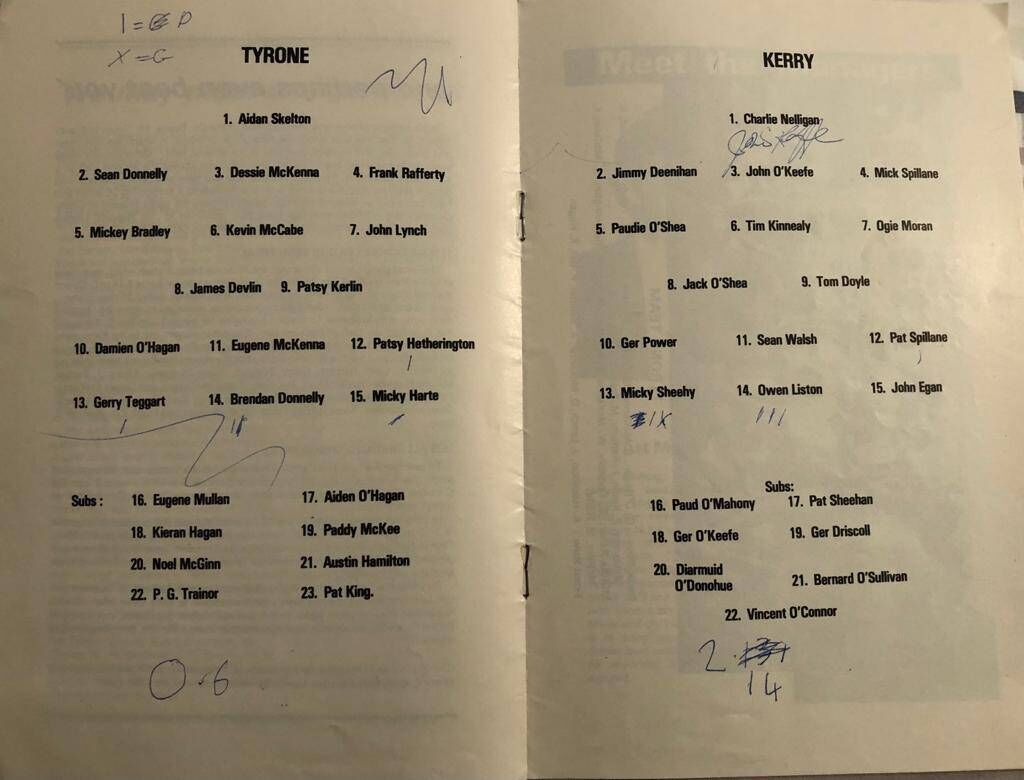
Kerry duly delivered the walloping, just as the locals would have wanted. 2-14 to 0-6. Bomber scored 0-3, marked by Dessie McKenna. Harte scored 0-2, picked up by Jimmy Deenihan.
“We thought they were wondermen coming to Tyrone. Stuff that was all in the distance, and here they were coming up to play challenge matches in Ulster,” recounts Harte, 40 years on.
“It was just amazing I suppose, to have the All-Ireland champions. Everybody thought this was magical, to see these boys who were the real deal, on the fields of Tyrone. It was an amazing event.
“We just weren’t in that league. You didn’t even dream about being in that league. They were ‘up there’ and we were where we were.”
The local paper, The Ulster Herald were in enthusiastic agreement.
‘For the most part they had really come to see the Kerrymen display their talents and they would probably have been very disappointed if Mike Sheehy, Eoin Liston, Pat Spillane and John Egan hadn’t obliged with several dazzling scores,’ they reported.
They breathlessly continued later; ‘The general verdict just had to be that the mighty Kingdom are in a class of their own and their standing as superstars was further consolidated among the Tyrone supporters.
‘They added to their reputation as outstanding ambassadors when they spent a full twenty minutes at half-time signing autographs for their young fans. It was a sight to behold and an operation that should do much to counteract the attractions of the cross-Channel soccer stars.’
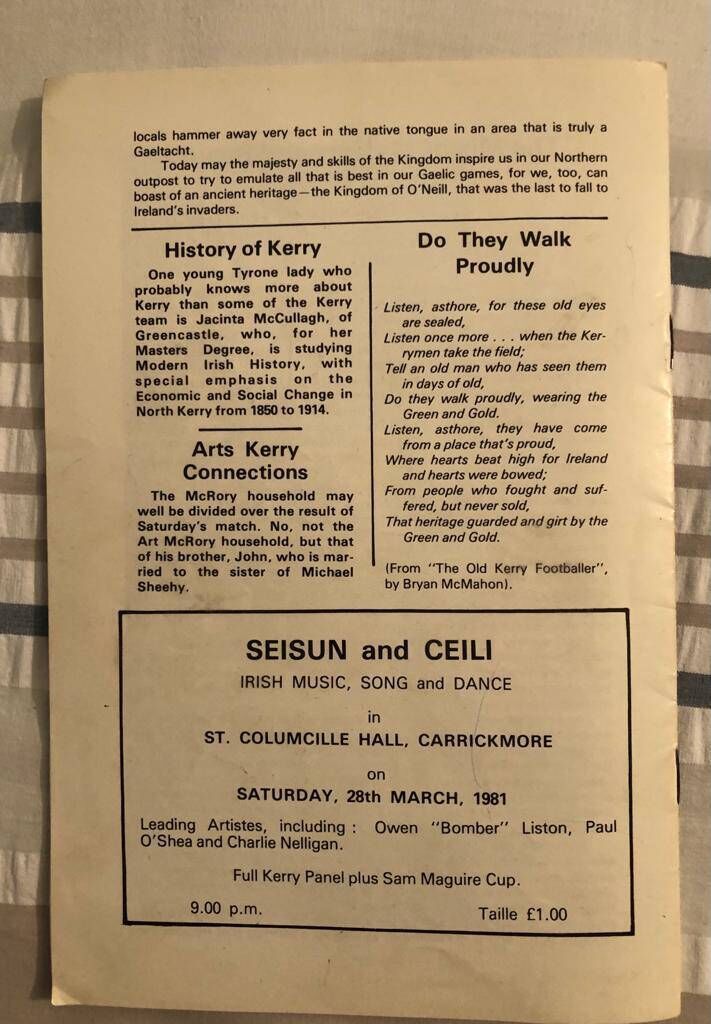
Within the extensive matchday programme, a ‘Seisún and Ceili’ was advertised that night for the local Patrician Hall. For the cost of £1 entry, it promised ‘Leading Artistes, including: Eoin ‘Bomber’ Liston, Paul O’Shea and Charlie Nelligan.’ It’s difficult to imagine a Kieran Donaghy or Con O’Callaghan being asked to double up as a bustling presence on the edge of the square before being asked to knock out a few rousing bars of ‘Willie McBride’ and reproduce a few Luke Kelly inflections, but the locals had Bomber in the mood.
“We couldn’t get over ourselves. And the welcome we got, they were wanting to help us in every way they could,” he recalls.
“They put us up, I was staying with a lovely Murtagh family in Burren, on the Friday night.
“In Tyrone, I don’t think we went to bed at all, so there was no need for accommodation. But they couldn’t have been nicer to us. We were chatting, drinking and singing all night.
“It was lovely to play teams we hadn’t played before. But the welcome and the friendliness, the spirit the matches were played in, everything was just lovely. People couldn’t have been nicer to us. The memories I have is the fun we had with the singing and the craic, discussing the match and everything.”
He added: “There was no baggage so. You hadn’t played them and there was no rivalry. In that time, they had an awful lot of respect for Kerry up north.”
In fairness to Kerry and the likes of Bomber in particular, they put their back into it. Upon arriving in Tyrone around noon the panel split up to coach U14 players in the various regions.
Donemana got the Jimmy Page-like genius of Mikey Sheehy landing. Ger Power made for Omagh. Pat Spillane and Paud O’Mahony parachuted into Eglish and the youngsters of Augher could barely contain themselves at the sight of Jack O’Shea and Charlie Nelligan landing at their pitch.
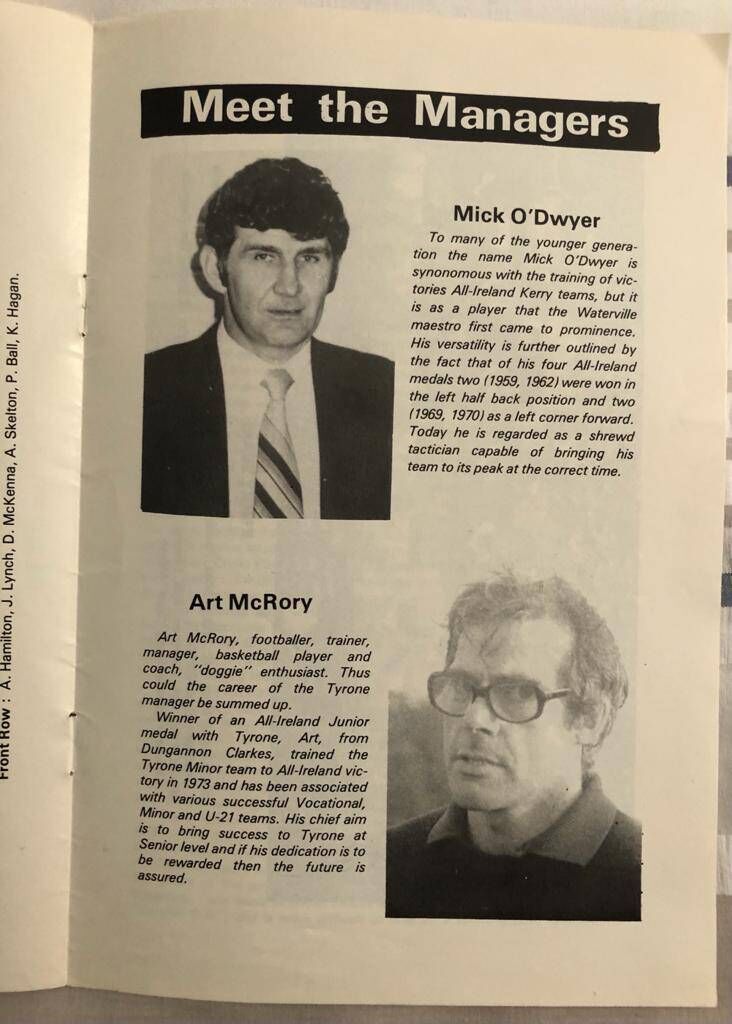
Come half-time, there was another innovation. Tyrone coach Art McRory had set up a free-taking competition, sponsored by Dungannon businessman Pat Shields.
The winner was one Mickey Harte, beating the recognised county free-taker at the time, Patsy Hetherington to give McRory some food for thought.
At the other end, Bomber and Sheehy put on their own exhibition, lost in the midsts of Liston’s memory as he chuckles, “I’d say I gave some exhibition alright!”
While the Kerry lads headed for a recovery session of roast beef and porter, the Tyrone players had other commitments. The following day they hammered Fermanagh 2-12 to 0-6 in the Dr McKenna Cup. Later that evening, a number of league games might have been postponed only for the Tyrone players speeding up the road from Irvinestown to play for their clubs.
“That always happened,” says Harte.
“The ‘Tournament’ games always used to be on a Sunday evening as well. You played your league match on a Sunday afternoon, you went home and got a cup of tea or whatever and went on to that. That was par for the course in those days. There was no talk about recovery, it was ‘get on and play on, play on.’
“But again, the games weren’t as demanding then either. You played positions. There was no way the corner back was going to get up and get a point, or the corner forward was going to be blocking a ball on the other side of the pitch. You spent a lot of the time waiting for someone to get the ball up to you.”
The craic was rolling so freely, there was no desire among the Kerry players to make for bed. Unusually for an Ulster town, there were no RUC barracks either, so the licensing laws around Carrickmore had more elasticity than most.
The next morning they gathered up the panel in various states. They had Louth to play in Dundalk.
‘There’s no doubt about it,” said Spillane, ‘but if there was a breathalyser test on the way into the field, seventy or eight percent of the Kerry team would have blown it sky-high. The only thing was, everybody went away happy. Louth went away from the match thinking they weren’t too far away.’
Liston chuckles at the memory; “The teetotallers among us carried us.”
Kerry went on to secure the four-in-a-row later that summer. But there was an undercurrent to their preparations. The Round The World Tour itself became a sprawling, exhausting juggernaut that dragged on, through Australia and Hawaii.
Even after the 1981 final, they ventured north again twice for another last rattle of the buckets. People couldn’t wait to turn their pockets out. If there was an objection to parading themselves around the country, none in the Kerry panel were willing to take it to Mick O’Dwyer.
The plan was to raise £60,000. They raised £102,000 by the end. Players were handed £1,800 each in spending money. A bit was held back for the return leg in case they were running low. A reminder; this was 1981.
But the combination of long-haul flights and late-night pints travelled down into tight hamstrings and unstable knees. Three days after their plane touched down at home they faced Dublin in a league game, tanned and plump and utterly bored by everything.
“The way we took those matches, it was totally different. Even league matches, we would have been indifferent to them,” said Liston.
“But Championship is a different ball game. You cannot compare those matches as Championship was all
different.
“It’s gone to a new level. Everything has gone to a new level, the preparation that players have to do now, you would wonder about the fun side of it. Are they missing out on a lot of stuff that we gained?”
Looking at it today, with all the skin and fur that has flown between Tyrone and Kerry since in their seven Championship meetings, the past is a very different place indeed.
“It is hard, looking back on it to imagine that they carried that sense of awe and wonder to them. And our county were as much in awe and wonder as anyone,” remarks Harte, before delivering the sentiment that he did more than anyone to achieve; “Thankfully, those days are gone!”
“Someone must have hit Mickey Harte a sneaky belt or something,” guesses Eoin Liston as the conversation draws to a close.
“Because it all changed by ’03, ’05 and ’08. I might put it down to his experience in that match.
“Who was marking him? Who was in his corner? Who caused all the trouble for us down the road?”
Why, it was Jimmy Deenihan, according to the programme.
Prompting a roar of laughter.
“Ah sure that explains everything!”


CONNECT WITH US TODAY



Be the first to know the latest news and updates