No basis for pausing wages cover for injured GAA players, argues Cork delegate
Freemount club delegate John O’Flynn doesn’t believe either clubs or players should have to fork out additional monies to secure loss of earnings cover
No basis for pausing wages cover for injured GAA players, argues Cork delegate

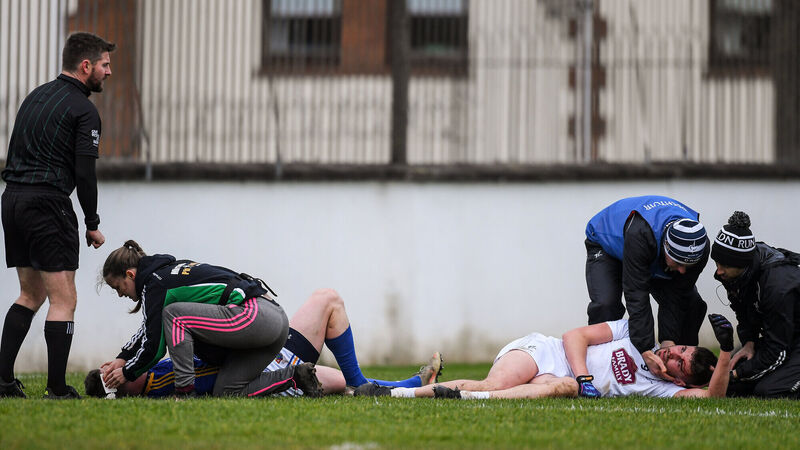
Referee Chis Dwyer looks on as Michael Quinn of Longford and Liam Power of Kildare are treated for injuries in the first half during the 2020 O'Byrne Cup match Kildare and Longford. Picture: Piaras Ó Mídheach/Sportsfile


A Cork club delegate believes there is no basis to the GAA decision to pause loss of wages cover, calling on Croke Park “to go back and look at their numbers”.

There has been significant pushback from clubs and counties to the Croke Park decision last December to pause cover for loss of earnings within the GAA’s injury benefit fund.

Prior to 2021, players who suffered an injury in the course of GAA activity which resulted in them having to take time off work were covered, through the fund, for up to €300 per week for a maximum of 26 weeks.

At last month’s Central Council meeting, Croke Park revealed two options were being explored for the 2021 season as alternatives to the paused wages cover. Under consideration is the provision of a personal injury policy through the GAA’s insurers, Marsh Ireland, for a set fee per player which would cover loss of wages and some additional injury benefit, while the other option on the table is a 25% premium increase for all units to cover the €1.3m annual loss of wages claims.

But Freemount club delegate John O’Flynn doesn’t believe either clubs or players should have to fork out additional monies to secure loss of earnings cover. He has made contact with GAA finance director Ger Mulryan to query the financial logic behind the initial decision to pause loss of wages cover.

When announcing on December 1 last year that players would no longer be covered for loss of earnings, GAA correspondence to clubs said the injury fund ran a deficit of €2m in 2020. The actual loss, as reported in Ger Mulryan’s financial report two months later, was €934k, less than half the figure cited in December.

Injury fund losses in recent years, including a €2m deficit in 2019, were covered by gate receipts from central coffers, but this has been deemed an unsustainable approach in the short term given the lack of crowds in 2020 and the forecast absence of crowds this year.

In the aforementioned correspondence from last December, injury claims incurred in 2020 were said to have totalled €8m, a figure in keeping with previous years, but the GAA’s audited accounts for 2020 show injury benefit fund claims and expenses came in at €6.05m last year, down €2m on 2019.

O’Flynn has said the figures presented in the audited accounts do not support Croke Park’s rationale for pausing cover for loss of earnings.

“The reasons for the decision by the GAA to not cover loss of wages for the coming year were on the basis that the claims in 2020 were similar to the claims in 2019 and that there was a loss in 2020 of about €2m, similar to other years where the GAA covered the actual shortfall.

“I am in correspondence with Ger Mulryan in Croke Park and their basis for arguing that the actual insurance costs for 2020 were similar to 2019 was on a cash basis, but from an accounting viewpoint, you have got to look at it on an accounts basis and an accruals basis, and when you look at the accounts presented at Congress, the actual insurance claim is €2m less in 2020 than it was in 2019. And that’s what you would expect because the level of activity in 2020 was much less than 2019,” remarked O’Flynn, an accountant by trade.

“Also, the suggestion there was a loss of €2m in 2020, and that is actually mentioned in the [March] Central Council report, but when you look at the accounts, there is a loss of €934k. When I delved into these accounts with Ger Mulryan’s assistants, the loss of €934k arises because €1m of the €6m paid by clubs in 2020 was allocated to the first three months in 2021 because it was decided to extend the 2020 insurance year [until March 2021].

“The point I am making is when you look at the audited accounts, they don’t support the reasons why there was a pause in the loss of wages. I think Croke Park needs to go back and look at their numbers. I don’t believe there was a loss on the fund from last year based on the audited accounts. If there was a loss, then the audited accounts are incorrect. This needs to be looked at in a lot more detail.”

x

More in this section

Cookie Policy Privacy Policy Brand Safety FAQ Help Contact Us Terms and Conditions

© Examiner Echo Group Limited