The Kieran Shannon interview: Tom Parsons steps away from the real Sunday social
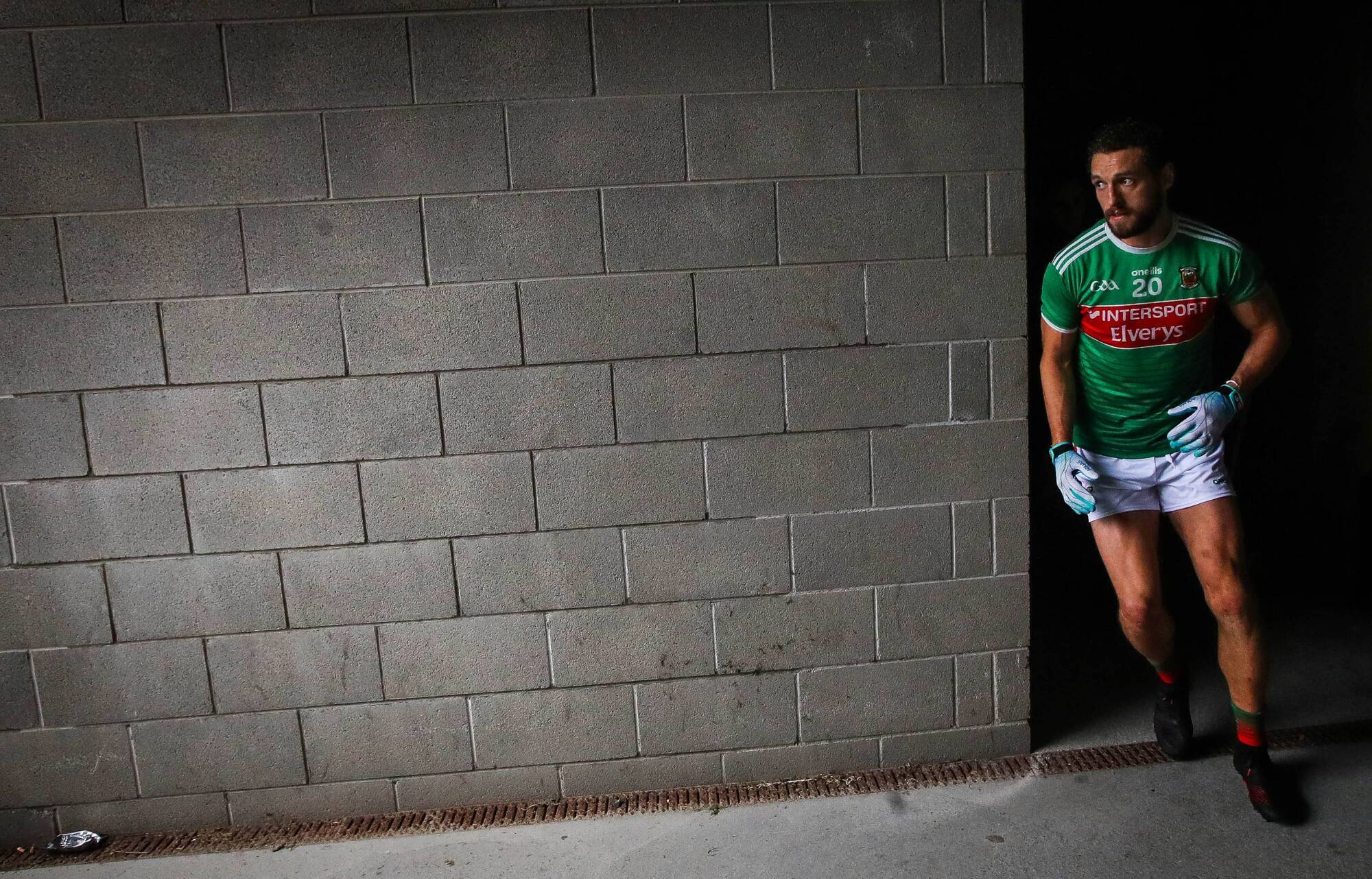
Tom Parsons bursts out of the dressing room ahead of the All-Ireland SFC quarter-final against Donegal in Castlebar in August 2019. Parsons battled back on to the Mayo panel that season, a year after a horrific leg injury had threatened to end his career.
THE OTHER ANY GIVEN SUNDAY SPEECH
AFTER for so long only looking forward, Tom Parsons has found himself a bit like Tony D’Amato and his LA drinking buddy, reflecting on what was so special and what he’ll miss about being a Mayo footballer.
As clear-eyed as his decision was and as happy as he is with it, his retirement and that of several other teammates this past week has caused plenty of misty eyes out by where he hails from, including his own at times. Yet while there’s a poignancy in that retrospection, it’s overrode by an even greater sense of gratitude.
We’ve caught up with him exactly 48 hours after he issued his statement via Mayo GAA. He’s at home in the family house in Tallaght, taking a timeout from double-jobbing between his day job and attending to his 15-month-old son Matthew who he jokingly bemoans hasn’t inherited his curly hair but rather his wife Carol’s blonde mane.
The job is with Jacobs Engineering, a Fortune 500 company, working as a culture manager for the entire European division. That’s a lot of people he’s over with a lot to be responsible for. And as he’ll explain over the course of our 90-minute chat, the lessons he’s taken from his time with Mayo have been the best training he could ever get for that job.
He might have left the dressing room but the dressing room will never leave him.
***
KS: What made you decide it was time to go now, as opposed to, say, the end of 2021, or the end of 2019?
TP: I think it was the sum of the parts. I’m 33 next season. I’m blessed to have a beautiful family. And the travelling this past season was relentless.
Normally those of us based in Dublin would commute together in a mini-bus or car share. This [past] year it was single travel. Only me and Rob Hennelly were in Dublin; Chrissie [Barrett] moved back to Mayo, as did Seámie [O’Shea]. So that meant if we had three sessions a week, I was driving 18 to 20 hours a week. That was quite lonely, getting back at 11.30 or 12 at night. To justify that energy and effort coming from Dublin, you’d really want to be playing. And this past season, I didn’t play much.
I came into the year with the body feeling really good again, but then I fractured my ankle and only became available for selection again just before the [Connacht semi-final] game against Roscommon. I came into the [matchday] panel for the Galway game and got minutes against Tipperary, then didn’t get on in the final which I’d have loved to have but that’s life; a team is only successful if you have 40 players pulling in the same direction even if only 18 are going to get serious game time.
But I was wondering: in 2021, would I be able to play consistently in every game to the best of my ability? I wasn’t sure. I wanted to finish my career being close to my best and that my teammates could never say, ‘Tom’s only giving it 90% this year.’ And with such a quick turnaround this season, if there’s something in your gut that says ‘I don’t think I’m 100% in’, you have to act on that.
So between Christmas Day and New Year’s, I sat down with my wife and realised, ‘I’ve had an amazing run and you know what, I’m going to end it here.’
KS: So what’s it like, now that you’ve made the decision?
TP: It’s been a real emotional few days. When you’re playing, you don’t really take time to reflect; you’re moving onto the next objective, the next session, the next game: what’s done is done.
When you play for a team like I have, you forge very special relationships with your teammates. And you know that once you leave that environment that in the case of 90% of the guys that relationship has changed forever more.
For every big game I’d sit on the bus with David Clarke. And there’d be no words or conversations between us. Just this shared moment. Of excitement, of anxiety, the assurance that you had a guy like him going into the arena with you to play in front of 82,000 people.
And deep down you know you can’t replicate those experiences and relationships in other aspects of life. That’s what I’ll miss. I have friendships that I have no doubt that will be maintained for years to come but there’ll be friendships from a distance.
***
KS: This isn’t the first time you and the Mayo panel have parted ways, of course. At the end of the 2011 league, you were one of a few big names James Horan let go. In 2014 he’d recall you but you’ve spoken about how that three-year hiatus was one of the best things that happened to you. How?
TP: Back during my first stint with Mayo my whole life was consumed by football. I won’t say it was a much bigger part of my life than it has been this past six or seven years but I didn’t have as much balance in that life. The football was always on my mind so when I was dropped, I won’t say for three months I was depressed, but there was definitely a high level of anxiety and a serious lowness.
KS: So what would the 33-year-old Tom Parsons say to that 23-year-old Tom Parsons?
TP: Don’t get all-consumed by the game. If you perform in other areas of life, be taking care of relationships, your work or studies, it’s much healthier for you, including your football.
KS: But in order to do that, do you have to give up more on the football side so to improve the other aspects of your life? Do you mean not bothering with doing extra skills work or skipping gym work?
TP: It’s more a mindset thing than a time thing. By taking more of an interest in other things other than football it allowed me to switch off more.
I played for Ireland at 20. My club were going really well, winning senior county titles. I was captain of the Mayo U21s and my Sigerson team. And then suddenly my Sigerson career ended, I was out of U21s, the club were relegated to intermediate and I was dropped from the Mayo panel.
I failed my engineering exams. I was all over the shop.
Looking back, there was a stage where I was playing too much football. I remember the week I came back from playing for Ireland in Australia, there was a college league game and our manager at the time made it seem like it was the most important game of my year. And I couldn’t say no to him.
KS: Because you were afraid to be seen to be above your station.
TP: Exactly. And it wasn’t until I moved to Cardiff to get work and was surrounded by a cohort of people who had never heard of the game that I really found myself and found value in myself. ‘You know what, I’m not just a footballer. I have a professional career, I have friends away from football, a partner that I love.’ I was doing some boxing, athletics. I found joy without the game. Then when I came back I was free.
Because I knew either way I’d be okay without the game. I could just let go and not be worried.
***
KS: What other memories have come flooding back in recent days?
TP: You know what, and it’s a weird thing to say, but probably my greatest memory is one of heartache. And that’s the final whistle in ’17 [when for the second straight year Mayo lost to Dublin by a point in an All Ireland final].
We’d played 10 games that summer, a run I’ll never forget, from playing Derry in Castlebar to Clare in Ennis to Cork in Limerick to replays against Roscommon and Kerry. I’d played every minute of every game that year. I always seemed to be playing with a broken finger or a sore ankle but in every game I believed I performed and just felt at the peak of my powers.
I went into final half-exhausted but we went again and at the end of the game I just remember standing there, absolutely exhausted. I couldn’t catch my breath. My legs were like jelly. I was so dizzy, I had to hunker down. And as I did, I just looked left and right and all round me I saw 14 other Mayo lads just as exhausted as me and 15 Dublin lads the same as well.
There’s that famous phrase about the pride of being exhausted on the battlefield, having given everything in the pursuit of victory for your cause. And though we’d lost and I was absolutely gutted, at the same time I felt so… proud. So… alive.
There have been plenty of games that we’ve won: you’ve to win big games to play in the biggest of all. But at the end of some of say a Connacht final or even some All Ireland semi-final wins, I wasn’t exhausted; I hadn’t been pushed or performed to my absolute limit. I think win or lose, there’s some sort of satisfaction in leaving it all out on the pitch. And that day there was a pride in yourself and your team.
KS: I get what that there’s no easy or good way to lose, and those who say that you might as well lose by 20 as by one are deluding themselves. But at the end of the day it was the Dublin lads who got over the line that day and you and your team didn’t. How have you squared that and how do you perceive your relationship with Dublin?
TP: I’ve definitely squared it. I will not be winning an All Ireland as a player with Mayo. That’s actually the first time I’ve said that out loud and it’s hard, but such is life. I would think I’d have far more regrets if I was standing there at the end of a game and knew I hadn’t given it my all – that day, that year.
Paul [Flynn, CEO of the same GPA executive that Parsons chairs] texted me just after I issued my statement and it was just one line: Respect. In ’16 and ’17 we crossed and marked each other for long periods of those finals and there were plenty of times where we gave it to each other on the ball and off it. But there’s a mutual respect there when you know you’ve battled someone and you can look each other in the eye and you both know, ‘I didn’t get it easy there.’
I think even with the existence of the GPA, players can find it hard to forge relationships with their opponents. But if you look at the NBA or tennis, there’s almost a brotherhood amongst even rivals. And in recent years through my work with the GPA I’ve met lads not just from Dublin but Kerry, Galway, Tyrone, Roscommon, wherever, and there’s a mutual respect because we’re all similar. Win or lose we all have our individual demons.
KS: Last month when the Clare footballer Gordon Kelly retired after 15 years he said that he’d recommend county GAA to any young fella, that it’s ‘a fantastic experience, the commitment is overstated sometimes’.
TP: It’s nearly like an experiment or microcosm of life. Outside of football, everyone is going to have some magic moments: maybe it’s getting married, having kids, whatever. Then everyone has experienced, or will experience, bereavement. You’re going to experience relationship breakdowns. You’re going to experience setbacks in your professional career. You’re going to experience illness. You can’t escape it.
And for me, football and sport can be like a life or career condensed into, say, 10 years. And along that journey, you’re bound to experience the disappointment of being dropped and losing and picking up a serious injury, dealing with difficult people.
You’ll receive feedback that you sometimes don’t want to receive but you need to receive to get better. So it just instils values and lessons that makes you a better person. That experience has to make you a better person.
KS: Well, mention of injury and setbacks. There was obviously that time that horrendous leg injury against Galway in 2018 when there was an eight-minute stoppage before you could be carried off. I read that you gave the thumbs up to the stands when you were being escorted off. Is that true?!
TP: It is, yeah! I always remember my mother or wife saying to me, ‘If you ever get injured like that on the pitch, please give us the thumbs up.’ So when it actually happened, I can’t describe the pain I was experiencing at the time but somehow I was just able to think of my family and to give the thumbs up.
My mother was running down the stand and roared to my wife, ‘Carol, it’s okay, he gave the thumbs up!’ Carol had seen the leg but she just went, ‘Oh yeah, he’s okay!’ Knowing full well I wasn’t.
KS: It was Aidan O’Shea who first came over to you. And he said, ‘Tom, look at me. Keep your eyes up here. Don’t look down.’
TP: It was incredible. I remember every pair of eyes that looked at me. Seán Armstrong was about 10 yards from me and he just put his hand to his face and turned away. No one would come near me. A few of the Galway lads ran away. But then Aidan came over and put his hand calmly on me.
KS: That was some emotional intelligence he showed there, and to say what he did.
TP: It was. And from [team doctor] Seán Moffatt and [physio] Martin McIntyre. You think of medics and how important bedside manners are. Because fear is the worst symptom; it triggers anxiety and causes your heart rate to increase. And you can’t tell someone to stay calm because that’ll only raise their anxiety all the more. They were able to look me in the eye and get me just to focus on my breath, retaining eye contact with them.
KS: Only a few days later you tweeted that you’d be back.
TP: I’ll tell you, I was so heavily medicated on morphine putting that out, I barely remember doing it, but once I did, I immediately regretted it! There were headlines: ‘Parsons vows to return!’ And Carol said it to me. ‘What have you done?!’ Only the previous day a doctor came into my room and picked up my chart. I said to him, ‘When will I be able to play again?’ And he just looked at me, ‘Play?! You’ll be lucky to walk again.’
So that tweet seemed very silly, but you know what, it was nearly one of those things where by putting it out there, everything seemed to align with it. People would ask, ‘How’s the journey going?’ and that’d give you the energy to maybe start walking, or start taking a little hop. And you’d begin to think, ‘God, maybe I will get back…’
KS: And you did, coming on in the 2019 All-Ireland semi-final. It was just as Dublin were pulling away from Mayo that day but it was still a proud moment or a bittersweet one?
KS: I wouldn’t say so. The greatest moment for me was a few weeks earlier. I had actually done all my training away from the team because I didn’t want that pressure of ‘Is Tom nearly back?’ Very early on the rehab lads had seen me trying to run and I know a few of them thought, ‘Not a chance he’ll get back.’
My first session back with the group was during the Super 8s. We were training in Tooreen, the sun was splitting the stones and I’d been told, ‘Right, Tom, just go at 70% today.’ But I went right in at 100%: my first contact was in a 6v6 and when the first ball was thrown up and I collided with Fionn McDonagh. I think I broke poor Fionn’s jaw! But after the session we were gathered in a circle. Just the players. And Andy Moran just spoke up. ‘Lads, can we just recognise what Tom has done tonight.’ And to a man everyone just clapped.
So my finest moment in that rehab, it wasn’t coming on in Croke Park. It was that time in Tooreen. It was just magic.
KS: You now have to leave that group. Where do you think it is now?
TP: I think it’s in a great place. There’s as much talent and energy and will and want as there has ever been. Yes, a few of us have retired this week but there’s a new group of leaders now in Stevie Coen, Diarmuid O’Connor, Conor Loftus. And I’m excited to see how it’ll continue to grow. Maybe those of us who finished up this week didn’t win it all but you’d just hope that you set the right behaviours for the group to push on and win.
In a county setup everything is being watched. To be honest, when I started out in 2008, not everything I saw was what you’d want to see: fellas showing up late or maybe not bothering with working on their skills or not being as welcoming of young fellas as they could or should have been.
But when I came back in 2014 all that had changed. And I’d like to think since then that any young fella that was looking at how Tom Parsons or Donie Vaughan warmed up or practised their skills felt that it was a good example. That we set a standard for them to follow.

CONNECT WITH US TODAY



Be the first to know the latest news and updates