Declan Bogue: Cavan's decade long journey from party boys to Ulster football powerhouse
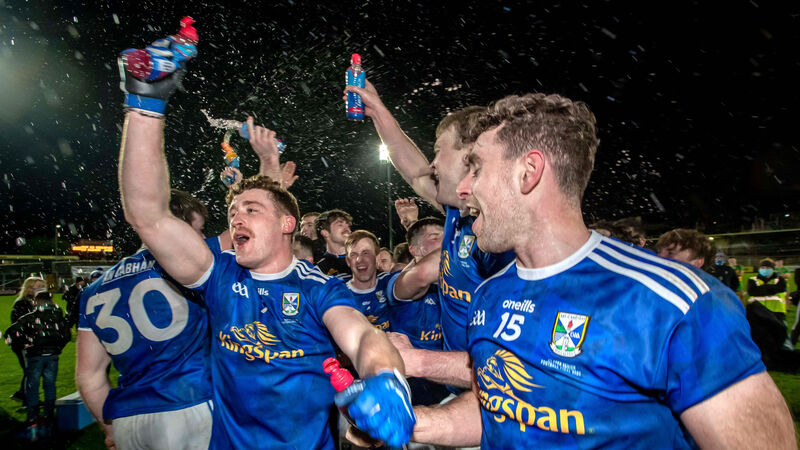
Cavan players celebrate beating Donegal. Picture: INPHO/Morgan Treacy
As is the way of embarrassing episodes, they have a habit of coming out in the wash. People just can’t help themselves.
It was in late July 2009. Cavan Public Relations Officer Mark Gillick was conducting an interview with radio station and he dropped the bomb. A number of Cavan players had actually been at the Oxegen music festival the night before a qualifier game against Wicklow – one they lost 1-12 to 0-8.
Naturally, the players hadn’t relayed their appointment to then-manager Tommy Carr. But there was widespread panic at how things had gotten so bad. Cavan had barely survived in Division 3 and were beaten in the Championship by two Division 4 teams; Antrim and now Wicklow.
And lads were running around Punchestown watching Blur and Snow Patrol the night before a game? What would Mick Higgins or Hughie Reilly make of it all?
Carr survived a vote of no-confidence at a county board meeting but it was only delaying the inevitable. The following year Fermanagh knocked them out of Ulster at the first hurdle, and in round two Cork horsed them out of it by 18 points.
Paul Brady, just back in the panel after retaining his US National handball title, could hardly believe his eyes the morning of the game as players filled their plates with rashers, sausages and soda bread.
Exit Tommy Carr. In his place came another Dub, Val Andrews in partnership with Terry Hyland. And within 18 months that experiment was in tatters, an unhappy arranged marriage coming to a miserable end with Andrews stepping down five weeks before they faced Donegal in the Championship.
It’s tempting to say now and it would provide neat symmetry a decade on, but there’s a case to be made that Cavan football was in its very lowest place a decade ago.
Finbarr O’Reilly was floating around the panel a number of those years, and looking back now, the Oxegen episode summed the whole thing up.
“That was symptomatic of the culture that was in existence at that time. It wasn’t a winning culture. Not a winning dressing room and the results back that up in that you could have a good win and go out in a fortnight time and lose,” he explains.
“There was no consistency. No form whatsoever. Players coming and going, managers coming and going.
In all that dark, there was still the chink that let the light in. On the evening the news of Andrews’ departure broke, Cavan U21s were in Brewster Park, beating Tyrone 1-10 to 0-10 in the Ulster final.
Terry Hyland was their manager, and joint manager of the seniors. Knowing that a raft of young talent was on its’ way gave him the backing to make changes.
“It’s difficult to pinpoint who was to blame,” says O’Reilly of that time.
“Is it a collective thing? It can be easy to just blame a manager. Maybe the manager wasn’t strong enough or imposing a strict enough culture or discipline throughout the squad.
“There does seem to be a prevailing attitude that you were just happy to play for Cavan and no undue expectation to win. It just wasn’t there. The only way to change that is in the dressing room and on the training field and setting high standards. And at that time, it wasn’t present.”
O’Reilly and Hyland were Lacken club mates. He knew the latter wouldn’t waste any time.
“Terry was there for four and a half years. In his final year he got them up to Division 1 and they had been to an All-Ireland quarter-final in 2013. So there were little spurts, signs that there was talent there and there was certainly good work going on,” O’Reilly says.
When Hyland stepped down, Mattie McGleenan took over as manager. The first appointment he made was O’Reilly as trainer. When he next walked into a Cavan dressing room, it was a different place.
“I would say it had changed wholesale from when I had been there as a player. Preparation, training, everything was advanced and professional.”
It’s curious in a way. A sizeable number of Cavan players had been hot-housed in the DCU way of Gaelic football for their college years, mixing with the elite. It just struggled to transfer onto the county stage. The ‘Cavan footballer’ took on cartoon characteristics. Difficult and obstinate, convinced of their own worth, way beyond the measure of others.
It didn’t help that other factors fed into it. In 1999, the players moved against then manager Liam Austin and trainer Hugo Clerkin, two highly-respected football men and players in their time.
There is a sense though that revolution has to come from within. While Mickey Graham’s prime playing years were spent collecting Cavan senior championships with Cavan Gaels, he was also hungry for titles on the sidelines.
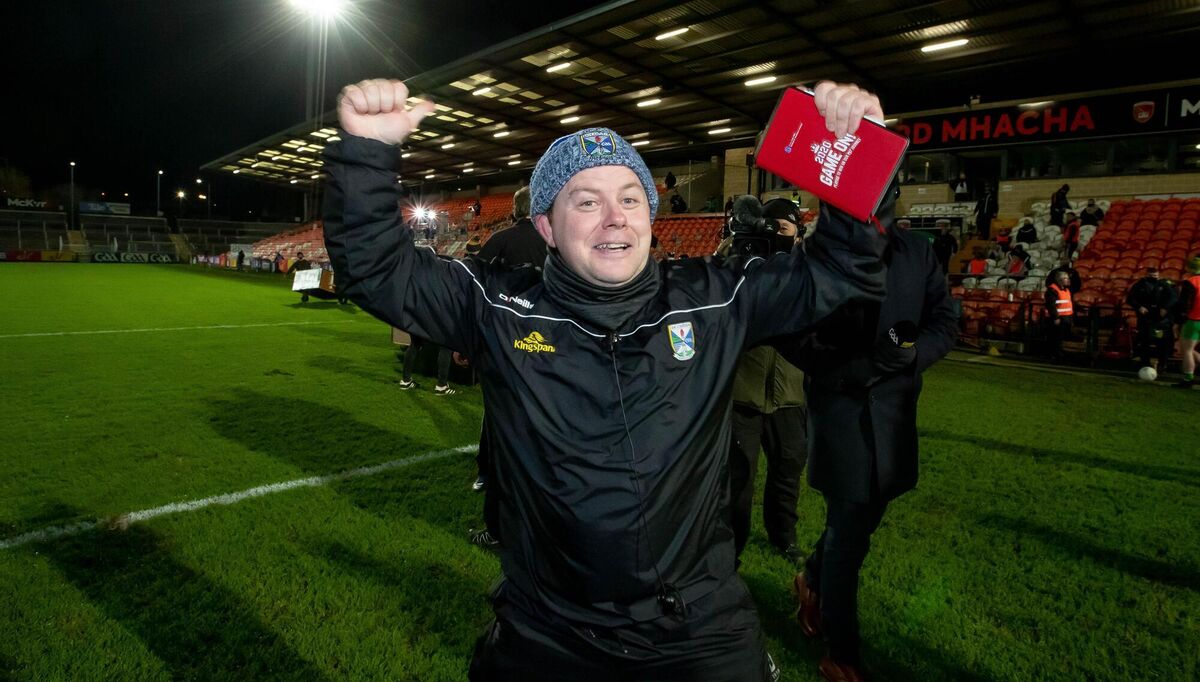
When in his mid-20s, he managed neighbouring Butlersbridge to a Junior Championship. A couple of years after that he brought Drumalee to an Intermediate.
He was at Clonguish in Longford for two different spells and when the second term ended, a man in Mullinalaghta was intrigued.
John Keegan was the club chairman at the time and as a member of Cavan Golf Club, had heard many good things. He invited him for a cup of coffee and one of the great sports stories began.
Drawing their players from half a parish of just 400 souls, Mullinalaghta hadn’t won a Longford title since 1950. But that wasn’t even Graham’s target when he took over.
“He was able to get into fellas heads and make them believe that we were good enough to win a Championship, and more than that, we were good enough to win a Leinster,” says Keegan.
“I’ll be honest with you now. Quietly, we would have laughed at the idea when he started.
And on the second Sunday in December 2018, that wind blew just right. Mullinalaghta shocked Dublin champions Kilmacud Crokes in the Leinster club football final, scoring 1-2 in the last five minutes to snatch the game.
“Before, we would have been expecting to come up second best. He would have changed that. It was his biggest attribute,” Keegan states.
“He was also good at calling players away from training. Asking them about how’s work going, are you under pressure? That sort of stuff. A good man off the field as well as on it. He would show concern and people knew he was here for our good as well as the club. It was for the love of football that Mickey Graham was doing it.
"It certainly wasn’t for money or anything like that. Because if money was the attraction, he wouldn’t be with us.”
Graham’s first year with Cavan was rough, a relegation from Division 1 followed by a crushing Ulster final loss and a heavy qualifiers defeat to Tyrone.
The trajectory looked even worse when they fell through the Division 2 trapdoor this year and found themselves seven points down to Monaghan in the Ulster preliminary round. Before one of the most unlikely Championship recoveries ever.
Something on a par with Mullinalaghta.
They laughed at him in that club when he suggested beating the cream of Dublin.
Nobody laughs at him now.
CONNECT WITH US TODAY



Be the first to know the latest news and updates