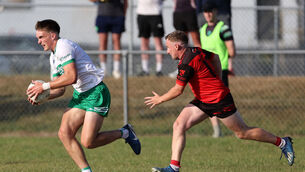
GAA set to register first gay club
The historic development emerged at a webinar to help increase inclusion in sport
The GAA is about to register its first gay club.
The association has increasingly been to the fore in promoting LGBTQI rights and supports in recent years and had its first official delegation take part in Dublin’s Pride Parade last year.
Men's Gaelic games already have two prominent gay activists in Cork star Dónal Óg Cusack and referee David Gough, but few other members, at inter-county level, have come out in the same public manner yet.
So to have a group of players openly identify themselves as an LGBTQI club is another significant step for the association.
The historic development emerged at a webinar to help increase inclusion in sport, hosted by DCU’s Centre of Excellence for Diversity and Inclusion today.
The speakers included Geraldine McTavish, Croke Park’s first Diversity and Inclusion Officer, who revealed that the GAA is about to register its first LGBTQI club in Leinster.
She noted that far fewer men’s players feel comfortable enough yet to come out compared to their female counterparts.
“I find it very hard to find visible (gay) male role models whereas you have a number of them in the LGFA, for example, who are very vocal and visible. I think it is just a changing culture,” McTavish said.
"That is the GAA’s mission and it is everyone’s responsibility, at every level from clubs upwards, to be their allies.”
The conference stressed that managers and coaches are uniquely well placed to help members of the LGBTQI community feel safe in sport and to lead in stamping out bullying and homophobia.
“People managers are the custodians of culture and whether they are voluntary or not, right the way from community sport upwards, team managers are the people who own sport’s culture and can change it,” said DCU’s Sandra Healy.
“Equipping managers with the information they need in this area is vital.”
Dr Tanya Ni Mhuirthile, an assistant professor of law at DCU said: “If something is said, in a dressing room or on a pitch, we need to empower managers, coaches and referees to say ‘stop that right now!’
“You would stop it if you saw boys picking on girls or someone picking on a racially different kid. It has to stop at the top level but it starts with all those micro-aggressions that must be stopped too,” she added.
“They’re the worst. If managers and coaches stop it, then other people in the sport will call it out. That’s only going to happen slowly, and with time, but it does happen when people in leadership roles take the lead and demonstrate what is acceptable. Ideally, you create an environment where no one ever needs to use a complaints procedure.”
Morgan Crowe of Leman Solictors said that just 15% of Irish sports clubs have what he called a proper “fit-for-purpose” grievance procedure to deal with complaints of homophobia, biphobia or transphobia.
Gordon Grehan of Transgender Equality Network Ireland (TENI) said a big problem for their members is that when they approach local sports clubs about joining they are immediately treated by rules that usually apply to elite, international athletes.
“You hear that it is a ‘difficult or complex issue’ and ‘tricky to deal with’ but I’d just like to remind people that we are talking about human beings here and human beings always just want to be treated with dignity and respect,” Grehan said.


CONNECT WITH US TODAY



Be the first to know the latest news and updates