Donal O'Sullivan's Covid-19 diary charts gruelling frontline response
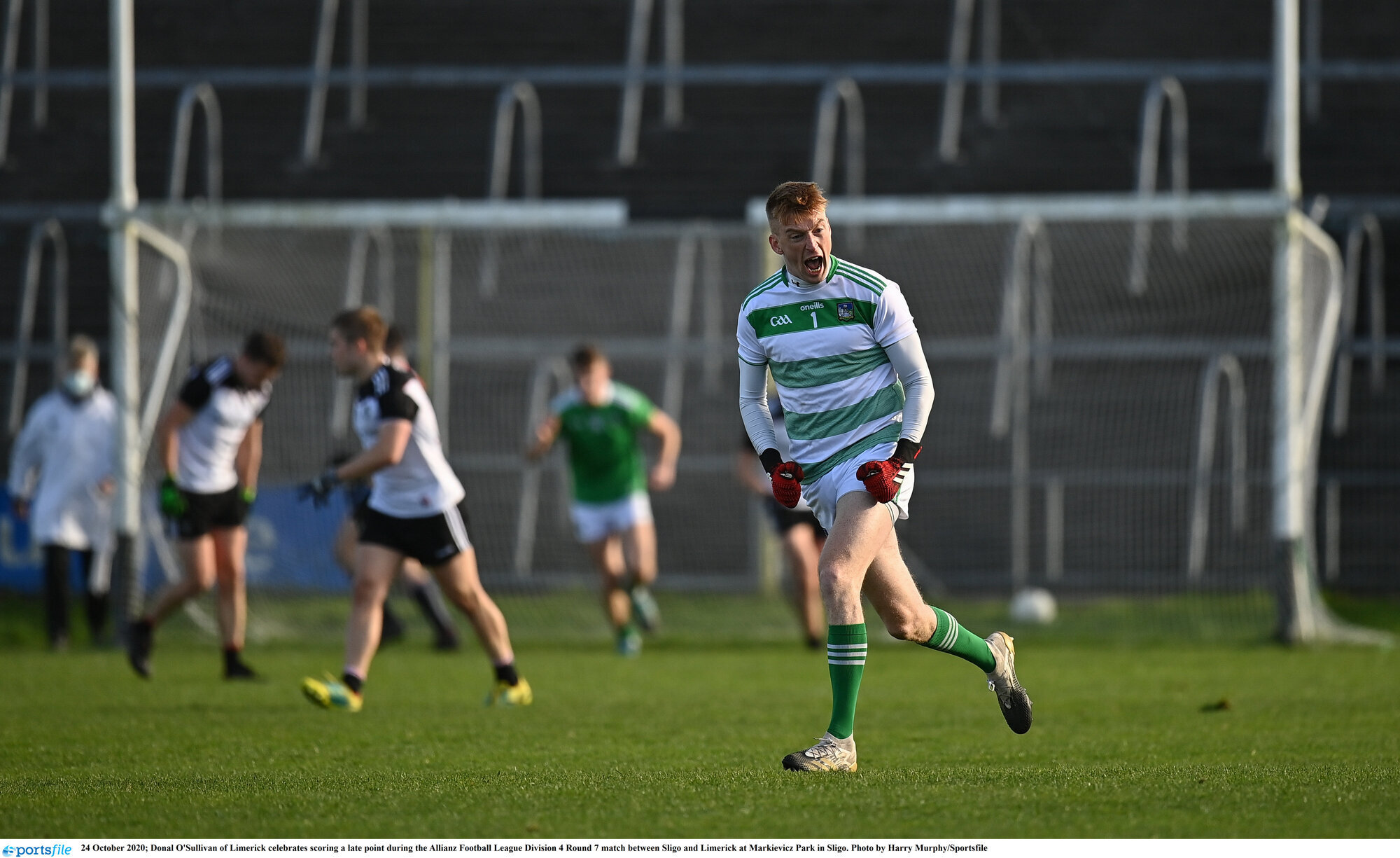
MAN OF MANY TALENTS: Limerick goalkeeper Donal O’Sullivan celebrates after scoring a late point against Sligo in their Allianz FL Division 4 clash last weekend. Even with the busy nature of hospital life, O’Sullivan is delighted inter-county activity has resumed.
No sooner had we been placed into nationwide lockdown when Donal O’Sullivan began tapping notes on his phone.
Working as a doctor at University Hospital Limerick, the Limerick football joint-captain took to jotting down his frontline experience.

Seven months later, his journal has grown to 15 chapters and 50,000 words.
How long he will persist with this “pet project” or what he will do with the finished product, he does not yet know. But what he can say with certainty is how therapeutic it has been to put down on paper the range of emotions that washed through him during those long and challenging hospital shifts in late spring and early summer.
A GP trainee, O’Sullivan was part of the Limerick hospital’s general medicine team as the first wave struck.
But with fears their intensive care unit would become overrun with Covid-19 patients, O’Sullivan and others were quickly upskilled in the event intensive care had to be provided at a ward level of management. Knowing the ins and outs of intubating a patient or how to troubleshoot a mechanical ventilator would not typically concern a GP trainee, but needs must.
It was very much all hands on deck.
Arriving into work each day, the 29-year-old felt a deep sense of privilege at being able to contribute to the national effort in repelling the virus. But there was also anxiety, fear.
“We were in a lucky position that we could actually help. That was definitely on my mind,” begins the Limerick goalkeeper.
“That then would be coupled with understandable worry about the future and fear about the uncertainty.
“People were worried about becoming unwell because there were healthcare workers dying in China and Europe. PPE stock running low definitely did heighten our concern. We also had huge concerns about loved ones becoming sick as a result of [us] transmitting the virus.”
The latter point saw O’Sullivan move out of the family home in the early days of the virus here in Ireland.
His frontline experience, as captured in the journal, is not all “doom and gloom”, though. That he cannot stress enough.
Walking into the staff kitchen on his break to find a freshly cooked lasagne from Adare Manor provided a lift you wouldn’t think any lasagne capable of.
Sustenance came in many different forms.
His friend and Mayo hurler Cathal Freeman raised €60k for charity and PPE gear when running a marathon on a small patch of grass beside his apartment. Teammates were constantly in touch to see how he was getting on at work.
“Healthcare workers, nurses, cleaners, porters and doctors rowed in together to try and help the community, and having the knowledge that the general community were backing us definitely strengthened the resolve of healthcare workers and inspired me going into long on-call shifts.”
The dwindling case numbers of the summer months did not mean a quietened work existence for O’Sullivan. As part of his GP training, which is broken down into six-month rotations, he took up station in the paediatric department of University Hospital Limerick in July.
And it’s just as well the All-Ireland championship wasn’t keeping to its usual calendar as the 24-hour shifts which he has been clocking over the past few months are not at all conducive to inter-county involvement.
The Monaleen clubman recently started the second half of his paeds rotation in the city’s maternity hospital. The weekly 24-hour shift in the latter does allow for two or three hours of shut-eye, a luxury when compared to the non-stop 24-hour stints he regularly put down when based in the paediatric department.
In the week leading up to Limerick’s Division 4 fixture against Wexford earlier this month, O’Sullivan clocked between 70-80 hours in the hospital.
And no sooner had the final whistle sounded in Rathkeale than he was on his way back into work to finish a 24-hour call which a colleague had been covering so as to allow him line out against Wexford.
“I got back to the hospital at around 5.15pm and worked till 8.30am the following morning.
As Donal so succinctly puts it, kids don’t choose the time of day they become unwell at. There have been situations, after midnight, where he has had six and seven children waiting in the emergency department to be seen and he has already worked 15 hours.
“My last two shifts in the paediatric department, I didn't get any sleep at all. It is physically and mentally draining and it does take a day or two to recover.
“I was finding the paediatric rotation hard at the start, trying to combine it with football. For me, you just try and get on with it because I know in three to six months I won't have any more 24-hour shifts.”
Such monstrous shifts are neither sustainable nor healthy, he argues. A 12-hour shift shouldn’t be a stroll in the park simply because one has become accustomed to being on their feet for periods of 24 hours at a time.
“I don't think 24-hour shifts are a good way to provide medical care. Are you learning much from hour 16 to hour 24? I don't think so. You are just literally trying to stay awake and do as good a job as possible.”
Even with the busy nature of hospital life, O’Sullivan was beyond eager for inter-county activity to be restarted.
Limerick’s interrupted season has already delivered McGrath Cup and Division 4 success, and with Cork and Kerry on the far side of the Munster draw, there’s every chance they could yet get a tilt at a third piece of silverware.
“Football is just a huge aspect of my life and something that helps get me through stressful times at work. The social aspect of it is more important than ever.”
Despite a full plate, still he journals.
“As well as my experiences of what it was like on the frontline, there are stories in there from playing with Monaleen and Limerick, and my time in New Zealand, stories that go way beyond results and performances. It was great to put it all down on paper and I found it therapeutic reading back over it.