Gerald McCarthy: ‘I don’t think anybody will ever equal Christy Ring's passion, his drive, and his achievements’
“I went to the All-Ireland final in 1956 and that was a real thrill. I was only 11 and it was my very first time seeing him in action. Even though Cork lost it was extraordinary and Ring was wonderful on the day, Wexford carried him off the field.
That was amazing for a child to see. As a 12- and 13-year-old I remember going to National League games and he stood out so much in those games, too, he really did – every time. He was a great, great player.
He always himself put it down to this strength. And I think that was a major part of his greatness. He believed he was stronger than anybody and – despite the fact he wasn’t tall – that he could burst through anybody. And it was like that with him. You simply couldn’t contain him.
And you could see that right up to the very end of his career. He played in a county final against us in 1964 and he got a goal and two points and practically won the game for the Glen. And he would have been 44 by then but he was still amazing. So you can imagine what he was like when was 28.
Of course, he had all the skills, too. All the skills, which very few players have.
Incredibly tough, he was impossible really to manage for the whole match and that was true at inter-county level but especially at club level. As well as the strength, he had a remarkable hurling brain – he always knew what to do in any situation.
When he got older, he slowed down in speed but he could compensate for that. All he needed was a ten-yard burst and he’d be in.
I was only 13 but when I saw him doing that … You couldn’t make it up.
There was, and the amazing thing was the selectors agreed to bring him on the panel. This was for the Munster Final.
His name actually appeared on the programme as a sub, but he wasn’t there on the day. Now, I don’t know why. Some people said that he wouldn’t appear as a sub or that the selectors only voted him on the panel 3-2.
We heard all sorts of stories but my own personal belief was that he felt himself that he didn’t deserve to be there. He wouldn’t be the kind to come in on top of a team on its way to an All-Ireland.
The players would have welcomed him completely, with open arms, I do know that – as captain, I was certain of it. But after the Munster Final it certainly wasn’t going to happen.
Now we also wanted him to win another All-Ireland medal and to get to nine and ahead of John Doyle. But quite honestly, he didn’t need that other All-Ireland to prove anything. He didn’t. He didn’t need to prove anything to anybody – especially Cork people.
Very much so. He was always fiery, a great character. When he had a point of view you knew it, you’d never be in doubt.
I remember in particular in 1976 when we were playing Galway in the All-Ireland semi-final and there was a lot of hassle over the footballers and the three stripes affair.
The hurlers just wanted to back up the footballers and the suspensions were a bit of a farce. We didn’t decide until we were in the dressing room before the match whether or not we would wear the shorts – I had the 20 shorts ready in my gear bag in case we needed them.
Eventually, the board gave us a guarantee that the suspensions would be dropped, but it was a close-run thing.
Of course, Christy and Jimmy were the best of friends and the whole thing was forgotten after and when it came to matches he was very much a players’ man. He knew what players would be thinking and suffering, coming up to big games. And he’d be talking to you and he had a habit of emphasising something by poking you in the shoulder – you’d be black and blue from him, that’s the kind he was, he was very intense.
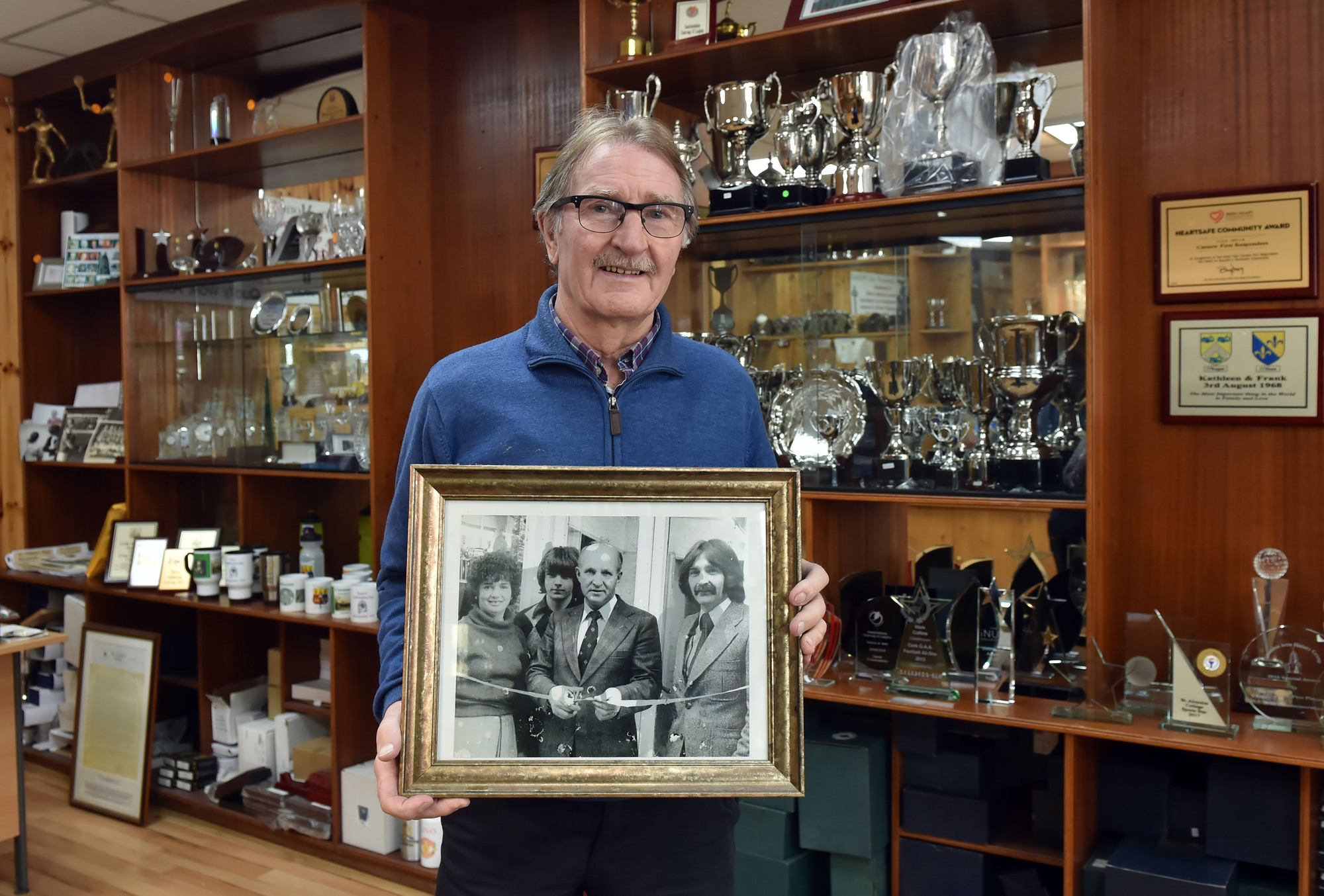
That was taken in October 1978, not long before he died. And when I asked him to open the shop he said no, he didn’t do openings. He was constantly being asked to open businesses and do all sorts of things but he didn’t like the limelight at all, he was a very shy man, really.
He said, look I’ll do it for you, Gerald. And there would be no question of taking money or anything like that. I engraved a silver plate and he didn’t want to take it but I convinced him to take it for his family. I’m very grateful to him for that.
I remember the day he died like it was yesterday, it happened not far away from here. I was in the shop when I heard it that morning and I couldn’t believe it. I couldn’t. It was a huge shock – for the whole city really.
No. Ah, no. I don’t think anybody will ever equal his passion, his drive and his achievements. Nobody. Not a hope.”
Gerald stood up, I stood up. The interview was over. Gerald turned to look at the photo on the wall. For a moment he was lost in memory and time.
‘There’ll never be another Christy Ring.’

CONNECT WITH US TODAY



Be the first to know the latest news and updates