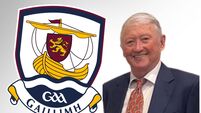
Cork-born Larry McCarthy becomes GAA's first overseas member to be elected president
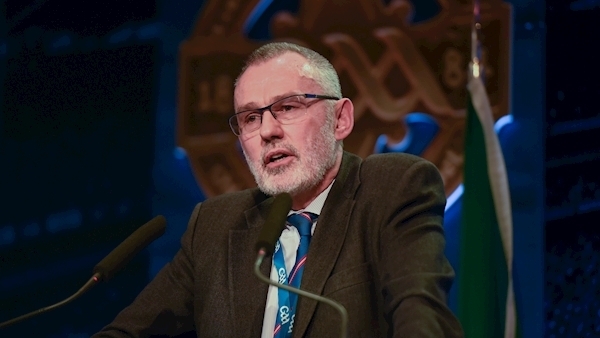
Cork-born Larry McCarthy was dramatically voted in as GAA president-elect after edging out Jarlath Burns in a fourth and final count, in doing so becoming the first overseas member to claim the office.
The Bishopstown man, an associate professor in New Jersey’s Seton Hall University and affiliated to the Sligo football club in New York, exceeded the quota by three votes with 142 after he received the majority of Leinster chairman Jim Bolger’s transfers. While Armagh man Burns received 17 more first preferences than McCarthy, the pair were tied at 110 votes after former Connacht chairman Mick Rock’s votes were distributed in the third count.
With the total valid poll being 276 votes, the quota was set at 139 although all five candidates fell considerably short of that after the first vote when Burns leads with 80 votes followed by McCarthy (63), Bolger (55), Rock (40) and Jerry O’Sullivan (38).
Following the distribution of O’Sullivan’s votes, McCarthy reduced the deficit behind Burns to four as his vote grew by 25 to 88, Burns jumped by 12 to 92, Bolger’s remain unchanged and Rock added one. Reacting to his victory, McCarthy said he would celebrate it in Ned Devine’s pub in The Bronx, New York, the GAA’s “home away from home” in the city.
McCarthy was the second overseas candidate to run for the presidency after John Kerry O’Donnell in 1981 when Paddy Buggy edged out Mick Loftus after a fifth vote. Burns, whose club Silverbridge had turned out in force to support him in Croke Park, had been a strong favourite to succeed John Horan and he had acknowledged the effort McCarthy made in travelling regularly to Ireland from his US base.
Congress also narrowly elected to retain the role of the maor foirne. Despite being backed by Central Council after being put forward by the playing rules committee, it fell short of the required 60% to come into rule by 1%. Limerick were among two speakers who argued against the motion, believing there are rules in existence that deal with running selectors who inordinately encroach the pitch.
A recount of the first presidential ballot promoted GAA president Horan to begin motions earlier than expected. The first motion by Tyrone, to allow the sideline official bring the referee’s attention to incident(s) he might not have seen, was passed with 70% support.
Former GAA president Christy Cooney highlighted how workable the proposal would be at club level where there are no fourth officials. However, Tyrone secretary Dominic McCaughey clarified the motion was only aimed at empowering sideline officials at games where they are currently appointed.
Limerick’s recommendation to introduce video technology via the use of the HawkEye official reviewing challenges made by teams to refereeing decisions was deferred to Central Competitions Control Committee for further consideration.
County chairman John Cregan insisted their idea wasn’t generated by “sour grapes” after losing last year’s All-Ireland semi-final to Kilkenny. However, they were influenced to propose it on the basis of Darragh O’Donovan’s last-gasp sideline cut being deflected by Cillian Buckley’s hurley passed the end-line but was deemed a wide. “We hit 15 wides on the day and we were beaten by the better team,” said Cregan. “But going forward it's not good enough that any team loses out when a mistake can't be rectified or a rule is broken."
Montreal’s idea of replacing the four-step rule in Gaelic football and hurling with a two-second rule was heavily defeated, receiving just 9%. St Rynagh’s of Offaly recommended the temporary substitute be extended to players with head injuries was referred to Central Council. Ending the back-pass to the goalkeeper from a player receiving a kick-out was passed, receiving 62%, and will be a rule in time for the start of this year’s Championship.
Responding to GAA director general Tom Ryan’s annual report, Fermanagh vice-chairman Philip Flanagan asked that future agreements between the GAA and GPA be administered by Croke Park because the job of processing weekly expenses of inter-county players was too much for volunteer county officials. It is believed the system is currently being trialled at central level for a number of counties with the intention to expand.
Flanagan also argued the practice was not sustainable nor were the costs of preparing teams. In reply, Ryan made the point that managing expenditure associated with county teams was a key point of his report.
Down chairman Jack Devaney called for a more coherent approach to addressing the fixtures issue as Special Congress had introduced a second tier football championship last October prior to the fixtures review task-force putting forward their own recommendations.
“What looms large is the setting of fixtures for our competitions,” he said. “It goes to the core of what we do and what we're about. A proposal in my head, going forward, we should try to have just one coherent approach as opposed to coming at this from various angles through different committees."


CONNECT WITH US TODAY



Be the first to know the latest news and updates