Motion proposed to limit amount of time a player can have ball
The proposers of a motion to clarify that the maximum time a footballer or hurler can carry the ball be limited to two seconds believe it reflects the reality of the game.
Montreal GAA’s recommendation, one of 63 motions finalised for the Clár at Annual Congress on February 29, seek to update the rules that currently allow players to carry the football or sliotar in the hand or hands for a maximum of four consecutive steps or the time that’s needed to take four steps.
Their briefing document opens: “Pull up any Gaelic football or hurling All-Ireland final from the past 10 years on YouTube, start watching anywhere in the game and within 2-3 minutes a player will carry the ball with five, six even up to 12 steps without being penalised.
“The breaking of this rule has now become part of the games of Gaelic football and hurling and universally accepted. There is an abundance of evidence to support this and it simply grows as each passing game is played.”
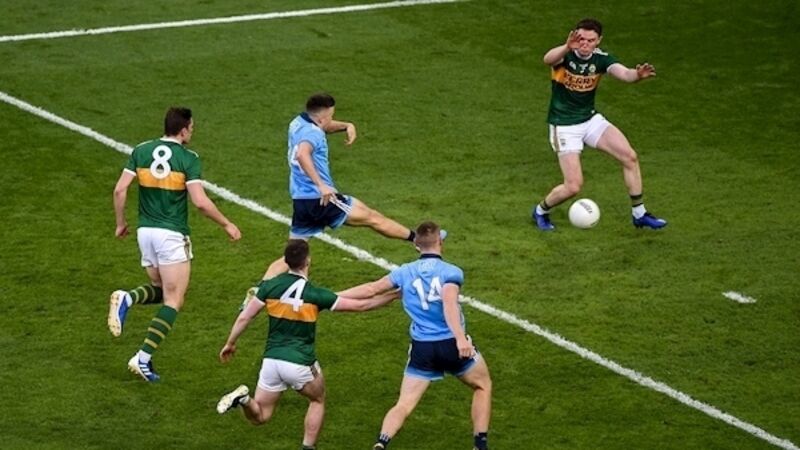
As an example, they highlight Eoin Murchan’s goal for Dublin in the opening seconds of the second half in last year’s All-Ireland final replay win over Kerry.
Analysing the score, they found Murchan took 36 steps in nine seconds but took eight steps in less than 1.88 seconds before bouncing the ball for the first time and took 11 steps while holding the ball before kicking for the score.
“The current rule, ‘the time it takes to take four steps’ is calculated here as exactly one second for four steps. This is not viable.” Montreal also scrutinised two hurling championship games in 2018 in which they claim the sliotar was over-carried 84 times.
“The referee penalised this on three of those 84 occasions,” they reported. “Why is two seconds the answer? Players’ fitness now allows them to take 6-10 steps in less than two seconds, it’s impossible for referees to accurately count these steps in this timeframe.”
While citing last year’s drawn All-Ireland SFC final referee David Gough’s assertion that the four-step rule is impractical, Montreal insist their amendments would not upset either game.
“Changing the rule to two seconds allows our games to continue to be played as they are currently being played. The rule change doesn’t change the game, it allows the games to be played within the rules.
“We are not advocating the changing of the rules based on the elite level of 1% which would have an impact on every other level. This proposal came about based on the complete other end of the spectrum, beginner adult players in Montreal.
This is what brought this to our attention and as we researched it further, it became clear that this is actually an issue at every level, everywhere. The above statistics are just to illustrate the issue given that intuitively two seconds seems like a very short period of time when looked at first.
Limerick’s video review motion is set to get an early hearing at Congress as it has been listed second among the 63 proposals. Limerick are calling for a manager or captain to be able to ask a referee for a replay review from HawkEye match official regarding the validity of a score, awarding of a free, sideline ball, wide, 45, 65 or a square infringement. Each team would be entitled to a maximum of two incorrect challenges.
The maor foirne could become a thing of the past for the Championship should the following motion put forward by the GAA’s standing playing rules committee receive 60% support.It, along with the body’s motions on the black card in hurling, a tweak to the advanced mark in football and the advantage rule in both codes are on the Clár.


CONNECT WITH US TODAY



Be the first to know the latest news and updates